
Trick Quiz
How the Scales are Structured
Who Usually Takes This Test?
See How You Compare
Below is a preview of how scores are typically distributed across each scale.
Example Questions From the Test
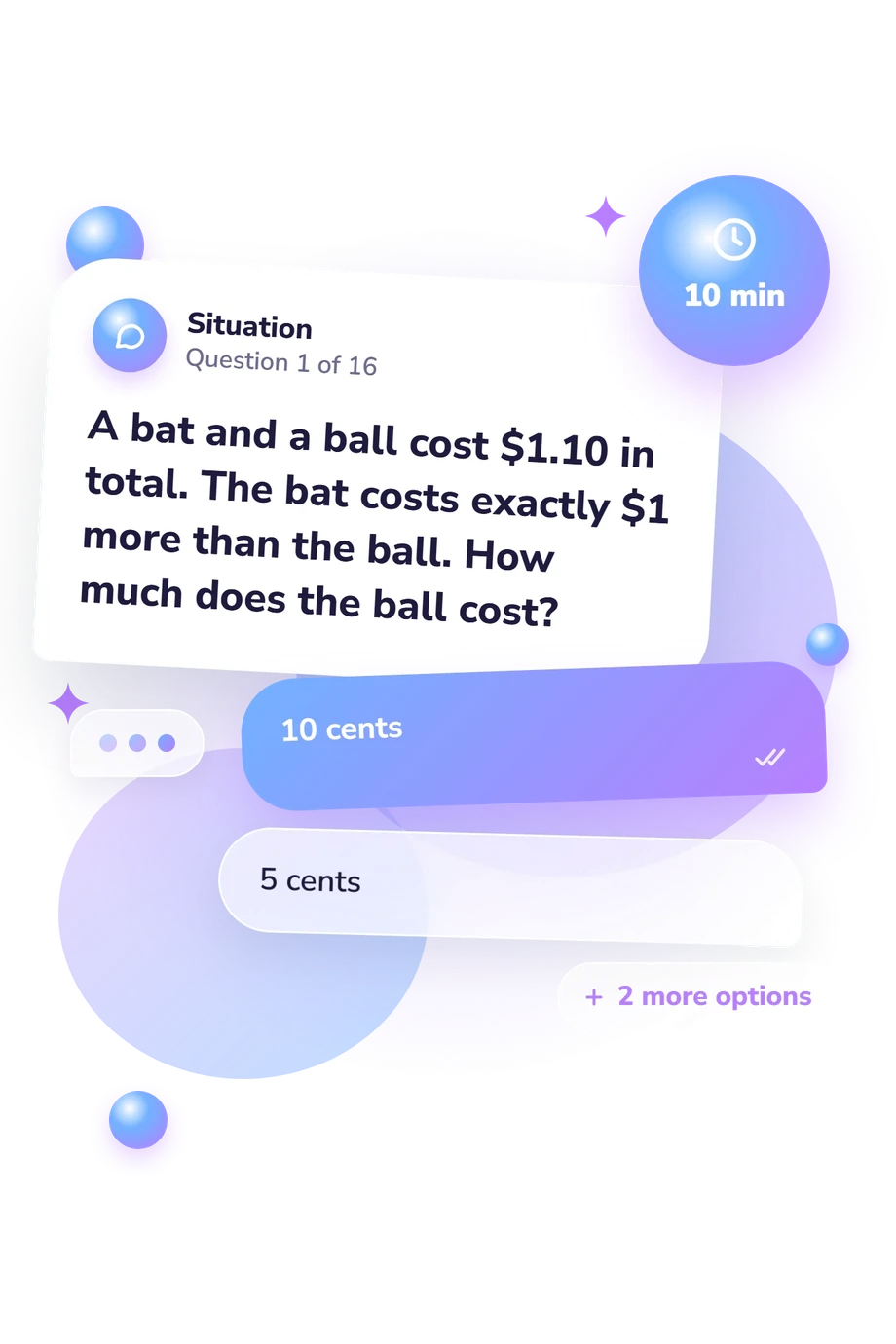
- 10 cents
- 5 cents
- 15 cents
- 1 cent
- 0
- 8
- 17
- 9
- All 12 months
- Only one month
- Six months
- Eleven months
Trick Quiz - Description and methodology of the test
For readers who enjoy puzzles but want to understand why an obvious answer can be wrong, this assessment offers a focused look at careful reasoning. The trick quiz asks you to weigh exact conditions rather than rely on speed alone. Its result helps show how consistently you check a prompt before choosing. It suits anyone curious about how familiar trick-quiz questions reward careful checking.
What This Assessment Explores
This logic puzzle quiz examines how consistently you check conditions before accepting a tempting answer. Its items use prices, calendars, labels, sequences, family relationships, and verbal distinctions to test whether you notice assumptions and the condition that controls each problem. The result describes performance on these prompts, not a broad reasoning trait.
The displayed scale, Trick Question Knowledge (0-16), is summarized by three result bands:
- Foundation (0-6) indicates that familiar traps often pulled you toward the immediate answer, so checking each condition may help.
- Developing (7-12) indicates that you handled many misleading prompts but missed some wording, sequence, or inference details.
- Sharp Solver (13-16) indicates that you consistently examined assumptions and applied relevant logic before answering.
This result may highlight a tendency to benefit from checking assumptions before answering misleading problems, especially when wording, sequence, or inference details compete for attention.
Methodology and Scientific Basis
Each item presents a short problem followed by four answer choices. A tempting option may seem familiar until a small wording detail changes what follows, so the task is to select the conclusion that survives a careful check rather than explain your reasoning in writing. As a trick question test, it measures performance on short prompts requiring arithmetic, temporal order, categorisation, verbal logic, or practical inference.
The item themes are conceptually consistent with the Cognitive Reflection Test (Frederick, 2005), which contrasts intuitive responses with answers reached through reflection. Work by Toplak, West, and Stanovich (2014), and Thomson and Oppenheimer (2016), extends this approach with varied items; its relationship to those instruments is conceptual rather than a stated adaptation.
Familiarity is an important limitation: Stieger and Reips (2016) found that prior exposure to classic reflection problems can affect performance. Attention, language comprehension, and current context may also influence choices. The questionnaire reports a total on the displayed scale without a documented alternative weighting rule, so the bands describe performance on this item set rather than population norms or a clinical judgment.
- Frederick, Shane. "Cognitive Reflection and Decision Making." Journal of Economic Perspectives 19, no. 4 (2005): 25-42. 10.1257/089533005775196732
- Toplak, Maggie E., Richard F. West, and Keith E. Stanovich. "Assessing miserly information processing: An expansion of the Cognitive Reflection Test." Thinking & Reasoning 20, no. 2 (2014): 147-168. 10.1080/13546783.2013.844729
- Thomson, Keela S., and Daniel M. Oppenheimer. "Investigating an alternate form of the cognitive reflection test." Judgment and Decision Making 11, no. 1 (2016): 99-113. 10.1017/S1930297500007622
- Stieger, Stefan, and Ulf-Dietrich Reips. "A limitation of the Cognitive Reflection Test: familiarity." PeerJ 4, no. 9 (2016): e2395. 10.7717/peerj.2395
Updated: