
Misplaced and Dangling Modifiers Quiz
How the Scales are Structured
Who Usually Takes This Test?
See How You Compare
Below is a preview of how scores are typically distributed across each scale.
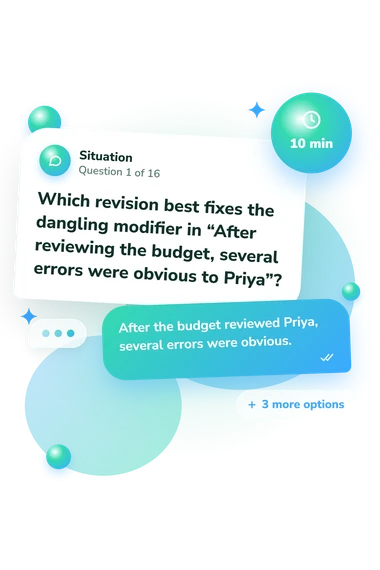
Example Questions From the Test
- Only Jordan said he would submit the report on Friday.
- Jordan said only he would submit the report on Friday.
- Jordan said he would submit only the report on Friday.
- Jordan said he would only submit the report on Friday.
- After sunset, the bats emerged from the cave.
- Covered in frost, the windshield glittered in the morning light.
- Nora placed the vase carefully on the shelf.
- The librarian handed books to the students bound in leather.
- Using a telephoto lens, I photographed a cyclist.
- The cyclist was photographed near me with a telephoto lens.
- I photographed a cyclist with a telephoto lens.
- I photographed the cyclist near the fountain with Sam.
Misplaced and Dangling Modifiers Quiz - Description and methodology of the test
Readers who want to strengthen sentence-level editing can use the misplaced and dangling modifiers quiz to gauge their overall performance and decide where further practice would be useful. In this dangling modifier quiz, the result gives students, writers, editors, and other learners a concise starting point for improving sentence clarity.
What This Assessment Explores
The questions examine whether a reader can connect a modifier to the word or phrase it logically describes. They cover dangling introductory phrases, misplaced and squinting modifiers, ambiguous adverb placement, and revisions that preserve intended meaning. In this misplaced modifier quiz, readers apply that knowledge to recognition and editing judgment, not labels alone.
The result appears on one scale, Misplaced and Dangling Modifiers Knowledge (0-16), with these bands:
- Foundations to build (0-6) shows that modifier patterns and logical attachment need more practice.
- Developing control (7-12) shows that many errors are manageable, but subtle ambiguity may remain.
- Strong command (13-16) shows consistent recognition of logical relationships and clear revisions.
Together, the result summarizes overall performance across the modifier skills tested.
Methodology and Evidence Base
The method uses rule-based grammatical analysis across 16 items with four answer choices. Some ask for definitions or grammatical diagnoses; others ask for the revision that best preserves intended meaning. Together, they assess conceptual knowledge and editing decisions, including whether an introductory phrase has a logical subject and whether adverb placement creates ambiguity.
As a quiz on dangling and misplaced modifiers, this questionnaire reports the displayed result and its corresponding band; the rule that converts individual answers into points is not documented. The displayed band is a broad summary for practice planning, and no separate item-level subscale result is displayed.
Donaldson’s 2021 thesis provides the closest specialist evidence for dangling modifiers. Hacker and Sommers’ 2020 manual, together with Huddleston and Pullum’s 2002 grammar, supports distinctions involving structure, attachment, and clarity. These sources support the rules represented in the questions but do not establish reliability, norms, or validation for this grammar editing assessment; terminology familiarity, attention, and limited context can affect performance.
- Donaldson, James. Control in free adjuncts: the 'dangling modifier' in English. PhD thesis, University of Edinburgh, 2021. DOI 10.7488/era/1055.
- Hacker, Diana, and Nancy Sommers. A Pocket Style Manual. 9th ed. Macmillan Higher Education, 2020.
- Huddleston, Rodney, and Geoffrey K. Pullum. The Cambridge Grammar of the English Language. Cambridge University Press, 2002. DOI 10.1017/9781316423530.