
When Should I Start Wearing a Bra Quiz
How the Scales are Structured
Who Usually Takes This Test?
See How You Compare
Below is a preview of how scores are typically distributed across each scale.
Example Questions From the Test
- Almost never; my current clothing feels right to me.
- Occasionally, depending on the fabric or setting.
- Often enough that I sometimes plan an extra layer.
- Most days; I would generally prefer a bra or bra-like layer.
- Uninterested; I would rather continue with my current clothing.
- A little curious, though I might decide not to try it.
- Open to trying it so I can learn how it feels.
- Glad to try it because it matches something I already want.
- Wearing the shirt as it is, without another layer.
- Adding a loose undershirt or camisole if I feel like it.
- Sometimes adding a soft bra-like layer for coverage.
- Usually having a bra or similar layer underneath.
When Should I Start Wearing a Bra Quiz - Description and methodology of the test
People considering a first bra or a change in what they wear can use this assessment to clarify personal preferences without following someone else’s timetable. The When Should I Start Wearing a Bra Quiz turns experiences with support, coverage, activity, and fit into a practical profile. The format also addresses the question behind a when should i wear a bra quiz by separating comfort from pressure.
What This Assessment Explores
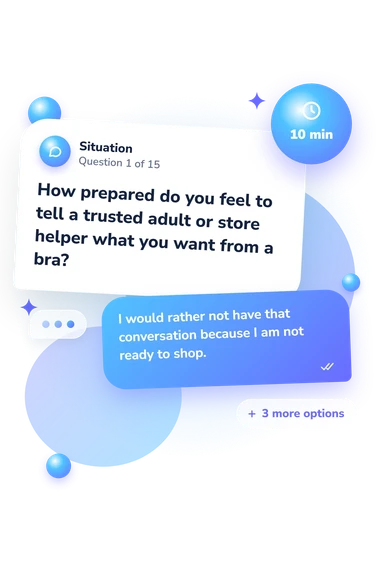
Questions focus on comfort, coverage, movement, fit, and readiness to discuss choices, not age or appearance. Viewed as a do i need a training bra quiz, it separates personal preference from assumptions about development. The result shows which situations matter and how prepared you are to explore options.
These dimensions are reflected in the result:
- Interest in Physical Support (0-15) shows whether gentle support may help with movement, rubbing, or comfort: Little current interest (0-5), Situational interest (6-10), or Strong interest (11-15).
- Personal Comfort and Coverage Preference (0-15) shows how much a bra-like layer appeals personally: Content as you are (0-5), Exploring preferences (6-10), or Clear personal preference (11-15).
- Readiness to Try and Fit a Bra (0-15) shows practical readiness to communicate preferences, check comfort, and manage care: Not a current priority (0-5), Ready for a small experiment (6-10), or Ready to explore (11-15).
Methodology and Scientific Basis
Each item presents a situation with four ordered response choices. Options move from little or no interest toward greater comfort, preference, or readiness; some address fit, help-seeking, and care. As a first bra quiz, it distinguishes wanting support from being prepared to try and manage it.
Responses combine into three separate 0-15 totals, not a pass/fail verdict. The displayed bands are reflective descriptions; they do not establish breast development, medical need, or a required age. Persistent pain, breathing difficulty, or skin injury means stopping that option and asking a trusted adult or clinician for help.
The evidence is conceptually consistent with Breast Survey (Omrani et al., 2019), which examined breast-related knowledge and attitudes, and with McGhee et al. (2010), which studied education about bra knowledge, fit, and support in adolescent athletes. Those studies provide context for the themes, not validation, norms, or standardization for this questionnaire.
Self-report results can shift with current context, self-awareness, clothing, activity, discomfort, or social pressure. They work best as a snapshot for reflection and a calm conversation about what feels comfortable.
- Omrani, A., Wakefield-Scurr, J., Smith, J., & Brown, N. (2019). The Development and Psychometric Properties of a Survey to Assess Breast Knowledge and Attitudes of Adolescent Girls. American Journal of Health Education, 50(6), 374-389. 10.1080/19325037.2019.1663380
- McGhee, D. E., Steele, J. R., & Munro, B. J. (2010). Education improves bra knowledge and fit, and level of breast support in adolescent female athletes: A cluster-randomised trial. Journal of Physiotherapy, 56(1), 19-24. 10.1016/S1836-9553(10)70050-3
Updated: