
Celebrity Face Quiz
How the Scales are Structured
Who Usually Takes This Test?
See How You Compare
Below is a preview of how scores are typically distributed across each scale.
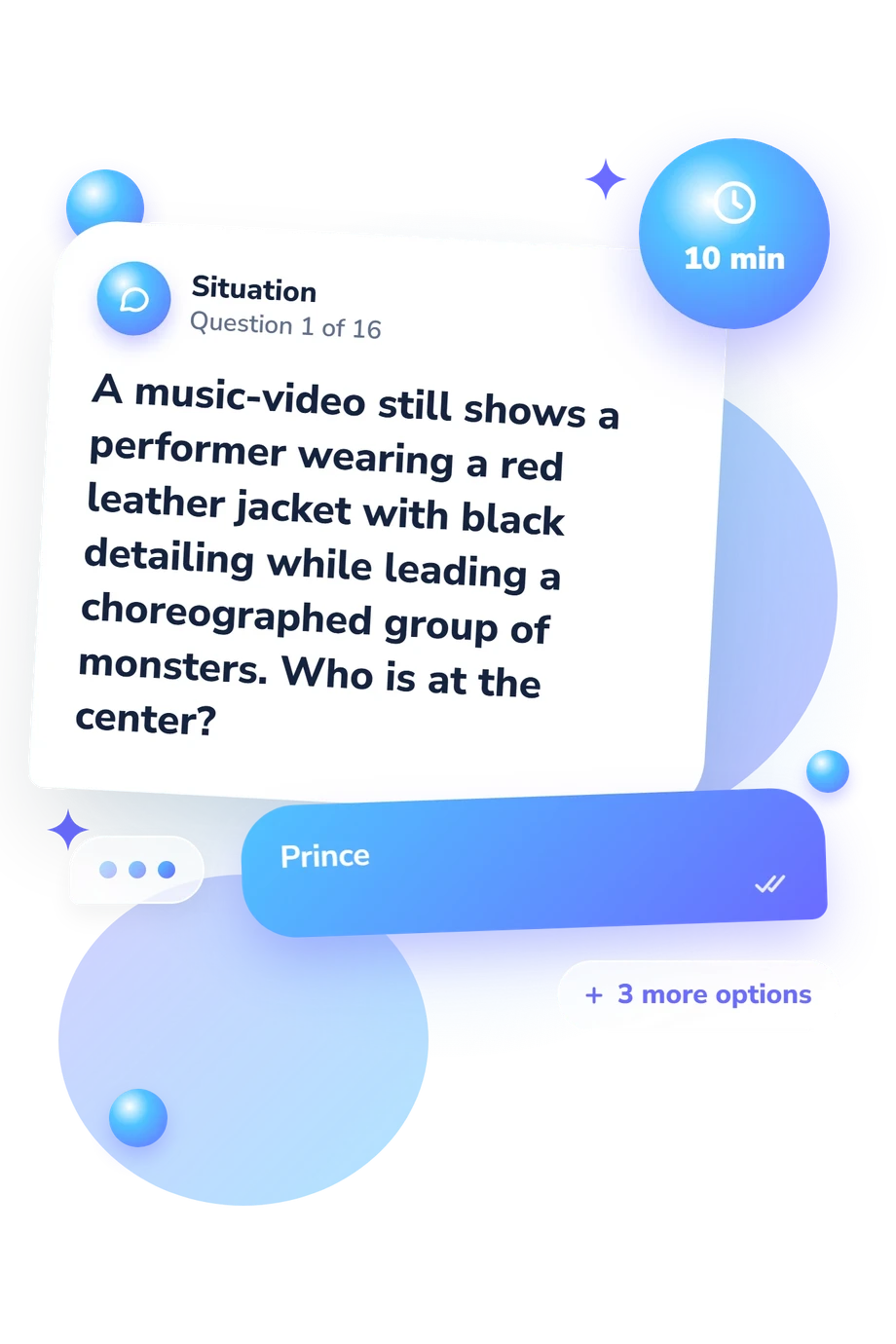
Example Questions From the Test
- Prince
- Lionel Richie
- Billy Ocean
- Michael Jackson
- Marilyn Monroe
- Jayne Mansfield
- Doris Day
- Kim Novak
- Christian Bale
- Keanu Reeves
- Tom Cruise
- Johnny Depp
Celebrity Face Quiz - Description and methodology of the test
For anyone who enjoys identifying public figures or testing visual familiarity, the celebrity face quiz offers a focused way to connect recognizable portraits with names and career clues. As a famous faces quiz, it suits pop-culture enthusiasts and curious learners who want a quick picture of how confidently they recognize well-known people. The result highlights current recognition skill rather than a broad cognitive profile.
What This Assessment Explores
Questions pair portraits with clues from music, film, art, and public life. In practice, this guess-the-celebrity-face quiz asks you to connect signature styling, famous roles, songs, and reproduced photographs with names. It suits anyone exploring entertainment knowledge across several celebrity fields.
The main item themes are:
- Music clues show whether stage images and signature appearances identify singers.
- Film clues show how readily actors connect with familiar roles.
- Publicity images test distinctive styling, poses, and historical photographs.
- Art portraits extend recognition beyond screen and stage.
Celebrity Face Knowledge ranges from 0-16: Emerging Recognition (0-6) means iconic faces may blend together; Developing Recognition (7-12) means many figures are identified but similar eras or fields remain challenging; Strong Recognition (13-16) means visual cues and career context connect reliably. This is entertainment knowledge, not memory or cognitive ability.
Methodology and Evidence Base
Each question presents a portrait or contextual description followed by four answer choices. You select the name that best fits the visual and biographical clues, so the total reflects correct matches rather than a self-rating. The result bands describe recognition level, not separately weighted psychological traits.
Viewed as a celebrity face recognition test, the questionnaire is conceptually consistent with the Famous Faces Doppelgangers Test (Pozo et al., 2023), which addresses familiar-face recognition, but it is not an adaptation or standardized administration of that instrument. Qiu and Li link semantic knowledge with face-identity processing, while Wilmer et al. describe face recognition as a specific ability that varies across individuals.
Interpretation should stay close to this task. Scores can shift with media exposure, cultural familiarity, image quality, attention, and guessing. The bands are descriptive feedback, not population norms or clinical classifications. A stronger result suggests more successful links between the selected cues and names; a lower result may reflect unfamiliarity with the chosen figures rather than a general memory problem.
- Pozo, Emilia, Laura T. Germine, Luke Scheuer, and Roger W. Strong. "Evaluating the Reliability and Validity of the Famous Faces Doppelgangers Test, a Novel Measure of Familiar Face Recognition." Assessment 30, no. 4 (2023): 1200-1210. 10.1177/10731911221087746
- Qiu, Yue, and Yuanzhe Li. "A correlational study investigating whether semantic knowledge facilitates face identity processing." Communicative & Integrative Biology 16, no. 1 (2023): 2206203. 10.1080/19420889.2023.2206203
- Wilmer, Jeremy B., Laura Germine, Christopher F. Chabris, Garga Chatterjee, Margaret Gerbasi, and Ken Nakayama. "Capturing specific abilities as a window into human individuality: The example of face recognition." Cognitive Neuropsychology 29, nos. 5-6 (2012): 360-392. 10.1080/02643294.2012.753433
Updated: