
Hard Trivia Quiz
How the Scales are Structured
Who Usually Takes This Test?
See How You Compare
Below is a preview of how scores are typically distributed across each scale.
Example Questions From the Test
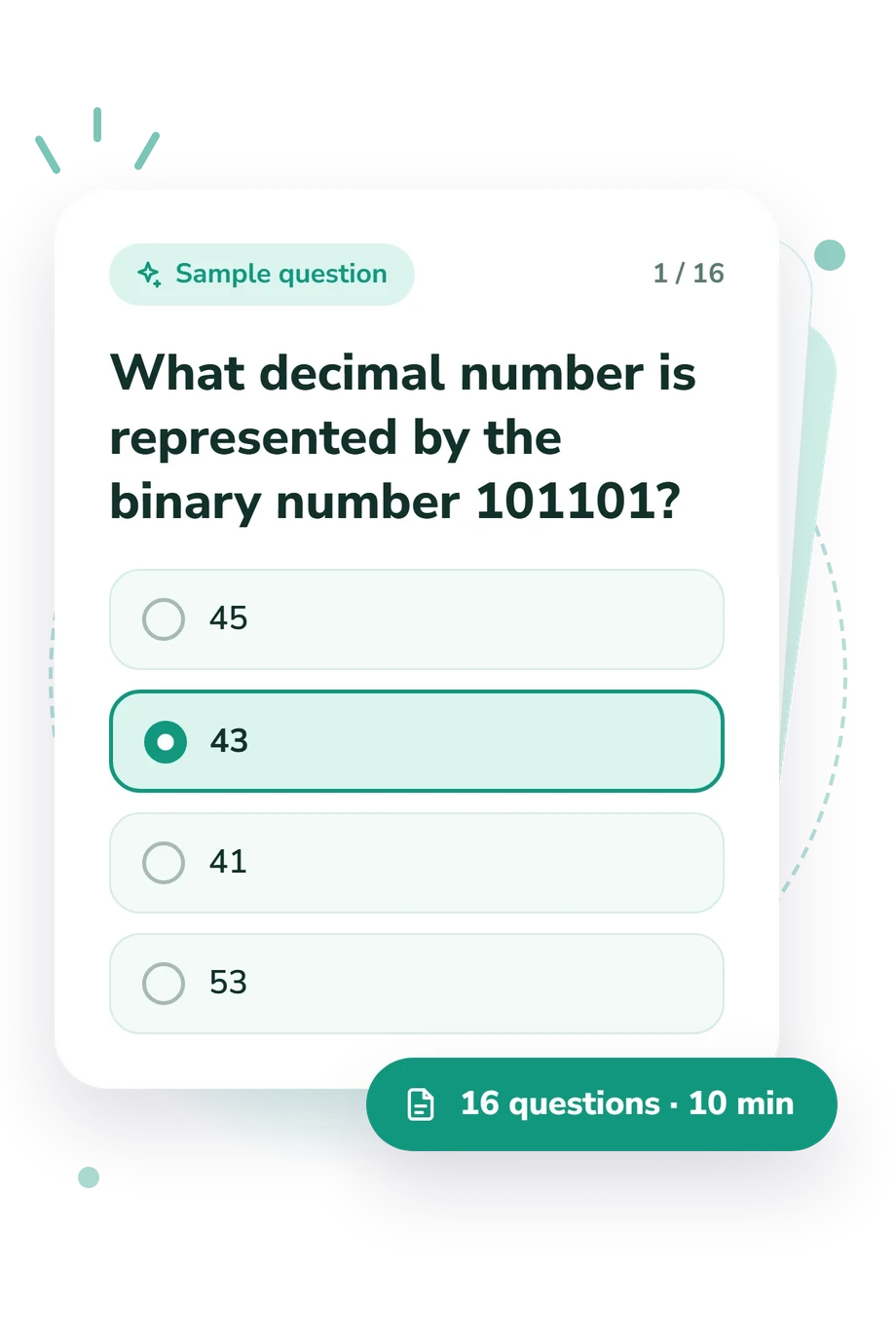
- 45
- 43
- 41
- 53
- Some chemists are sculptors.
- No chemists are artists or scientists.
- All artists are sculptors.
- No sculptors are chemists.
- Dracula
- The Strange Case of Dr Jekyll and Mr Hyde
- Frankenstein
- Wuthering Heights
Hard Trivia Quiz - Description and methodology of the test
Designed for readers who enjoy demanding cross-subject questions, this hard trivia quiz offers a quick snapshot of broad factual knowledge rather than a deep profile of one specialty. The hard online quiz format suits anyone curious about the knowledge they can accurately recall across disciplines, from science and mathematics to literature and history. The result gives a performance level and a useful prompt for choosing areas to revisit.
What This Assessment Explores
The questionnaire measures breadth and accuracy of general knowledge across unrelated domains. As a general knowledge quiz, it suits people who want to test broad recall and gauge the accuracy of their recall across subjects rather than focus on one specialty.
Hard Trivia Knowledge spans 0-16 points: Building Groundwork covers 0-6, Strong Challenger covers 7-12, and Advanced Command covers 13-16. The bands describe the amount of correct knowledge demonstrated across the varied material.
The question themes can be understood through these practical knowledge groups:
- Quantitative science shows how you handle binary notation, arithmetic, biology, physics, chemistry, and astronomy.
- History and civics show how readily you recall major events, political texts, and historical conflicts.
- Literature and the arts show familiarity with canonical works and artistic vocabulary.
- Geography and languages show how well you recognize countries, language classifications, and world facts.
Methodology and Evidence Base
Each item presents a question with four answer choices, and the respondent selects the option judged correct. Because subjects change from item to item, the task measures retrieval across domains rather than sustained performance in one field. Its challenging trivia quiz format rewards accurate knowledge, not self-rated confidence.
Scoring is direct: the stated rule assigns one point for each correct answer. The resulting total summarizes demonstrated knowledge across the quiz’s varied subject matter and is interpreted through the displayed performance bands.
The closest conceptual reference is the General Knowledge Test by Irwing, Cammock, and Lynn, which treats general knowledge as broad semantic memory with separable components. This questionnaire is conceptually consistent with that work, not an adaptation. Nelson and Narens add context on accuracy in general-information questions, while Tourangeau, Maitland, and Yan show that question format and don't-know options can affect knowledge measurement. Here, wording and guessing can influence performance.
The displayed bands are descriptive feedback tied to this quiz’s score range. Education, cultural exposure, language, memory cues, guessing, and concentration may affect results, so the score reflects performance on this particular set of questions.
- Irwing, P., Cammock, T., & Lynn, R. (2001). Some evidence for the existence of a general factor of semantic memory and its components. Personality and Individual Differences, 30(5), 857-871. 10.1016/S0191-8869(00)00078-7
- Nelson, T. O., & Narens, L. (1980). Norms of 300 general-information questions: Accuracy of recall, latency of recall, and feeling-of-knowing ratings. Journal of Verbal Learning and Verbal Behavior, 19(3), 338-368. 10.1016/S0022-5371(80)90266-2
- Tourangeau, R., Maitland, A., & Yan, H. Y. (2016). Assessing the Scientific Knowledge of the General Public: The Effects of Question Format and Encouraging or Discouraging Don't Know Responses. Public Opinion Quarterly, 80(3), 741-760. 10.1093/poq/nfw009
Updated: