
What Will My Girlfriend Look Like Quiz
How the Scales are Structured
Who Usually Takes This Test?
See How You Compare
Below is a preview of how scores are typically distributed across each scale.
Example Questions From the Test
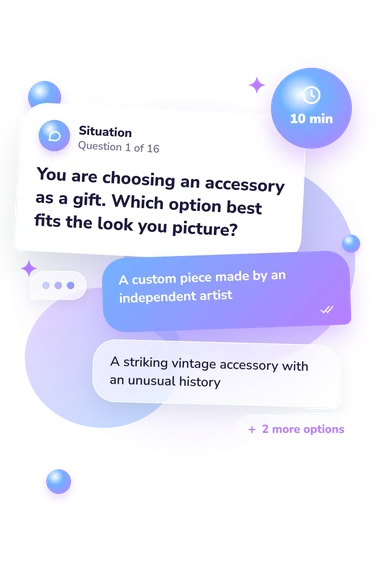
- A custom piece made by an independent artist
- A striking vintage accessory with an unusual history
- A delicate chain or timeless watch that works with anything
- A lightweight performance watch or compact activity bag
- Earthy colors, comfortable fabrics, and delicate accessories
- A coordinated coat, timeless bag, and neat styling
- Mixed patterns, bold jewelry, and a standout hairstyle
- Technical layers, trainers, and a practical tied-back style
- A sleek bob or smooth blowout with a neat finish
- Air-dried texture with a loose, effortless shape
- A vivid color combination or sharply asymmetric cut
- A tidy braid or ponytail that looks active and composed
What Will My Girlfriend Look Like Quiz - Description and methodology of the test
For readers curious about the style they might find appealing in a partner, this assessment turns an imagined appearance into a structured preference profile. The What Will My Girlfriend Look Like Quiz focuses on clothing, grooming, and presentation rather than predicting a person’s face or identity. Imagining a future girlfriend in this quiz helps you notice the visual cues that shape attraction.
What This Assessment Explores
The items use scenarios about outfits, accessories, hair, makeup, footwear, and overall impression. Choosing an option reveals which visual details matter most when this quiz asks who your girlfriend might be.
This quiz organizes questions about who will be your girlfriend into four visual preference dimensions. Together, they show which presentation best matches the girlfriend aesthetic you imagine:
- Creative and Expressive (0-12) captures artistic, original styling: Different Direction (0-4), Expressive Accent (5-8), or Strong Creative Affinity (9-12).
- Natural and Understated (0-12) captures soft, unfussy presentation: Different Direction (0-4), Natural Accent (5-8), or Strong Natural Affinity (9-12).
- Polished and Classic (0-12) captures tailoring, coordination, and timeless elegance: Different Direction (0-4), Classic Accent (5-8), or Strong Classic Affinity (9-12).
- Sporty and Casual (0-12) captures functional clothing and energetic ease: Different Direction (0-4), Sporty Accent (5-8), or Strong Sporty Affinity (9-12).
Methodology and Scientific Basis
Each item presents four style alternatives, and you choose the option closest to the girlfriend aesthetic you imagine. Clothing, accessories, hair, makeup, footwear, and overall impression appear as structured comparisons. Rather than predicting who will be my girlfriend, this quiz measures visual preference, not biography.
Answers are tallied into four outcome scores. The highest is your strongest affinity; any outcome within one point joins it in a blended result. These bands describe relative preference, while no separate per-answer value or normative cutoff is specified.
A study by Hur and colleagues on everyday clothing preferences provides the closest conceptual reference because it treats clothing preferences as measurable patterns. Work by Stolovy links styling with personality and body image, while Hester and Hehman describe dress as part of person perception. The questionnaire is conceptually consistent with these works, not a direct administration or validated adaptation.
Current mood, context, and self-interpretation can affect the resulting profile. Comparing close scores can show whether the style you imagine for the person who will be your girlfriend is mixed rather than centered on one visual direction.
- Hur, Young-Jin, Nancy L. Etcoff, and Emmanuel S. Silva. “Can Fashion Aesthetics be Studied Empirically? The Preference Structure of Everyday Clothing Choices.” Empirical Studies of the Arts, 41(2), 525-545, 2023. 10.1177/02762374221143727
- Stolovy, Tali. “Styling the Self: Clothing Practices, Personality Traits, and Body Image Among Israeli Women.” Frontiers in Psychology, 12, 719318, 2021. 10.3389/fpsyg.2021.719318
- Hester, Neil, and Eric Hehman. “Dress is a Fundamental Component of Person Perception.” Personality and Social Psychology Review, 27(4), 414-433, 2023. 10.1177/10888683231157961
Updated: