
Verb Tenses Quiz
How the Scales are Structured
Who Usually Takes This Test?
See How You Compare
Below is a preview of how scores are typically distributed across each scale.
Example Questions From the Test
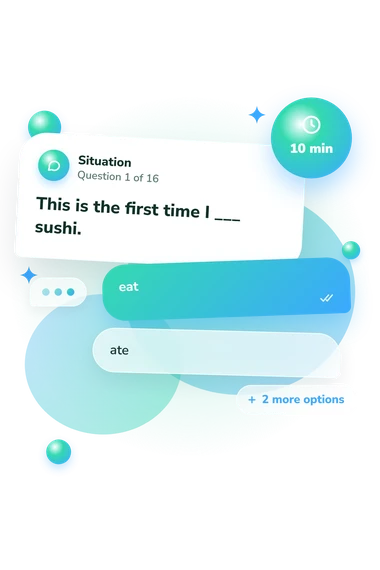
- eat
- ate
- have eaten
- had eaten
- completed
- has completed
- had completed
- completes
- is sleeping
- sleeps
- slept
- has slept
Verb Tenses Quiz - Description and methodology of the test
English learners, students, and anyone reviewing grammar can use this verb tenses quiz to examine how well they connect tense forms with time, sequence, duration, routine, and completion. As a verb tense practice quiz, it offers a focused checkpoint before study, helping identify whether attention should go to auxiliaries, irregular forms, aspect, or time clauses. It helps turn uncertainty into a focused list of grammar topics to revisit.
What This Assessment Explores
The assessment checks whether a learner can choose verb forms that express when an event happens, how it unfolds, and its relationship to another event. Contexts include present states and routines, past events and earlier actions, future plans and predictions, ongoing activity, completion, and duration. Items also touch regular and irregular past forms, stative verbs, future time clauses, and sequence. This English verb tense quiz offers a sentence-level snapshot rather than a broad measure of vocabulary or fluency.
The result is organized under Verb Tenses Knowledge (0-16), and the bands describe what each score means:
- Foundations to strengthen (0-6) indicates that tense purposes, auxiliaries, and common regular or irregular forms need structured review.
- Developing control (7-12) shows recognition of many standard patterns, with further practice useful for aspect, time clauses, or sequence.
- Strong control (13-16) reflects accurate application of English verb tenses across a broad range of contexts.
Methodology and Scientific Basis
Each item presents a sentence or context with four answer choices. The respondent selects the form that fits the meaning and time reference, including states, routines, actions in progress, completed events, earlier past actions, arrangements, evidence-based predictions, and future completion. Some prompts also test regular-past spelling or irregular forms.
For this verb tense quiz online, scoring is direct: each correct answer contributes one point. The total therefore reflects answer accuracy in this questionnaire, not overall English proficiency.
The structure is conceptually consistent with Bardovi-Harlig and Reynolds (1995) on tense, aspect, and lexical meaning. Bardovi-Harlig (2000) adds a form-meaning-use framework, while Huddleston and Pullum (2002) supports the grammatical treatment of the constructions represented here. These are reference points, not evidence that this questionnaire is an adaptation or validated reproduction.
When a learner takes this tenses of the verb quiz, the result remains sensitive to attention, prior teaching, context familiarity, and guessing. No population norms, reliability estimates, or clinical cutoffs are supplied, so interpret the result as a focused grammar checkpoint alongside actual writing and speaking performance.
- Bardovi-Harlig, Kathleen, and Dudley W. Reynolds. 1995. The Role of Lexical Aspect in the Acquisition of Tense and Aspect. TESOL Quarterly 29 (1): 107-131. 10.2307/3587807
- Bardovi-Harlig, Kathleen. 2000. Tense and Aspect in Second Language Acquisition: Form, Meaning, and Use. Oxford: Blackwell.
- Huddleston, Rodney D., and Geoffrey K. Pullum. 2002. The Cambridge Grammar of the English Language. Cambridge: Cambridge University Press. 10.1017/9781316423530