
The Scarlet Letter Quiz
How the Scales are Structured
Who Usually Takes This Test?
See How You Compare
Below is a preview of how scores are typically distributed across each scale.
Example Questions From the Test
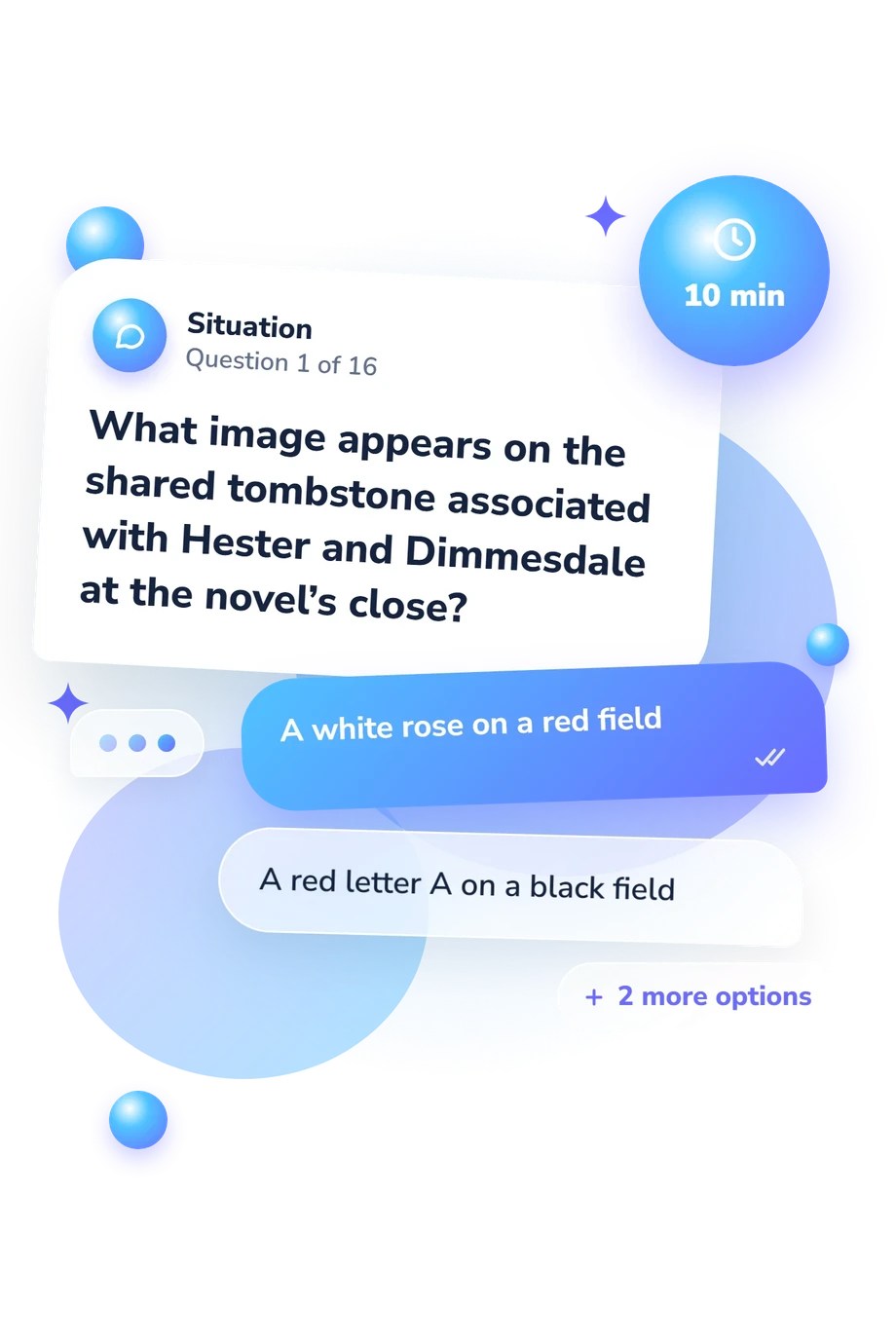
- A white rose on a red field
- A red letter A on a black field
- Two joined hands surrounding a silver heart
- A golden scaffold beneath a black sky
- They repeat Hester’s punishment without substantially changing any relationship.
- They move from Hester’s public shame, through Dimmesdale’s private vigil, to his public acknowledgment.
- They mark Chillingworth’s progression from physician to colonial magistrate.
- They trace Pearl’s education from infancy through her departure for Europe.
- It represents the complete disappearance of their past choices.
- It places them under stricter legal control than the scaffold does.
- It offers temporary freedom and moral ambiguity beyond the town’s surveillance.
- It shows that the wilderness follows the same public rituals as Boston.
The Scarlet Letter Quiz - Description and methodology of the test
Readers who want to check their grasp of Hawthorne’s novel can use this literary knowledge check to move beyond isolated plot points. Students, book-club members, and independent readers can use The Scarlet Letter Quiz to gauge their preparation for discussion, study, or a close rereading. It turns a broad impression of the book into a focused opportunity to revisit the text.
What This Assessment Explores
The questionnaire asks readers to connect events with the novel’s larger design rather than recall names alone. Its focus includes Scarlet Letter themes such as public punishment, private guilt, social judgment, changing identity, and moral freedom.
The question themes below are domains of knowledge that contribute to the single knowledge result:
- Plot and structure show how well you place the scaffold scenes, the Custom-House frame, and the ending within the narrative.
- Characterization and relationships reveal your grasp of Hester, Dimmesdale, Chillingworth, Pearl, and the community.
- Symbolism and themes show whether you can interpret the letter, rosebush, forest, and meteor while recognizing questions of guilt, secrecy, revenge, gender, and power.
The catalogue reports The Scarlet Letter Knowledge on 0-16: Foundation to build (0-6), Developing command (7-12), and Strong command (13-16). The band describes command of this novel, not literary ability.
Methodology and Evidence Base
The narrative framework comes from Scarlet Letter (Hawthorne, 1850), while the selected-response format asks you to choose the best answer from four alternatives. Distractors often distinguish close interpretations: a symbol’s changing meaning, a character’s motive, or the contrast between public and private experience. The result is presented through descriptive knowledge bands, and the questionnaire gives no individual-answer weighting rule.
The approach is conceptually consistent with Hawthorne’s allegorical patterns, which Daniel Fyfe discusses in relation to the novel’s symbols and narrative design. Sandra M. Gilbert and Susan Gubar provide a literary-critical context for reading Hester’s constrained social position and the novel’s treatment of gender. The questions are conceptually consistent with these literary analyses, but the online questionnaire is not an adaptation or validation of those works.
The displayed bands are descriptive; population norms and psychometric validation are not provided. Results can vary with memory, recent rereading, classroom preparation, and preferred interpretation. A Scarlet Letter study guide can help you revisit strengths and discussion topics.
- Hawthorne, Nathaniel. The Scarlet Letter. Introduction by Michael J. Colacurcio. John Harvard Library. Cambridge, MA: Belknap Press of Harvard University Press, 1962. 10.2307/j.ctv1p6hq53
- Fyfe, Daniel. “Hawthorne’s Allegorical Techniques in ‘The Scarlet Letter.’” Estudios Humanísticos. Filología, no. 16, 1994, pp. 101-114. 10.18002/ehf.v0i16.4224
- Gilbert, Sandra M., and Susan Gubar. The Madwoman in the Attic: The Woman Writer and the Nineteenth-Century Literary Imagination. 2nd ed. New Haven, CT: Yale University Press, 2020. 10.12987/9780300252972
Updated: