
Body Type Quiz Men
How the Scales are Structured
Who Usually Takes This Test?
See How You Compare
Below is a preview of how scores are typically distributed across each scale.
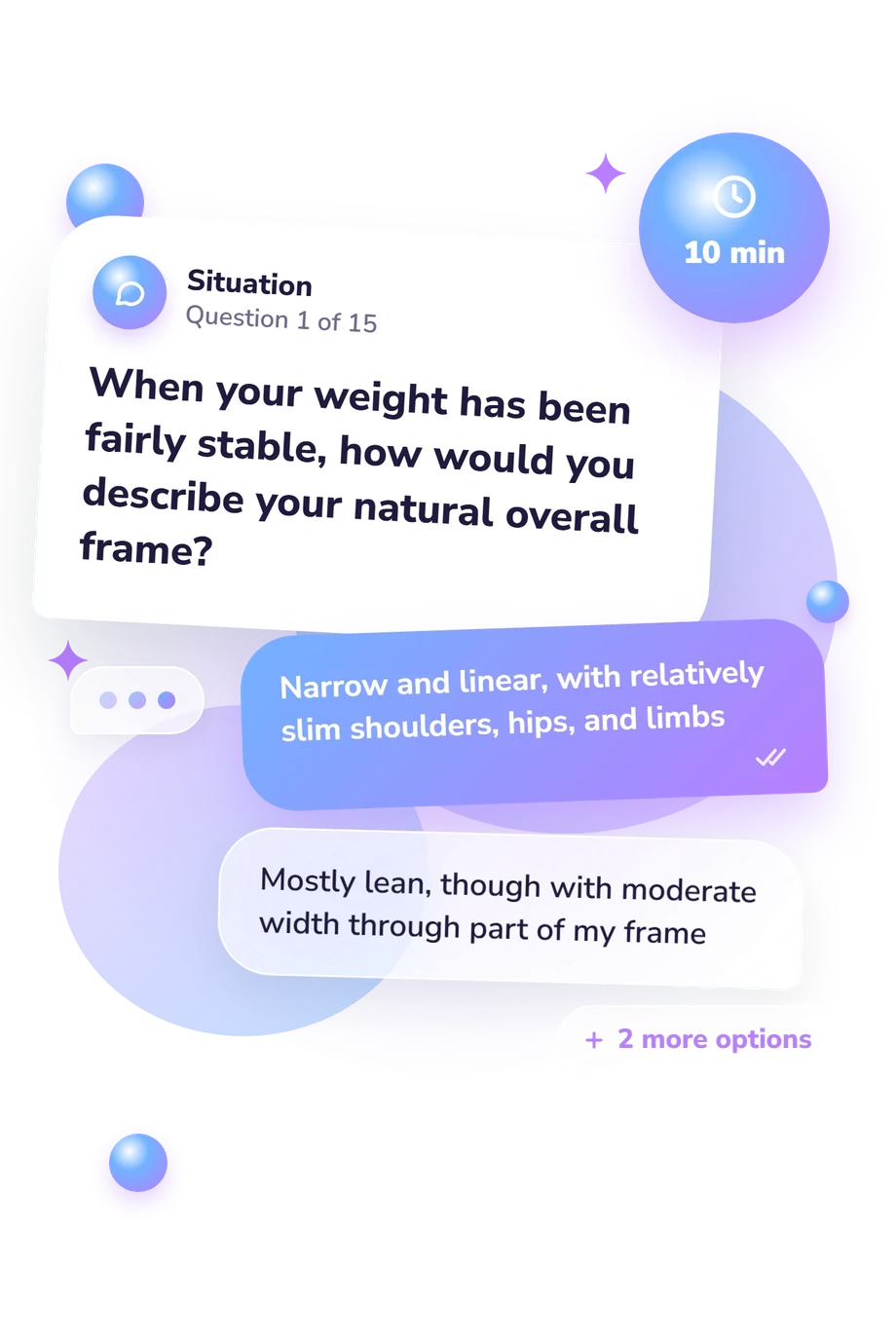
Example Questions From the Test
- My waist or overall fullness would become noticeably greater
- I would probably notice a moderate change in fit or measurements
- I might notice a slight change, mainly after the month ends
- My shape would probably remain almost unchanged
- My strength can improve, but visible size tends to build slowly
- I usually add a modest amount of visible muscle over time
- I tend to develop noticeable muscle at a steady pace
- My muscles generally look fuller or larger fairly quickly
- I remained notably slim through most changes in routine
- I was usually lean but had some visible fluctuations
- My build shifted between leaner and fuller periods
- I usually maintained a solid, broad, or fuller appearance
Body Type Quiz Men - Description and methodology of the test
Men who want a clearer starting point for understanding their build can use this body type quiz men to compare frame, proportions, weight response, and training response. A free body type quiz male readers can complete privately shows which traditional physique profile best matches their answers. The result is descriptive, helping organize observations without treating a category as fixed, medical, or predictive.
What This Assessment Explores
Rather than assess health or fitness, the questionnaire translates body-type language into experiences such as frame, silhouette, clothing fit, weight change, visible muscularity, and response to resistance training. It suits men seeking a descriptive way to organize observations about their build.
The displayed affinities are:
- Ectomorph Affinity (0-15) reflects a narrower frame, persistent leanness, or slower size gains; 0-5 - Limited affinity, 6-10 - Mixed affinity, and 11-15 - Strong affinity.
- Endomorph Affinity (0-15) reflects a broader or fuller build and routine-related weight gain; 0-5 - Limited affinity, 6-10 - Mixed affinity, and 11-15 - Strong affinity.
- Mesomorph Affinity (0-15) reflects muscularity, torso taper, or response to strength work; 0-5 - Limited affinity, 6-10 - Mixed affinity, and 11-15 - Strong affinity.
A male body type test is most useful when the highest result is treated as an affinity, not a fixed identity.
Methodology and Scientific Basis
Each item presents a familiar situation and several ordered descriptions, asking the respondent to choose the option that best matches their usual experience. Themes cover frame, proportions, weight change, muscularity, clothing fit, and response to resistance training. As self-report prompts, the items depend on honest recall and current context.
Scoring produces one affinity result for each profile rather than one all-or-nothing type. The highest score is the strongest affinity; any other score within one point of it is included in a blended result. The labels describe similarity to traditional somatotype patterns, not metabolism, discipline, health, fitness, or athletic ability.
Conceptually, the questionnaire is consistent with the Heath-Carter somatotype method (Heath and Carter, 1967) and the earlier constitutional framework described by Sheldon, Stevens, and Tucker (1940). It is not a standardized adaptation of either published instrument. The online format has no stated population norms or diagnostic validation, so any answer to what is my body type should be read as a structured snapshot shaped by self-perception, memory, and present circumstances.
- Heath, Barbara Honeyman, and J. E. Lindsay Carter. (1967). A modified somatotype method. American Journal of Physical Anthropology, 27(1), 57-74. 10.1002/ajpa.1330270108
- Sheldon, William Herbert, Stanley Smith Stevens, and William Boose Tucker. (1940). The Varieties of Human Physique: An Introduction to Constitutional Psychology. New York: Harper and Brothers Publishers
Updated: