
Their Eyes Were Watching God Quiz
How the Scales are Structured
Who Usually Takes This Test?
See How You Compare
Below is a preview of how scores are typically distributed across each scale.
Example Questions From the Test
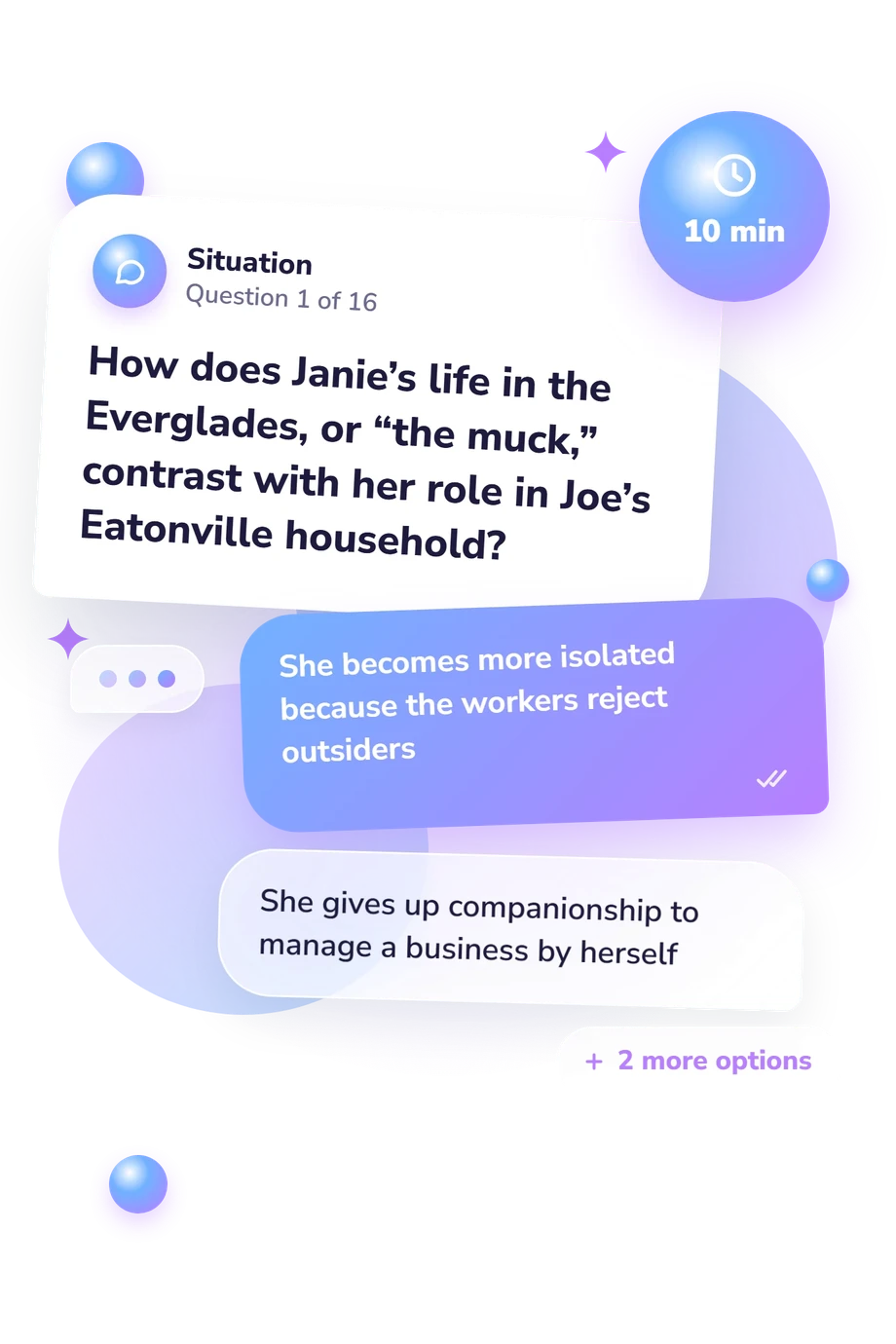
- She becomes more isolated because the workers reject outsiders
- She gives up companionship to manage a business by herself
- She participates more directly in work and communal social life
- She gains formal political authority over the local community
- A warning that desire inevitably leads to loss
- The financial security that comes from owning fertile land
- The social recognition available through marriage
- A vision of mutual, harmonious love and fulfillment
- Competition between Eatonville and Everglades workers
- Conflict over whether Janie should return to Logan
- Colorism and the internalization of a racial hierarchy
- Resentment toward people who own land in Florida
Their Eyes Were Watching God Quiz - Description and methodology of the test
Students, discussion participants, and returning readers may use Their Eyes Were Watching God Quiz to prepare for conversation or renew their familiarity with Janie Crawford’s journey. This literary knowledge quiz reviews plot, relationships, symbolism, and theme through selected details from Zora Neale Hurston’s novel.
What This Assessment Explores
Items test recall and interpretation, covering Janie’s relationships, Joe’s control, Tea Cake’s fate, Nanny’s priorities, and Eatonville versus the Everglades. In this literature quiz about Their Eyes Were Watching God, details link character, social pressure, and meaning.
The questions cover three thematic areas:
- Plot and character development show how well you connect Janie’s choices and outcomes.
- Settings and social experience reveal how place shapes choices and community life.
- Symbols and themes show what the pear tree and horizon suggest about love, control, and agency.
The scale, Their Eyes Were Watching God Knowledge: 0-16, counts correct answers about characters, events, settings, symbols, and themes. Foundation 0-6 calls for plot and symbol review; Developing 7-12 shows understanding with subtler connections to review; Strong 13-16 shows a well-developed grasp of story and meaning. Missed items may reflect forgotten details or different interpretations.
Methodology and Evidence Base
Each item presents four answer choices, and the total counts correct choices. Prompts combine factual recall-authorship, events, and narrative framing-with interpretation of motives, symbols, social pressures, and themes. The score shows performance on selected material, helping readers identify parts of the novel to review.
The primary literary source is Their Eyes Were Watching God (Hurston, 1937), supplying the characters, events, and situations represented in the items. Wall (2000) offers context for voice, relationships, race, gender, symbolism, and cultural setting. The questionnaire is an informal online knowledge quiz based on the novel’s content.
Reviewing answers from the quiz on Their Eyes Were Watching God alongside the novel can clarify whether a missed item reflects forgotten detail or an uncertain interpretation. A higher result suggests stronger command of tested material; a lower result identifies topics worth revisiting, helping readers plan discussion around uncertain characters, events, symbols, or themes.
Because responses are self-administered, performance can vary with memory, rereading history, attention, and uncertainty about interpretation. Its clearest uses are study planning, discussion, and self-reflection around uncertain characters, events, symbols, or themes.
- Hurston, Zora Neale. Their Eyes Were Watching God. Philadelphia: J. B. Lippincott, 1937.
- Wall, Cheryl A., editor, with contributions by Henry Louis Gates Jr. Zora Neale Hurston's Their Eyes Were Watching God: A Casebook. Oxford University Press, 2000. 10.1093/oso/9780195121735.001.0001
Updated: