
Theater Quiz
How the Scales are Structured
Who Usually Takes This Test?
See How You Compare
Below is a preview of how scores are typically distributed across each scale.
Example Questions From the Test
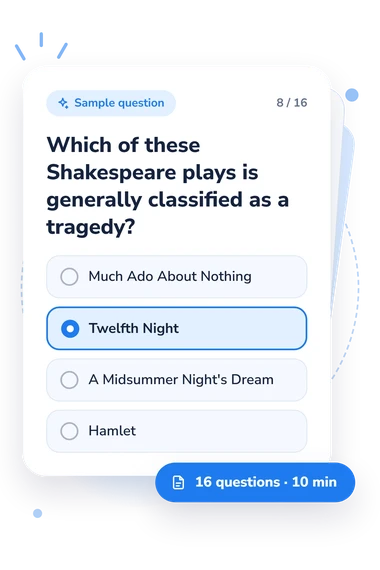
- Much Ado About Nothing
- Twelfth Night
- A Midsummer Night's Dream
- Hamlet
- The construction of scenery before rehearsals begin
- The planned movement and positioning of performers
- The division of a script into acts and scenes
- The process of preventing light from reaching the stage
- A beat
- A preset
- A cue
- A callback
Theater Quiz - Description and methodology of the test
Readers who want to understand the language of live performance can use this theater quiz as a focused check of practical theater knowledge. For curious theatergoers, students, performers, and returning learners, this theater knowledge quiz uses short situations and definitions to check practical theater vocabulary. Its overall result describes current familiarity without assigning separate skill scores or specific study gaps.
What This Assessment Explores
The assessment covers theater vocabulary rather than acting quality or personal taste. The theatre quiz uses situations and definitions to test how productions are organized, how performers work, and how dramatic meaning is communicated.
The thematic areas represented by the questions are:
- Stagecraft covers stage configurations, movement terms, cues, technical rehearsals, and production organization.
- Performance practice covers roles and processes such as understudies, stage managers, blocking, and rehearsals.
- Dramatic language covers subtext, dramatic irony, asides, and deus ex machina, where meaning extends beyond dialogue.
- Theatrical conventions cover the fourth wall, Shakespearean genre, historical stage vocabulary, and performer-spectator relationships.
Together, these areas feed one overall result. The single total reflects accuracy across the tested topics, without separate scores or specified feedback about individual study gaps. It supports self-reflection and topic selection, not judgments of creativity or artistic merit.
Methodology and Evidence Base
Each item presents a scenario or definition with four choices; the respondent selects a theatrical term or explanation. Scoring is a direct total of correct answers: the Theater Knowledge scale runs from 0-16. Its bands are Foundation (0-6), Developing (7-12), and Strong (13-16), representing familiarity with performance, text, and production.
In this format, theatre quiz questions sample recognition and application of terminology rather than observed performance. The content is conceptually consistent with Praxis Theatre (Swiggett et al., 2012), which defines theatre-teacher knowledge domains through job analysis; the ETS Theatre (5641) companion outlines related content, and Peppler et al. (2023) illustrates standards-based drama-performance assessment. Together, these sources provide context for the content, not evidence that this online questionnaire is standardized or adapted from them.
Results describe these items, not a population norm. Strong results indicate broad accuracy across tested topics; lower bands point to concepts worth reviewing. Prior instruction, cultural exposure, familiarity with English terminology, guessing, and test-taking conditions can affect the outcome, so the score is a snapshot of current knowledge rather than a measure of theater competence.
- Swiggett, Wanda D., Stacy L. Robustelli, and Nicole DiCrecchio. (2012). Validity Evidence to Support the Development of a Licensure Assessment for Theatre Teachers: A Job-Analytic Approach. ETS Research Memorandum No. RM-12-09. Princeton, NJ: Educational Testing Service.
- Educational Testing Service. (2022). The Praxis Study Companion: Theatre (5641). Princeton, NJ: Educational Testing Service.
- Peppler, Kylie, Sophia Bender, Anthony Phonethibsavads, Nickolina Yankova, and Molly Stewart. (2023). Lights up! Assessing standards-based performance skills in drama education. Studies in Educational Evaluation, 77, 101259. 10.1016/j.stueduc.2023.101259
Updated: