
Special Right Triangles Quiz
How the Scales are Structured
Who Usually Takes This Test?
See How You Compare
Below is a preview of how scores are typically distributed across each scale.
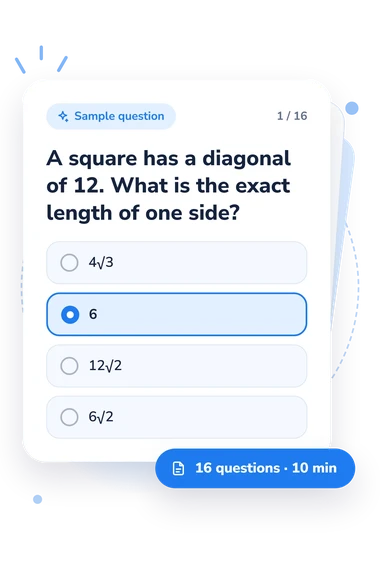
Example Questions From the Test
- 4√3
- 6
- 12√2
- 6√2
- 6√3
- 9
- 18√3
- 9√3
- It is a 45-45-90 triangle.
- It is a 30-60-90 triangle.
- It is right but not a special right triangle.
- The listed lengths cannot form a right triangle.
Special Right Triangles Quiz - Description and methodology of the test
Learners who want to check their command of exact geometry can use the special right triangles quiz to identify which relationships and applications deserve attention during revision. This geometry quiz on special right triangles can support lesson review, classwork preparation, or a decision about what to practise next. The result describes current performance on these relationships, not effort or potential.
What the Test Measures
Students can use the assessment when revising geometry, preparing for classwork, or checking whether memorized rules transfer to unfamiliar diagrams. As a practice quiz for special right triangles, this questionnaire helps identify foundational skills that are secure and those needing targeted review, while practising exact relationships and applications in calculations and geometric situations.
The main skill groups represented by the questions are:
- Classifying 30-60-90 and 45-45-90 triangles shows whether you recognize their defining relationships.
- Finding missing lengths shows how accurately you use fixed ratios and simplify radicals.
- Applying geometry shows whether those relationships transfer to squares, equilateral triangles, coordinates, ladders, area, altitude, and perimeter.
The displayed scale is Special Right Triangles Knowledge: 0-16. Foundations to revisit (0-6) signals review needs; Developing knowledge (7-12) indicates uneven consistency; Strong knowledge (13-16) indicates accurate application across geometric situations.
Methodology and Scientific Basis
Each item presents a geometry prompt with several answer choices, including exact radicals, numerical values, classifications, ratios, and applied outcomes. Choosing correctly combines recognition with equivalent-value reasoning, calculation, and transfer to geometric situations.
Its format makes the questionnaire a special right triangles assessment covering recognition, calculation, and application. Results are interpreted through the displayed bands; use them to judge which relationships and applications merit further review rather than infer how individual choices contribute to the result.
Larson and Boswell (2015) provide the central mathematical framework for the fixed side relationships. Africk (2021) offers a related geometry treatment, while the Common Core standards place these connections within geometric reasoning and modeling. These sources support the mathematical content and classroom context; they do not establish psychometric properties for this online questionnaire.
The result reflects performance on the tested relationships at completion; prior instruction, notation familiarity, attention, and guessing can affect it. The online questionnaire has no stated standardization status, so its bands describe this performance rather than overall mathematical ability.
- Larson, Ron, and Laurie Boswell. Big Ideas Math: Geometry: A Common Core Curriculum, Chapter 7, section 7.4: Special Right Triangles. Erie, PA: Big Ideas Learning, 2015. ISBN 978-1-60840-839-9.
- Africk, Henry. Elementary College Geometry (2021 ed.), section 4.5: Special Right Triangles. New York City College of Technology, CUNY Academic Works, 2021.
- National Governors Association Center for Best Practices, and Council of Chief State School Officers. Common Core State Standards for Mathematics. Washington, DC: Authors, 2010.
- Bergstrom, Carly, and Dake Zhang. Geometry Interventions for K-12 Students With and Without Disabilities: A Research Synthesis. International Journal of Educational Research 80 (2016): 134-154. 10.1016/j.ijer.2016.04.004.