
Of Mice and Men Chapter 4 Quiz
How the Scales are Structured
Who Usually Takes This Test?
See How You Compare
Below is a preview of how scores are typically distributed across each scale.
Example Questions From the Test
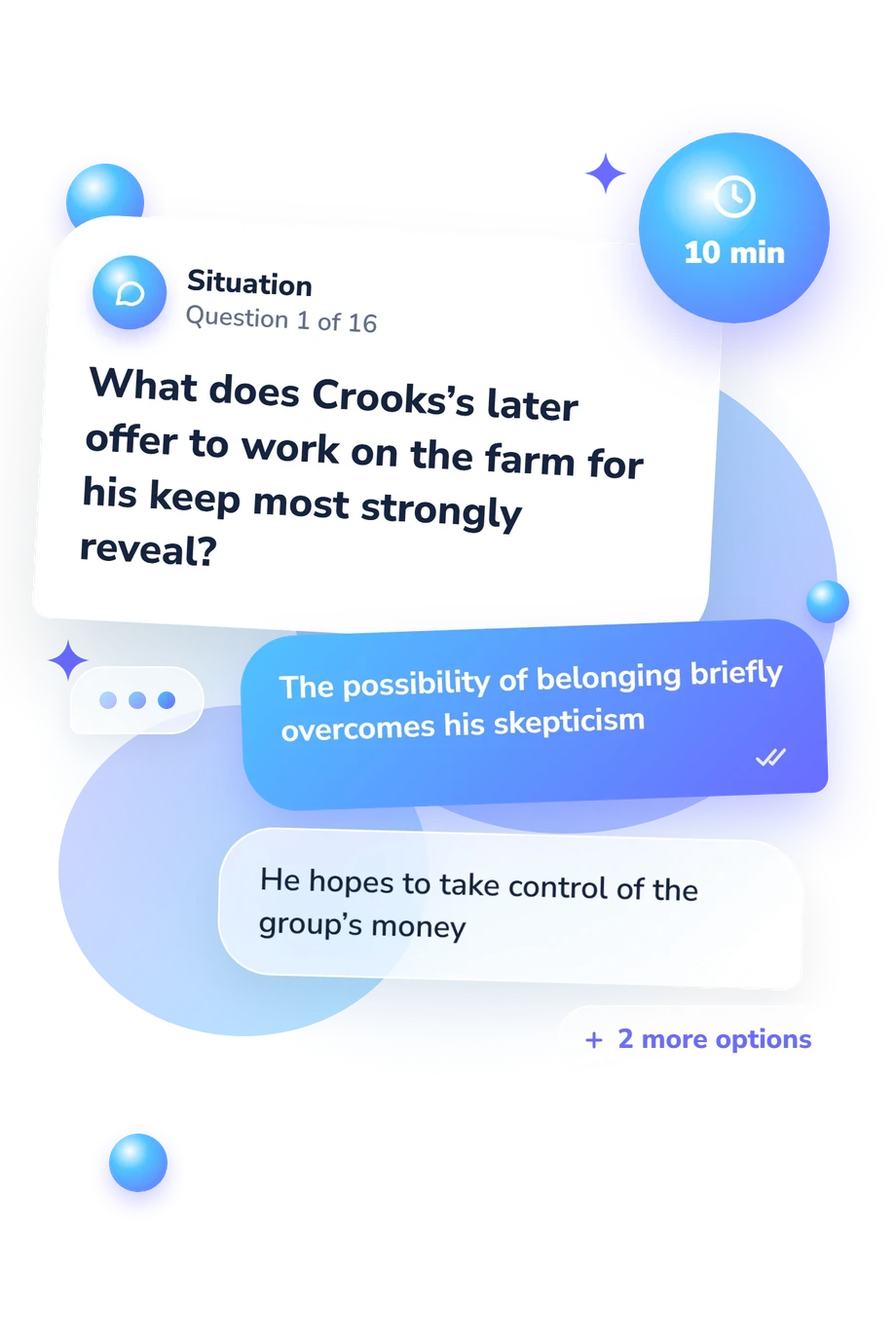
- The possibility of belonging briefly overcomes his skepticism
- He hopes to take control of the group’s money
- He has always disliked caring for horses
- He wants to prove that he is physically stronger than Candy
- She threatens to have him dismissed without wages
- She threatens to tell Curley that Crooks helped plan an escape
- She invokes the threat of a racist accusation and lynching
- She threatens to accuse him of stealing from the ranch house
- Candy
- Slim
- Carlson
- Whit
Of Mice and Men Chapter 4 Quiz - Description and methodology of the test
Readers preparing for class discussion, an assignment, or personal review can use the Of Mice and Men Chapter 4 Quiz to connect recall with literary interpretation. It is designed for people who want to examine how Crooks’s room develops conflict, character motives, loneliness, and changing power. Chapter 4 comprehension questions ask for supported understanding rather than isolated recognition, and the result indicates the reader’s general command of the chapter.
What This Assessment Explores
Crooks’s room brings loneliness, hope, vulnerability, and power together. The assessment connects dialogue and actions with motives, racialized authority, and the fragile farm dream. It suits anyone studying or revisiting the chapter.
The questions examine four recurring themes within one overall result:
- Plot and events show whether key encounters are placed accurately.
- Character motives show why the principal figures act as they do.
- Power and exclusion show how threats and racial hierarchy limit protection.
- Hope and isolation show how the farm dream changes belonging.
Results appear on the Of Mice and Men Chapter 4 Knowledge scale (0-16): Foundational (0-6) indicates some Chapter 4 details; Developing (7-12) shows understanding with room to review motives and power shifts; Strong (13-16) indicates confident command of plot, characterization, and implications. Its questions form an Of Mice and Men Chapter 4 summary quiz that guides review.
Methodology and Evidence Base
Each item presents a question about a specific event, inference, or character response with several answer choices. Together, the items combine recall of events and details with interpretation of motives, power, and themes; readers select the best-supported answer from the choices. The test reports one overall knowledge result on the displayed scale; no separate scores are produced.
Steinbeck’s novel supplies the literary source for the events, dialogue, and conflicts examined here. Gerken’s character study offers a closely related reading of Crooks as a figure shaped by exclusion, dialogue, and changing possibilities. This questionnaire is conceptually consistent with those works, not a reproduction or adaptation of either publication.
The result works as an Of Mice and Men Chapter 4 test of reading knowledge, offering a snapshot rather than a complete judgment of literary ability. Its displayed bands are the test’s interpretive categories, and performance can vary with memory, attention, reading context, and familiarity with literary analysis. Missed ideas can guide rereading and discussion, while a single band should be interpreted alongside the reader’s actual understanding of the chapter.
- Steinbeck, John. Of Mice and Men. Covici-Friede, 1937.
- Gerken, Eileen. "Crooks, the Stable Buck: A Dialogic Approach to Character Study." The Steinbeck Institute, Stanford University, 2007.
- Haladyna, Thomas M., Steven M. Downing, and Michael C. Rodriguez. "A Review of Multiple-Choice Item-Writing Guidelines for Classroom Assessment." Applied Measurement in Education, 15(3), 309-334, 2002. 10.1207/S15324818AME1503_5
Updated: