
Adjectives and Adverbs Quiz
How the Scales are Structured
Who Usually Takes This Test?
See How You Compare
Below is a preview of how scores are typically distributed across each scale.
Example Questions From the Test
- The guide explained the route well.
- Priya writes well under pressure.
- The team performed well yesterday.
- After a night of rest, Priya felt well.
- She spoke respectful during the ceremony.
- She spoke respectfully during the ceremony.
- She spoke respect during the ceremony.
- She spoke respectfulness during the ceremony.
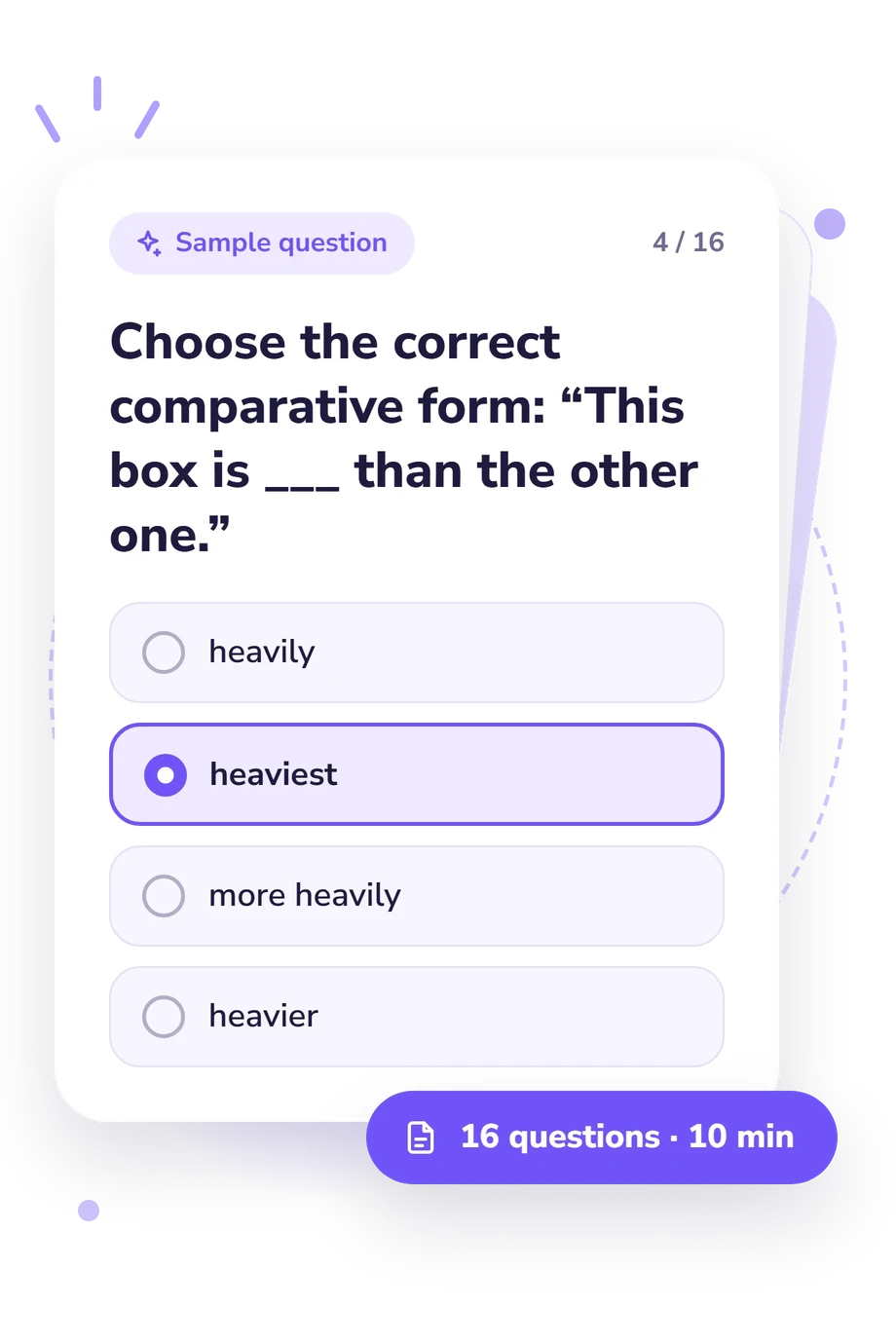
- heavily
- heaviest
- more heavily
- heavier
Adjectives and Adverbs Quiz - Description and methodology of the test
For readers who want to check command of modifier choice, this assessment focuses on how adjectives and adverbs function in complete sentences. The adjectives and adverbs quiz suits learners, writers, and anyone reviewing core English grammar. It turns choices about description, manner, degree, and comparison into a concise summary of grammar performance. As an adjective or adverb quiz, it keeps attention on sentence meaning rather than isolated terminology.
What This Assessment Explores
Rather than testing vocabulary in isolation, the questions ask what a word modifies and which form fits the intended meaning. They cover recognition, context, and application. In this quiz about adjectives and adverbs, the questions cover four recurring areas:
- Modifier roles show whether you distinguish adjectives for nouns or pronouns from adverbs for verbs, adjectives, or other adverbs.
- Meaning in context shows whether forms express manner, state, or degree.
- Comparison shows whether you use comparative and superlative forms.
- Form and placement show whether you handle exceptions such as well, friendly, and almost.
The overall scale, Adjectives and Adverbs Knowledge (0-16), summarizes these themes. Foundations to strengthen (0-6) points to review of modifier functions and linking verbs; Developing knowledge (7-12) reflects common uses but further practice with comparison, placement, and confusing forms; Strong knowledge (13-16) reflects consistent distinction across varied sentences.
Methodology and Evidence Base
Each item presents a sentence or brief prompt with four choices. The respondent selects the option matching the required function, meaning, or form. Tasks include identifying modifiers, choosing comparative and superlative forms, distinguishing adjective and adverb uses, and handling endings such as -ly that can mislead. Some also test whether a form matches the intended meaning in context.
The approach is a structured knowledge check, not a self-report measure. The distinctions used here are conceptually consistent with Huddleston and Pullum (2002), with terminology and teaching guidance also aligned with Huddleston, Pullum, and Reynolds (2021) and Parrott (2010). No standardization is stated for this online version.
As an adjectives and adverbs assessment, the displayed result summarizes performance on these selected choices. The displayed bands describe performance on this questionnaire rather than a population-normed proficiency level, and reliability for this online version is not established. Interpret the score as a snapshot: guessing, attention, prior instruction, and current writing experience can affect responses, so review of actual sentences gives a fuller picture of the learner’s modifier use and grammar performance.
- Huddleston, Rodney, and Geoffrey K. Pullum. The Cambridge Grammar of the English Language. Cambridge University Press, 2002. DOI 10.1017/9781316423530
- Huddleston, Rodney, Geoffrey K. Pullum, and Brett Reynolds. A Student's Introduction to English Grammar. 2nd ed. Cambridge University Press, 2021. DOI 10.1017/9781009085748
- Parrott, Martin. Grammar for English Language Teachers. 2nd ed. Cambridge University Press, 2010. DOI 10.1017/9781009406536
Updated: