
Celebrity Twin Quiz
How the Scales are Structured
Who Usually Takes This Test?
See How You Compare
Below is a preview of how scores are typically distributed across each scale.
Example Questions From the Test
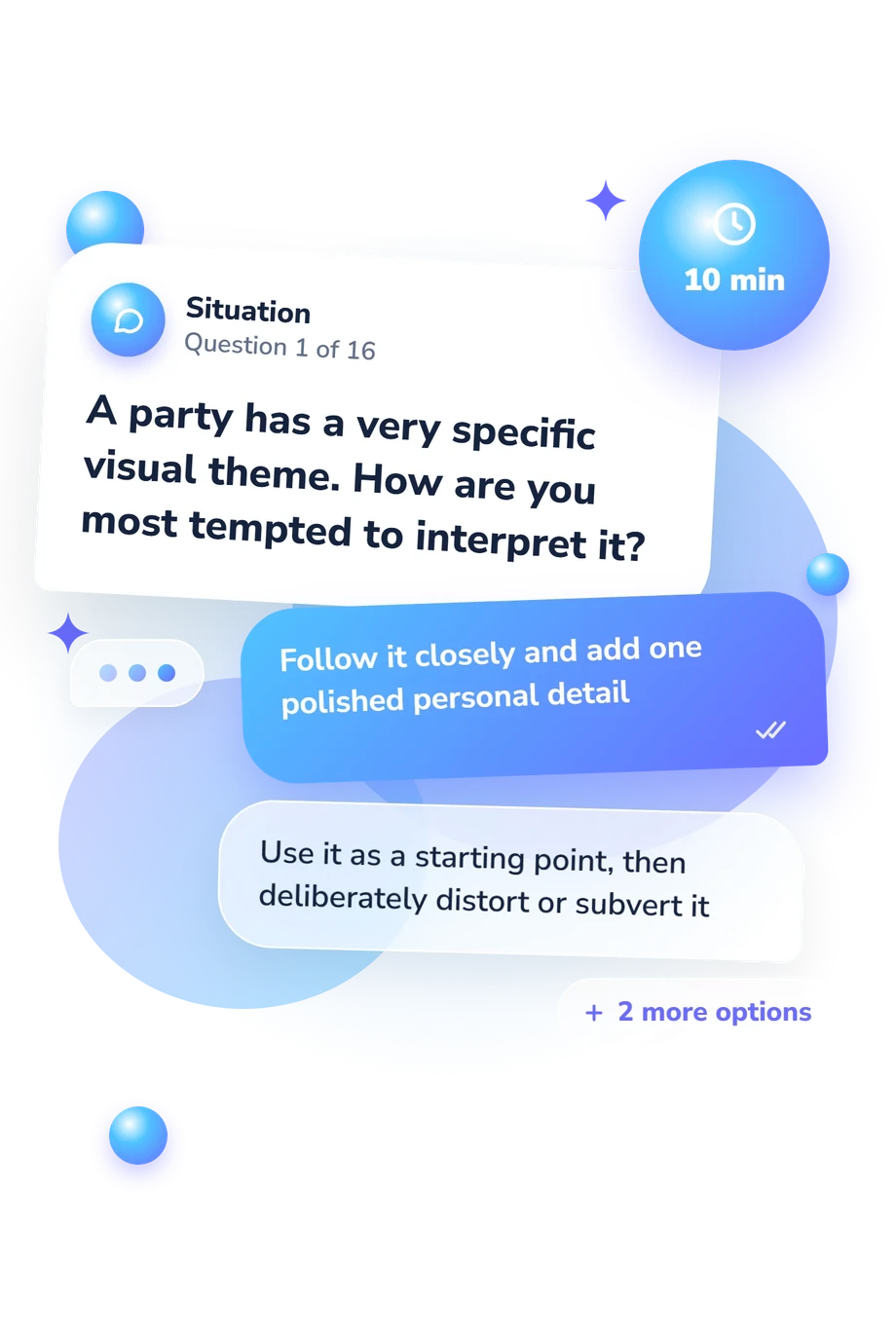
- Follow it closely and add one polished personal detail
- Use it as a starting point, then deliberately distort or subvert it
- Choose something connected to a favorite memory or personal era
- Keep it simple so I can focus on enjoying the people and activities
- Something nostalgic with lyrics or details I can connect to my own past
- Something unusual and atmospheric that creates a world of its own
- Something polished that reveals range across different styles
- Something bold and energizing that changes the mood of the room
- Something comfortable that lets me move easily all evening
- A subtle reference to a memory, era, or inside joke
- A polished combination that works in several settings
- An unexpected element that deliberately breaks the theme
Celebrity Twin Quiz - Description and methodology of the test
Designed for visitors who enjoy personality reflection through pop culture, this celebrity twin quiz turns everyday preferences into four playful creative profiles. It suits anyone drawn to the question behind a who-is-my-celebrity-twin quiz because the outcome offers more than a name: it connects choices about taste, energy, storytelling, originality, and adaptability with a concise self-portrait. The emphasis is on public creative styles, not private celebrity character.
What This Assessment Explores
Rather than measuring physical resemblance, the questionnaire examines creative choices, social energy, change, and personal challenges. As a celebrity style quiz, it measures affinity with public-facing artistic qualities, not private celebrity personality. The strongest profile is the closest match; scores within one point indicate a blend.
These are the four result dimensions:
- Billie Eilish - Unconventional Original (0-12) measures aesthetic independence and rule-bending: Different wavelength (0-4), Independent edge (5-8), Strong affinity (9-12).
- Dwayne Johnson - Driven Energizer (0-12) measures drive, group energy, and goal-focused optimism: Different wavelength (0-4), Motivating streak (5-8), Strong affinity (9-12).
- Taylor Swift - Reflective Storyteller (0-12) measures autobiographical expression and meaningful detail: Different wavelength (0-4), Shared notes (5-8), Strong affinity (9-12).
- Zendaya - Poised Chameleon (0-12) measures composed adaptability and polished range: Different wavelength (0-4), Flexible presence (5-8), Strong affinity (9-12).
Methodology and Evidence Base
Each item uses forced-choice self-report: four responses describe ways to interpret situations, handle change, express taste, or support a group. Choosing the closest usual response assigns the item to a profile rather than marking it right or wrong. The highest total is the strongest match; a one-point gap indicates a blend.
A playful answer to the question behind this who-is-your-celebrity-twin quiz avoids reducing the result to resemblance. As a celebrity personality quiz, it translates preferences into affinity with public personas. Its framework is conceptually consistent with Fraser and Brown (2002) on celebrity identification and social influence. Cohen (2001) distinguishes identification from liking; Hoffner and Buchanan (2005) link wishful identification with perceived similarity and character attributes; McCutcheon, Lange, and Houran (2002) add context on celebrity-focused attachment. These works support the logic, but this questionnaire is not an adaptation or validation of any one instrument.
The profile scoring is an interpretive system rather than a standardized normed measure. The bands describe affinity, not ability, popularity, resemblance, or a celebrity’s private character. Self-report, mood, current circumstances, self-awareness, and familiarity with public images can influence the outcome, so it is a structured reflection tool rather than a diagnosis.
- Fraser, Benson P., & Brown, William J. (2002). Media, Celebrities, and Social Influence: Identification With Elvis Presley. Mass Communication and Society, 5(2), 183-206. 10.1207/S15327825MCS0502_5
- Hoffner, Cynthia, & Buchanan, Martha. (2005). Young Adults’ Wishful Identification With Television Characters: The Role of Perceived Similarity and Character Attributes. Media Psychology, 7(4), 325-351. 10.1207/S1532785XMEP0704_2
- Cohen, Jonathan. (2001). Defining Identification: A Theoretical Look at the Identification of Audiences With Media Characters. Mass Communication and Society, 4(3), 245-264. 10.1207/S15327825MCS0403_01
- McCutcheon, Lynn E., Lange, Rense, & Houran, James. (2002). Conceptualization and Measurement of Celebrity Worship. British Journal of Psychology, 93(1), 67-87. 10.1348/000712602162454
Updated: