
Anime Kin Quiz
How the Scales are Structured
Who Usually Takes This Test?
See How You Compare
Below is a preview of how scores are typically distributed across each scale.
Example Questions From the Test
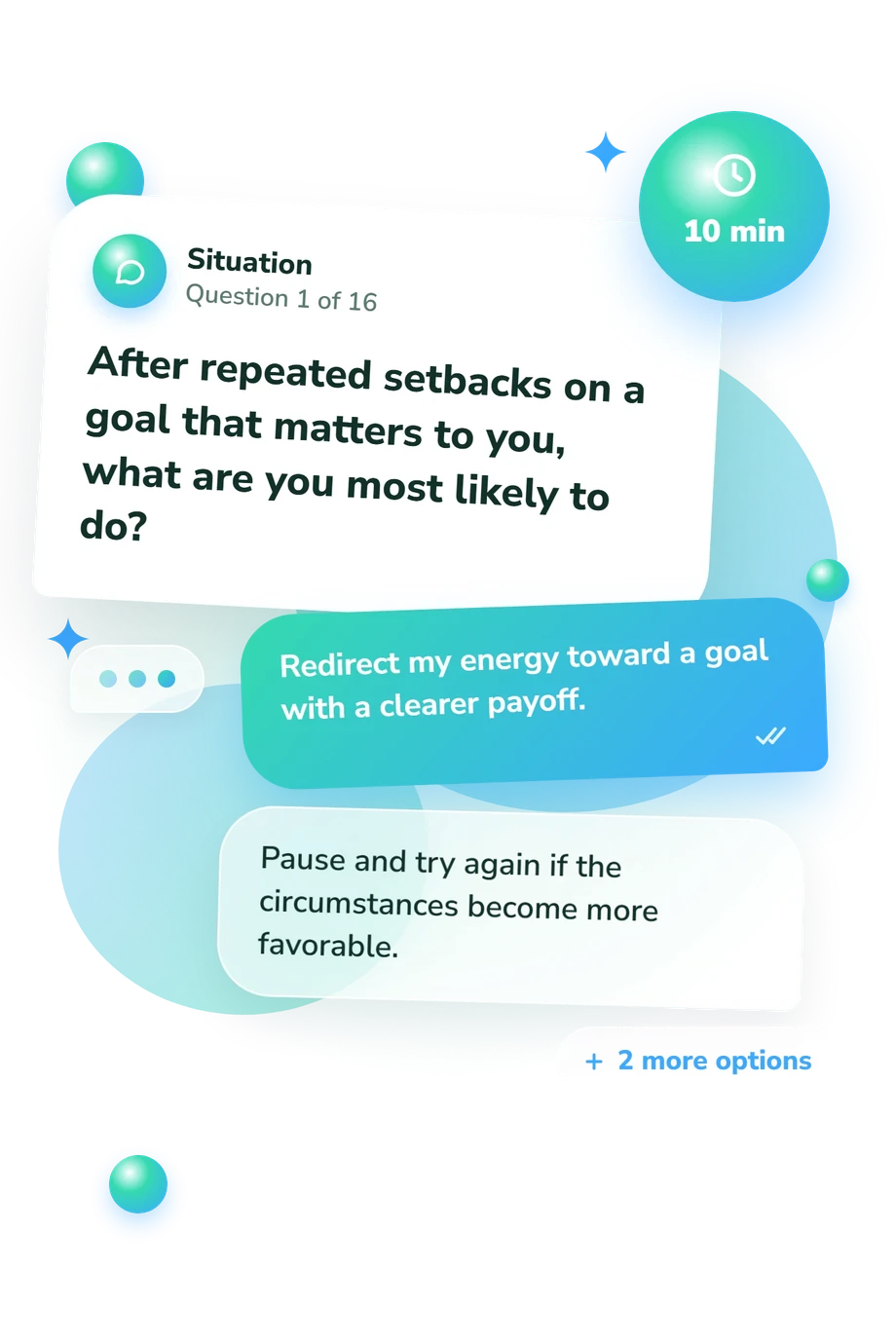
- Redirect my energy toward a goal with a clearer payoff.
- Pause and try again if the circumstances become more favorable.
- Adjust my approach while continuing to work toward the same goal.
- Keep going despite being dismissed; doubt from others strengthens my resolve.
- Knowing privately that I mastered something difficult.
- Seeing tangible progress, whether or not anyone notices.
- Earning the respect of people whose judgment I trust.
- Being acknowledged after others underestimated or rejected me.
- Follow it for now because consistent systems have value.
- Ask for an exception through the available process.
- Interpret it flexibly when doing so causes no meaningful harm.
- Challenge it directly when it interferes with essential freedom.
Anime Kin Quiz - Description and methodology of the test
People who enjoy anime fandom and want a reflective way to compare their own choices with familiar character qualities may find this assessment useful. The anime kin quiz turns reactions to pressure, belonging, freedom, loyalty, and care into a playful profile rather than a claim of literal identity. Its anime kin list quiz format links those themes to distinct character profiles for self-reflection.
What This Assessment Explores
It examines four character-linked patterns: disciplined precision, freedom-led exploration, persistent belonging, and emotionally open care. Scenarios involving pressure, promises, uncertainty, conflict, and friendship connect character affinity with recognizable choices. It suits fans seeking an anime character personality quiz for reflection without treating a result as literal identity.
These are fandom affinities, not character identities:
- Levi Ackerman (0-12) measures precision, composure, standards, and duty: Flexible Method (0-4), Steady Discipline (5-8), Focused Resolve (9-12).
- Monkey D. Luffy (0-12) measures adventure, trust, and freedom: Chosen Course (0-4), Adventurous Streak (5-8), Unbound Spirit (9-12).
- Naruto Uzumaki (0-12) measures persistence, recognition, promises, and belonging: Independent Path (0-4), Shared Resolve (5-8), Unshakable Will (9-12).
- Usagi Tsukino (0-12) measures openness, faith, relationship-centered courage, and hope: Quiet Care (0-4), Heartfelt Resonance (5-8), Compassionate Light (9-12).
Methodology and Scientific Basis
Each item offers four response choices for the same situation. They contrast practical judgment, emotional expression, social connection, responsibility, and adventure, so the respondent selects the option that feels most characteristic. The result answers the who do you kin anime quiz prompt with a multi-profile reading instead of forcing one match.
Scoring converts the response pattern into separate affinity scores and gives each profile a banded interpretation. Read together, the results show which tendencies resonate more strongly; they do not create a fixed personality ranking.
Rarity et al. (2022) offers the closest conceptual support by linking identification with media characters to perceived personality overlap. Cohen’s framework explains identification as a meaningful relationship between audience and character, while Ramasubramanian and Kornfield (2012) add anime-specific context on wishful identification and parasocial engagement. These studies support character resonance, but this questionnaire is not an adaptation of their instruments.
The questionnaire is a self-report fandom tool: mood, current relationships, and self-awareness may influence answers, so its profile is a structured reflection rather than a standardized clinical measure or diagnosis.
- Rarity, Erica C., Matthew R. Leitao, and Abraham M. Rutchick. "Identification With Characters in Parasocial Relationships Predicts Sharing Their Personality Traits." Psychology of Popular Media, 11(2), 2022, 111-116. 10.1037/ppm0000389
- Ramasubramanian, Srividya, and Sarah Kornfield. "Japanese Anime Heroines as Role Models for U.S. Youth: Wishful Identification, Parasocial Interaction, and Intercultural Entertainment Effects." Journal of International and Intercultural Communication, 5(3), 2012, 189-207. 10.1080/17513057.2012.679291
- Cohen, Jonathan. "Defining Identification: A Theoretical Look at the Identification of Audiences With Media Characters." Mass Communication & Society, 4(3), 2001, 245-264. 10.1207/S15327825MCS0403_01
Updated: