
Common and Proper Nouns Quiz
How the Scales are Structured
Who Usually Takes This Test?
See How You Compare
Below is a preview of how scores are typically distributed across each scale.
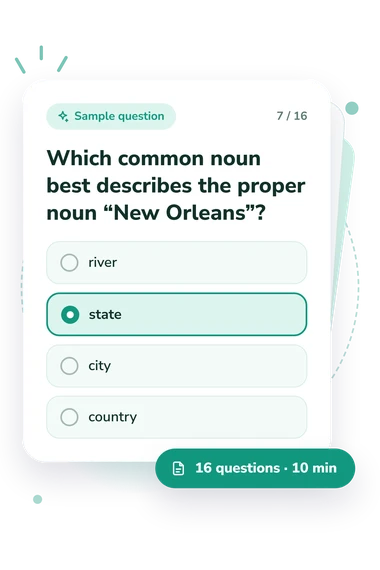
Example Questions From the Test
- Rosa planted flowers in the garden.
- The farmer loaded apples into baskets.
- Students visited Boston in spring.
- The tourists photographed Big Ben.
- It identifies the dog’s breed.
- It is the specific name given to the dog.
- It describes what the dog looks like.
- All words for pets are proper nouns.
- Both “company” and “Elena” are common nouns.
- Both “company” and “Elena” are proper nouns.
- “company” is proper, and “Elena” is common.
- “company” is common, and “Elena” is proper.
Common and Proper Nouns Quiz - Description and methodology of the test
Learners who want to sharpen sentence editing can use this assessment to check their overall knowledge of common and proper nouns. This common nouns quiz reviews grammar in context, using sentences involving people, places, organizations, objects, and events. Taking the common and proper nouns quiz shows an overall knowledge level within the test's result bands.
What This Assessment Measures
Questions test whether you recognize a common noun as a general class and a proper noun as a particular person, place, organization, or named thing. Context matters: a word may be common when capitalized at a sentence opening, while a multiword name may require several capitals.
It works as an identifying quiz about common and proper nouns by covering classification, specific names, capitalization editing, and plural surnames. It suits learners seeking a focused grammar check.
The questionnaire and its result can be understood through these points:
- General and specific reference shows whether you distinguish a class from one named member.
- Capitalization in context shows whether you apply rules to sentence openings, dates, seasons, and names.
- Classification and editing show whether you can revise a sentence without confusing noun type and capitalization.
- Common and Proper Nouns Knowledge (0-16) reports Foundations to Review (0-6), Developing Knowledge (7-12), or Strong Knowledge (13-16).
Methodology and Evidence Base
Each item presents a sentence, definition, comparison, or editing situation with several answer choices. You select the option that identifies a noun type, explains why a word is proper, or applies a capitalization rule. This selected-response method checks recognition and application rather than extended writing.
The common proper nouns quiz reports one displayed knowledge result rather than separate trait scores. Because the items cover related skills, an error may reflect uncertainty about reference, capitalization, or sentence context. The displayed bands describe performance within this questionnaire. This questionnaire has no stated standardization or population norms.
Huddleston and Pullum (2002) provide the grammatical framework for distinguishing common nouns, proper names, and their roles in sentences. Straus, Kaufman, and Stern (2014) support the practical emphasis on capitalization rules and applied exercises. The questionnaire is conceptually consistent with these grammar sources but is not an adaptation of either work.
Interpretation is practical: use the result to identify topics for review, while recognizing that attention, prior instruction, and familiarity with the examples can affect performance.
- Huddleston, Rodney, and Geoffrey K. Pullum. The Cambridge Grammar of the English Language. Cambridge University Press, 2002. 10.1017/9781316423530.
- Straus, Jane, Lester Kaufman, and Tom Stern. The Blue Book of Grammar and Punctuation: An Easy-to-Use Guide with Clear Rules, Real-World Examples, and Reproducible Quizzes. 11th ed. Jossey-Bass, 2014. ISBN: 9781118785560.
Updated: