
WW2 Plane Quiz
How the Scales are Structured
Who Usually Takes This Test?
See How You Compare
Below is a preview of how scores are typically distributed across each scale.
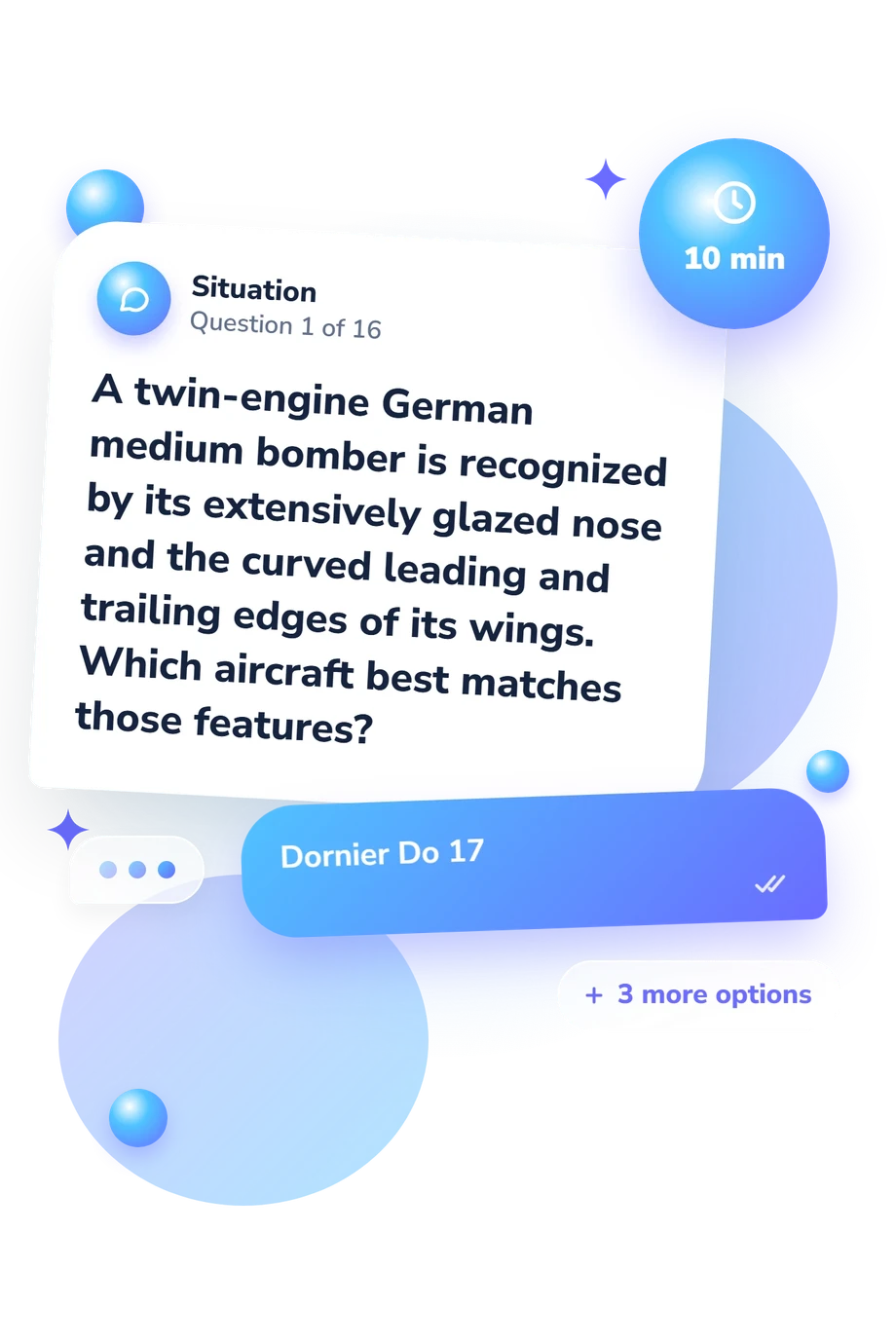
Example Questions From the Test
- Nakajima Ki-43 Hayabusa
- Kawanishi N1K-J Shiden
- Mitsubishi A6M Zero
- Nakajima Ki-84 Hayate
- Dornier Do 17
- Junkers Ju 88
- North American B-25 Mitchell
- Heinkel He 111
- Boeing B-17 Flying Fortress
- Handley Page Halifax
- Short Stirling
- Avro Lancaster
WW2 Plane Quiz - Description and methodology of the test
Designed for readers who enjoy military history, aviation, or visual identification, WW2 Plane Quiz offers a clue-based historical knowledge check built around descriptions of shape, equipment, role, and wartime use. In this ww2 aircraft quiz, clue-based prompts make recognition a focused exercise, while the overall result helps you understand how confidently you handled the clues across the questionnaire.
What This Assessment Explores
The questions test aircraft recognition, not operational skill, through silhouettes, engines, wing arrangements, landing gear, cockpit layouts, service history, and battlefield roles. It suits enthusiasts, students, and anyone checking historical aviation knowledge.
In this World War II plane identification quiz, visual, technical, and historical clues make each identification concrete. Its thematic groups include fighters, bombers, and aircraft used in more than one wartime role. The scale combines recognition across them:
- Fighter questions ask you to distinguish single- and twin-engine fighters from design clues.
- Bomber questions ask you to identify medium and heavy bombers through structure and mission.
- Multirole questions ask you to connect aircraft with more than one wartime function.
- WW2 Plane Knowledge (0-16) summarizes recognition across all groups: Recognition Foundation (0-6), Developing Spotter (7-12), and Accomplished Spotter (13-16) indicate basic familiarity, broader clue use, and strong, consistent recognition, respectively.
Methodology and Evidence Base
Within this WW2 plane identification test, each item presents a scenario followed by four aircraft choices. Prompts combine visual, historical, and technical clues, including range, armor, engine arrangement, wing planform, tail design, landing gear, carrier use, and combat role. Plausible period options reward discriminating features rather than vague familiarity.
Scoring produces one knowledge result. Its bands label this educational result, not an official aviation or historical qualification. The overall band reflects recognition across fighter, bomber, and multirole prompts: a higher band indicates broader, more consistent use of the supplied clues, while a lower band reflects less secure recall.
The format is conceptually consistent with FM 30-30 Aircraft Recognition Pictorial Manual (1943), which emphasizes observable distinguishing features. It also aligns with Whitmore, Cox, and Friel (1968) on classroom aircraft-recognition training and Ganapathy et al. (2015) on a smart-tutor visual-aircraft recognition task. These works provide conceptual context for observable aircraft-recognition clues; they do not validate this questionnaire.
Interpretation is sensitive to prior exposure, memory, image-free clues, and concentration; a lower result points to topics that may repay study.
- War Department and Navy Department. FM 30-30/BUAER 3, Military Intelligence, Aircraft Recognition Pictorial Manual. Washington, DC: U.S. Government Printing Office, 1943.
- Whitmore, Paul G., John A. Cox, and Don J. Friel. A Classroom Method of Training Aircraft Recognition. HumRRO Technical Report 68-1. Alexandria, VA: Human Resources Research Office, George Washington University, 1968.
- Ganapathy, Priya, Ion Juvina, Tejaswi Tamminedi, Gautam Kunapuli, Matt Sherwood, and Mohd Saif Usmani. Development of a Smart Tutor for a Visual-Aircraft Recognition Task. In Foundations of Augmented Cognition, edited by Cali M. Fidopiastis and Dylan D. Schmorrow, 583-594. Lecture Notes in Computer Science, vol. 9183. Springer, 2015. 10.1007/978-3-319-20816-9_56
Updated: