
Fundamentals of Nursing Quiz
How the Scales are Structured
Who Usually Takes This Test?
See How You Compare
Below is a preview of how scores are typically distributed across each scale.
Example Questions From the Test
- Turning away from the sterile field after it has been opened
- Keeping sterile supplies above waist level and in view
- Opening the package flap farthest from the body first
- Dropping a sterile item onto the field without reaching across it
- Analyze the data to identify nursing diagnoses or problems
- Carry out the planned nursing interventions
- Establish goals before interpreting the findings
- Evaluate whether expected outcomes were achieved
- Only patients receiving care in isolation rooms
- Only patients with laboratory-confirmed infections
- Every patient, regardless of known or suspected infection status
- Only patients who have visible blood or body-fluid drainage
Fundamentals of Nursing Quiz - Description and methodology of the test
For learners reviewing basic patient-care principles, a nursing fundamentals quiz can organize the areas that deserve further study. It suits students, new staff, and anyone refreshing essential nursing knowledge before supervised practice. The fundamentals of nursing quiz tests practical judgment rather than memorization alone. Its result summarizes performance across common safety, communication, infection-control, documentation, and medication situations.
What This Assessment Explores
Each scenario asks for the safest or most appropriate response to a routine care problem. As a fundamental quiz, it tests applying core principles to communication, mobility, assessment, infection prevention, documentation, delegation, and medication safety.
The practical themes are:
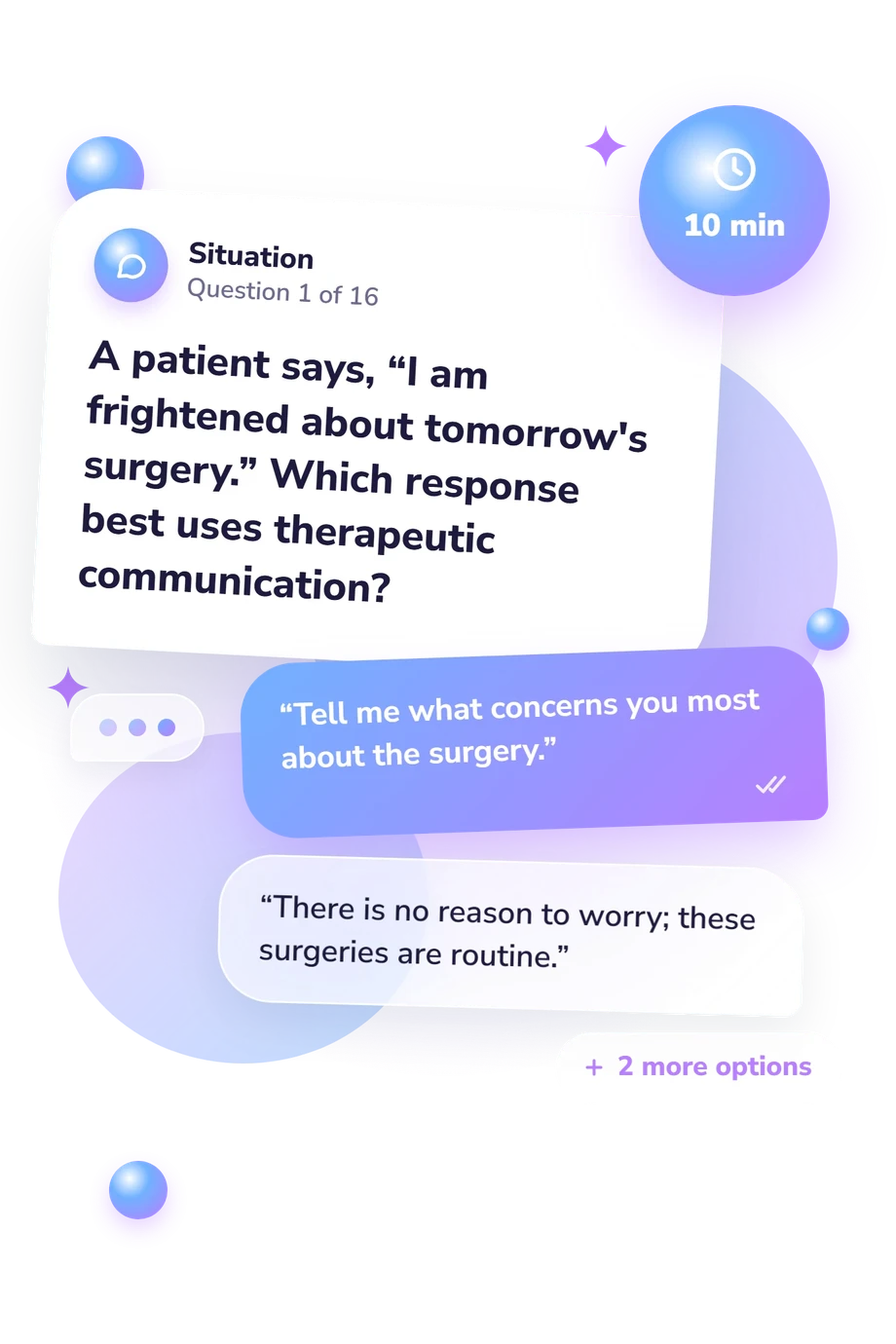
- Therapeutic communication shows whether responses invite expression without minimizing concern.
- Safety and mobility show whether actions reduce falls, pressure, and transfer hazards.
- Assessment and documentation show whether observations remain objective and usable.
- Infection prevention shows whether precautions and hand hygiene are applied appropriately.
- Medication and delegation show whether verification, escalation, and role boundaries are respected.
The single scale, Fundamentals of Nursing Knowledge, runs from 0-16: Foundation to Build (0-6) means core principles need review; Developing Knowledge (7-12) means many fundamentals are understood but consistency and judgment may improve; Strong Foundation (13-16) means the covered concepts show broad command. These bands describe educational performance, not clinical competence.
Methodology and Evidence Base
Each item presents one clinical situation with four answer choices and one best response. The format tests recognition and application: the respondent must distinguish a safe, objective, or policy-consistent action from a tempting but incorrect alternative. A fundamentals of nursing test is most useful when reviewed after completion, because each choice can reveal a knowledge gap or reinforce a sound principle.
The content is conceptually consistent with Bowen et al. (2024), which covers foundational nursing practices, and with the competency emphasis represented in the 2026 NCLEX-RN plan. Infection-control items also align with the precaution principles described by Siegel et al. (2007) and the hand-hygiene recommendations discussed by Pittet et al. (2009). The questionnaire is not presented as an adaptation or validation of those published sources.
Scoring produces one overall educational result rather than separate clinical diagnoses or normative comparisons. Because the score is unvalidated and has no reported population norms, it is a focused snapshot of performance on the situations sampled here, not evidence of clinical competence. Results can guide revision, while local policy, patient complexity, supervised practice, and actual clinical performance may lead to different decisions.
- Bowen, Christy, Lindsay Draper, and Heather Moore. Fundamentals of Nursing. Houston, TX: OpenStax, 2024.
- National Council of State Boards of Nursing. 2026 NCLEX-RN Test Plan. Chicago, IL: National Council of State Boards of Nursing, 2026.
- Siegel, Jane D., Emily Rhinehart, Marguerite Jackson, Linda Chiarello, and Healthcare Infection Control Practices Advisory Committee. 2007 Guideline for Isolation Precautions: Preventing Transmission of Infectious Agents in Health Care Settings. American Journal of Infection Control, 35(10 Suppl):S65-S164, 2007. 10.1016/j.ajic.2007.10.007
- Pittet, Didier, Benedetta Allegranzi, John Boyce, and World Health Organization World Alliance for Patient Safety First Global Patient Safety Challenge Core Group of Experts. The World Health Organization Guidelines on Hand Hygiene in Health Care and their consensus recommendations. Infection Control and Hospital Epidemiology, 30(7):611-622, 2009. 10.1086/600379
Updated: