
Vagina Quiz
How the Scales are Structured
Who Usually Takes This Test?
See How You Compare
Below is a preview of how scores are typically distributed across each scale.
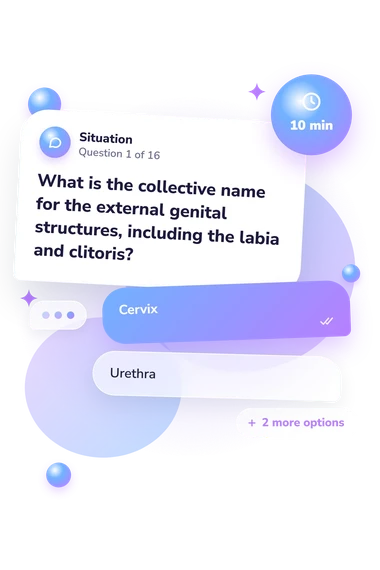
Example Questions From the Test
- Cervix
- Urethra
- Vulva
- Endometrium
- From the ovaries
- From the external labia
- From the lining of the bladder
- From the cervix
- Hormonal changes associated with ovulation
- A loss of the vagina's natural bacteria
- Menstrual blood remaining in the uterus
- Permanent weakening of the vaginal walls
Vagina Quiz - Description and methodology of the test
People who want to check their understanding of anatomy and everyday vaginal-health situations can use this vagina quiz as a practical starting point. It is intended for readers who want clearer terminology, safer hygiene knowledge, and a better sense of when a symptom needs professional assessment. This vaginal health quiz connects anatomy, body changes, hygiene, and decisions about seeking care.
What This Test Measures
Questions test whether readers can distinguish the vagina from the vulva, interpret common discharge variation, and recognize situations requiring caution. They connect anatomy with hygiene, screening, infections, menstrual changes, pregnancy, menopause, the hymen, and retained tampons. This vaginal anatomy quiz tests practical knowledge about anatomy, body changes, and common care situations.
The main result areas are:
- Anatomy and terminology show whether structures and functions are identified.
- Discharge and vaginal environment test recognition of normal variation and warning patterns.
- Hygiene, screening, and infection knowledge cover safer care and testing limits.
- Warning signs and life stages assess responses to pain, pregnancy, menopause, and bleeding.
The result appears as Vagina Knowledge: 0-16: Foundation Building (0-6) signals review needs; Developing Knowledge (7-12) reflects developing understanding; Strong Knowledge (13-16) indicates strong practical understanding. These are educational bands, not validated medical cutoffs.
Methodology and Evidence Base
Each item is a plainly worded multiple-choice question with four answer options. The format checks recognition of anatomy and health information, not a personal history. This vaginal hygiene quiz shows what a reader recognizes from the available choices, while the displayed total summarizes knowledge rather than symptoms.
Its discharge-related content is conceptually consistent with Ilankoon et al. (2017), and its public anatomy focus is consistent with El-Hamamsy et al. (2022). Questions about the hymen also reflect the evidence summarized by Mishori et al. (2019), which challenges using hymenal appearance to infer sexual history. This questionnaire is not an adaptation of those studies.
The displayed total condenses performance across the knowledge questions into one educational result. Prior education, guessing, attention, wording, and current concerns can affect performance, so the score is best read as an educational snapshot. It cannot diagnose a cause of discharge or pain; new, persistent, painful, or concerning discharge warrants medical advice, while fever with worsening symptoms, severe pelvic pain, fainting, heavy bleeding, or possible fluid leakage during pregnancy warrants urgent medical care.
- Ilankoon MPS, Goonewardena CSE, Fernandopulle RC, Perera PP. Women's Knowledge and Experience of Abnormal Vaginal Discharge Living in Estates in Colombo District, Sri Lanka. International Journal of Women's Health and Reproduction Sciences. 2017;5(2):90-96. 10.15296/ijwhr.2017.17
- El-Hamamsy D, Parmar C, Shoop-Worrall S, Reid FM. Public understanding of female genital anatomy and pelvic organ prolapse (POP); a questionnaire-based pilot study. International Urogynecology Journal. 2022;33(2):309-318. 10.1007/s00192-021-04727-9
- Mishori R, Ferdowsian H, Naimer K, Volpellier M, McHale T. The little tissue that couldn't - dispelling myths about the Hymen's role in determining sexual history and assault. Reproductive Health. 2019;16(1):74. 10.1186/s12978-019-0731-8