
Will I Pass a Drug Test Quiz
How the Scales are Structured
Who Usually Takes This Test?
See How You Compare
Below is a preview of how scores are typically distributed across each scale.
Example Questions From the Test
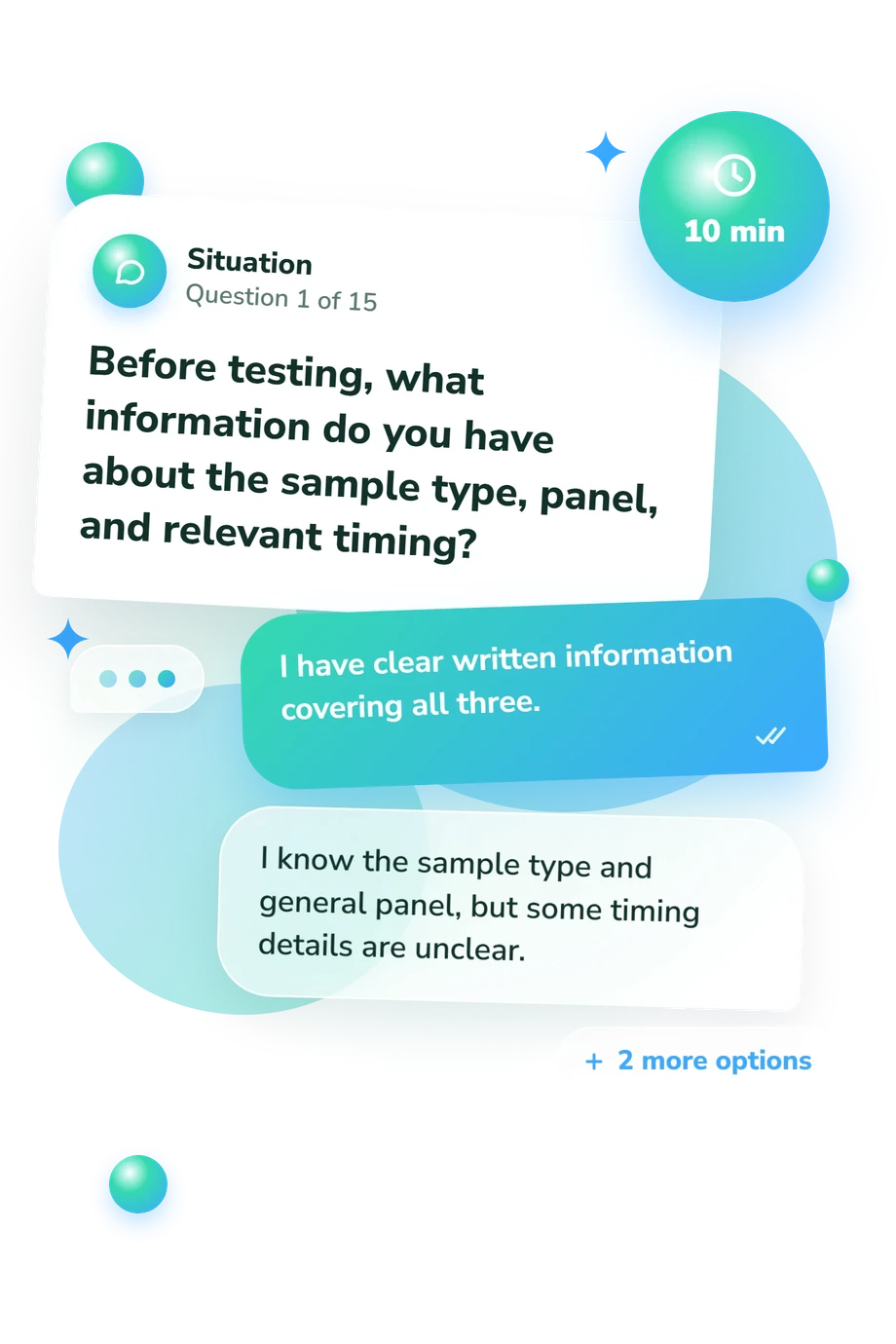
- I have clear written information covering all three.
- I know the sample type and general panel, but some timing details are unclear.
- I know only that a drug test is required, with limited specifics.
- The test details conflict, keep changing, or have not been provided despite an immediate deadline.
- I followed the written instructions, and no collection problem was reported.
- There was a minor deviation, but collection staff documented and accepted it.
- Hydration, timing, storage, or another issue could make the sample inconclusive.
- The sample was altered or substituted, or staff reported it as invalid or possibly adulterated.
- Following the official instructions and asking the authorized provider about uncertainties.
- Reading about shortcuts, but not planning to use one.
- Using an unverified detox product or extreme fluid intake despite uncertain effects.
- Altering or substituting the sample, or taking an unknown product that could endanger me.
Will I Pass a Drug Test Quiz - Description and methodology of the test
People facing an uncertain screening process may use the Will I Pass a Drug Test Quiz to organize what they know, what remains unclear, and support needs. Rather than estimating a pass rate or predicting a drug test result, it helps visitors prepare for testing and consequences by separating exposure, process, and safety concerns. Use it to organize questions for the testing provider or support contact, including during that contact.
What This Assessment Explores
Self-report items address drug testing questions about exposure, timing and ingredient uncertainty, collection, pressure, red-flag symptoms relevant to immediate safety, and reliable support. Four response choices move from documented or lower-concern circumstances toward uncertainty, risk, or a red flag. Results show what merits verification or support, not a passing probability.
The three displayed summaries distinguish these result dimensions:
- Exposure Indicators (0-15) reflects reported exposure: No scored indicator (0), Details to review (1-2), or Prompt action warranted (3-15).
- Safety and Support Needs (0-15) reflects immediate safety, pressure, and support needs; its summary does not diagnose intoxication or measure its severity: No support concern indicated (0), Support worth arranging (1-2), or Prompt support needed (3-15).
- Testing Process Uncertainty (0-15) reflects process uncertainty: Process documented (0-0), Clarification useful (1-2), or Prompt verification warranted (3-15).
These are non-diagnostic, unvalidated summaries; a concerning response matters independently, and one red flag overrides the total.
Methodology and Evidence Base
The result displays three 0-15 summaries with the listed bands; how individual responses contribute to them is unspecified, as are any pass/fail formula or probability. Interpret the bands as prompts for verification or support alongside instructions, timing, product information, collection records, and professional guidance. Only the official result determines the outcome.
Evidence includes the SAMHSA MRO Guidance Manual (2025) on specimen validity, prescription documentation, confirmation, and medical review. Jarvis and colleagues (2017) discuss clinical drug testing, while Moeller, Lee, and Kissack (2008) explain why screens need context and confirmation. This questionnaire is conceptually consistent with these sources, not an adaptation or validated administration.
Drug test preparation means following authorized instructions, not diluting, substituting, or altering a sample; never stop prescribed medicine without medical advice. If impaired, do not drive or operate machinery. Seek urgent or emergency help for trouble breathing, chest pain, severe confusion, inability to stay awake, or immediate danger. Memory, distress, and fear of consequences can affect self-report; use the result to decide what to verify and whom to contact.
- Substance Abuse and Mental Health Services Administration. Medical Review Officer Guidance Manual for Federal Workplace Drug Testing Programs. Rockville, MD: U.S. Department of Health and Human Services; 2025.
- Jarvis Margaret, Williams Jessica, Hurford Matthew, Lindsay Dawn, Lincoln Piper, Giles Leila, Luongo Peter, Safarian Taleen. Appropriate Use of Drug Testing in Clinical Addiction Medicine. Journal of Addiction Medicine. 2017;11(3):163-173. 10.1097/ADM.0000000000000323
- Moeller Karen E, Lee Kelly C, Kissack Julie C. Urine Drug Screening: Practical Guide for Clinicians. Mayo Clinic Proceedings. 2008;83(1):66-76. 10.4065/83.1.66
Updated: