
Guess the Cartoon Character Quiz
How the Scales are Structured
Who Usually Takes This Test?
See How You Compare
Below is a preview of how scores are typically distributed across each scale.
Example Questions From the Test
- Mr. Krabs
- Patrick Star
- Squidward Tentacles
- SpongeBob SquarePants
- Daffy Duck
- Bugs Bunny
- Porky Pig
- Road Runner
- Zuko
- Sokka
- Korra
- Aang
Guess the Cartoon Character Quiz - Description and methodology of the test
People who enjoy animation, comics, games, and memorable fictional personalities can use the Guess the Cartoon Character Quiz to examine how readily visual and story clues bring a name to mind. Its light format suits readers who enjoy a guess-the-cartoon quiz and want casual self-reflection about media familiarity. The result summarizes recognition across eras, genres, and franchises without treating familiarity as a fixed ability.
What This Assessment Explores
The questionnaire asks readers to identify familiar cartoon characters from appearance, catchphrases, settings, relationships, occupations, and plot clues. It suits anyone curious about how contextual details bring a character’s name to mind across animation, comics, anime, films, and games.
Reviewing the guess-the-cartoon-character quiz answers can show which clue types supported a correct choice, while the result summarizes recognition rather than taste.
The result uses these dimensions:
- Cartoon Character Knowledge runs from 0-16: Emerging Spotter (0-6) marks some recognition; Capable Guesser (7-12) marks broad familiarity; Cartoon Connoisseur (13-16) marks reliable identification across eras, genres, and franchises.
- Visual and design recognition shows how appearance details guide identification.
- Narrative and setting recognition shows how story context connects clues to a name.
The bands describe this character set, not general memory or intelligence.
Methodology and Scientific Basis
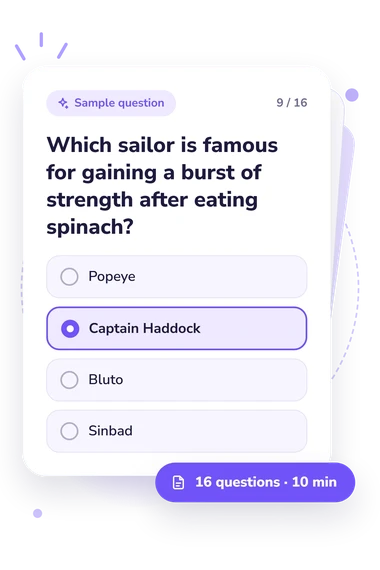
Each item presents a short description or scene followed by four answer choices. Clues may point to a signature object, visual design, catchphrase, companion, occupation, setting, or story role, so the task uses recognition supported by context rather than open-ended naming.
Scoring is direct: one point is awarded for each correct identification, producing the total. The name-the-cartoon quiz format keeps the response clear: select the character that best fits the evidence, even when several options are familiar.
The method is conceptually consistent with Szubielska and Dziopa (2017), whose study examines how children name animal cartoon characters, but this questionnaire is not an adaptation of it. Brédart and Valentine (1998) and Fogler and James (2007) provide related evidence that descriptive information can influence retrieval of proper names, including fictional characters. Those studies support descriptive clues; they do not standardize or validate this questionnaire.
Interpret the score as a snapshot within the selected character set. Franchise exposure, cultural familiarity, attention, and confidence can affect performance. With no supplied normative comparison, the result is best used for focused self-reflection rather than a clinical or general cognitive assessment.
- Szubielska, Magdalena, and Kamila Dziopa. "Mass media and conceptual development: A study of naming animal cartoon characters by children." Psychologia Społeczna, 12(42), 304-318, 2017. 10.7366/1896180020174205
- Brédart, Serge, and Tim Valentine. "Descriptiveness and Proper Name Retrieval." Memory, 6(2), 199-206, 1998. 10.1080/741942072
- Fogler, Kethera A., and Lori E. James. "Charlie Brown Versus Snow White: The Effects of Descriptiveness on Young and Older Adults' Retrieval of Proper Names." The Journals of Gerontology: Series B, 62(4), P201-P207, 2007. 10.1093/geronb/62.4.P201