
Should I Buy It Quiz
How the Scales are Structured
Who Usually Takes This Test?
See How You Compare
Below is a preview of how scores are typically distributed across each scale.
Example Questions From the Test
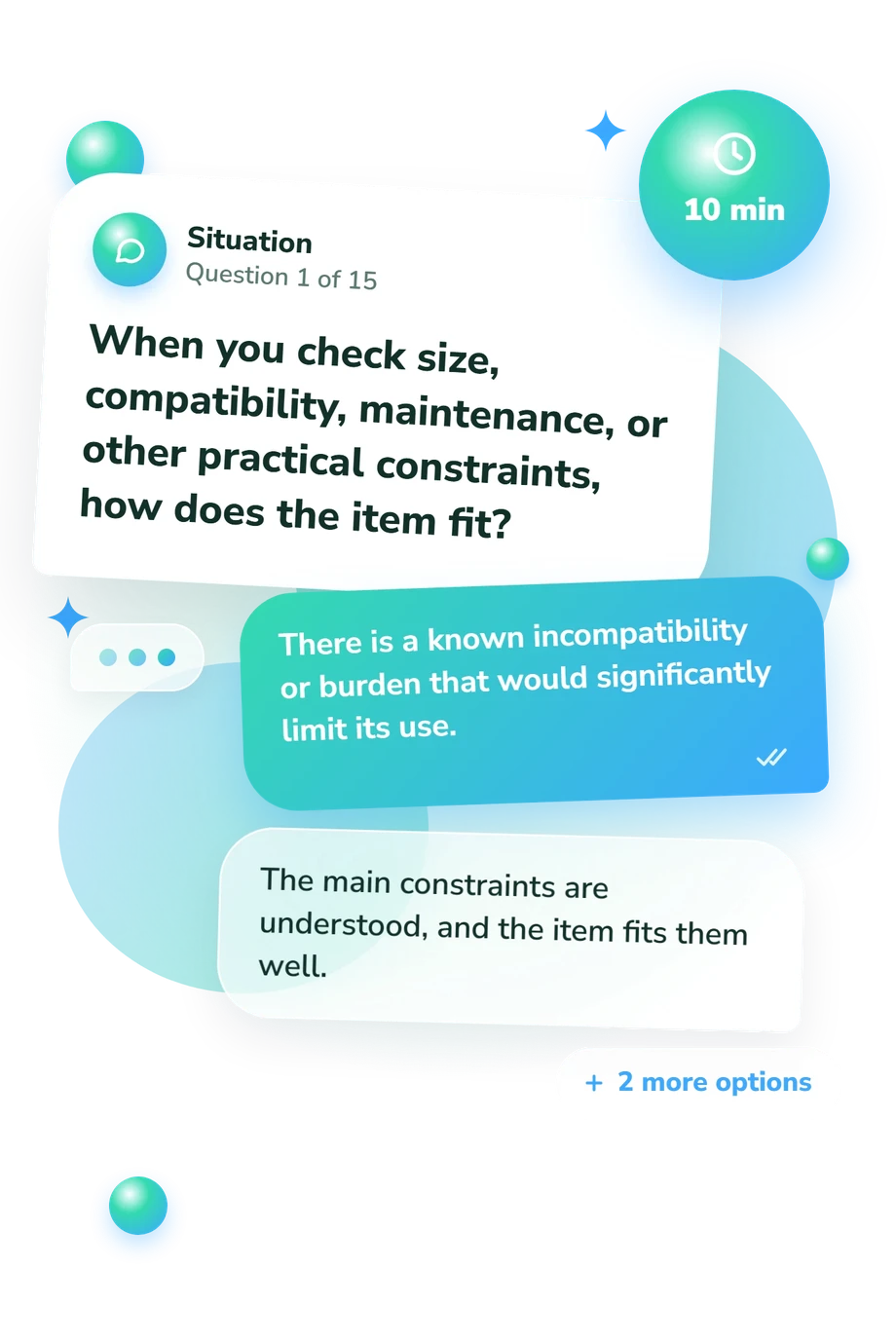
- There is a known incompatibility or burden that would significantly limit its use.
- The main constraints are understood, and the item fits them well.
- A major fit question remains unanswered.
- There is one compromise, but it seems manageable for my intended use.
- The deadline is the main reason I feel tempted to buy.
- I would still want it at its normal price because it meets a clear need.
- The discount makes an optional upgrade feel more appealing.
- I would probably buy it, but I still want to compare the offer with alternatives.
- I would probably lose much of my interest.
- I would still want it for the same practical reasons.
- I would likely want it, though I might reconsider which version to choose.
- Without the deadline or repeated promotion, I would have little reason to act.
Should I Buy It Quiz - Description and methodology of the test
People weighing a practical need against a tempting purchase can use the Should I Buy It Quiz to organize the decision before checkout. It suits shoppers who want to examine fit, affordability, timing, and pressure instead of relying on a first impression. The result is not a command; it highlights what seems settled and what deserves another look. Its should i buy it or not quiz format keeps attention on reasons rather than urgency.
What This Assessment Explores
The question behind a should i buy this quiz is whether the item earns a place in your routine, budget, and priorities. Items cover compatibility, expected use, existing alternatives, total cost, competing priorities, purchase terms, and promotional pressure. The profile separates practical value from financial strain and urgency.
The result reports three dimensions:
- Decision Confidence and Timing (0-15) reflects whether the choice is informed, stable, and deliberate: Unresolved Decision 0-5; Emerging Confidence 6-10; Well-Timed Decision 11-15.
- Financial Comfort and Tradeoffs (0-15) reflects whether the full cost fits current priorities: Significant Tradeoff 0-5; Conditional Comfort 6-10; Comfortable Fit 11-15.
- Need and Practical Fit (0-15) reflects whether the item solves a real problem and matches expected use: Weak Fit 0-5; Partial Fit 6-10; Strong Fit 11-15.
Taken together, the dimensions show where a decision needs clarification before action.
Methodology and Evidence Base
Each item presents a purchase situation with four response options, from clear fit or confidence to unresolved concerns, pressure, or tradeoffs. You select the statement closest to your circumstances. As a buying decision quiz, the tool aggregates choices into three displayed scores; the result description gives the bands, but not a point-by-point weighting formula.
Conceptually, it is consistent with Heitmann et al. (2007), which connects decision goals with satisfaction after a choice. Bearden, Hardesty, and Rose (2001) support consumer self-confidence, while the CFPB Financial Well-Being Scale offers a reference for spending within broader priorities. Rook and Fisher (1995) help explain how promotional urgency and normative pressure can influence impulsive buying. These sources support the constructs, not authorship of this online questionnaire.
Interpret the profile as a structured snapshot. A lower band identifies a dimension to review; a higher band indicates stronger alignment with the measured criteria. Scores can shift with finances, needs, alternatives, or mood. Self-report allows response bias and limited self-awareness; no norms or independently established clinical cutoffs are stated, so wider circumstances still matter.
- Heitmann, Mark, Donald R. Lehmann, and Andreas Herrmann. (2007). Choice Goal Attainment and Decision and Consumption Satisfaction. Journal of Marketing Research, 44(2), 234-250. 10.1509/jmkr.44.2.234
- Bearden, William O., David M. Hardesty, and Randall L. Rose. (2001). Consumer Self-Confidence: Refinements in Conceptualization and Measurement. Journal of Consumer Research, 28(1), 121-134. 10.1086/321951
- Consumer Financial Protection Bureau. (2017). CFPB Financial Well-Being Scale: Scale Development Technical Report. Consumer Financial Protection Bureau.
- Rook, Dennis W., and Robert J. Fisher. (1995). Normative Influences on Impulsive Buying Behavior. Journal of Consumer Research, 22(3), 305-313. 10.1086/209452
Updated: