
Object Oriented Programming Quiz
How the Scales are Structured
Who Usually Takes This Test?
See How You Compare
Below is a preview of how scores are typically distributed across each scale.
Example Questions From the Test
- Singleton
- Factory Method
- Template Method
- Decorator
- Establishing the object's initial state and required dependencies
- Choosing which overridden method will run at compile time
- Granting every other class direct access to internal fields
- Destroying the object when it is no longer referenced
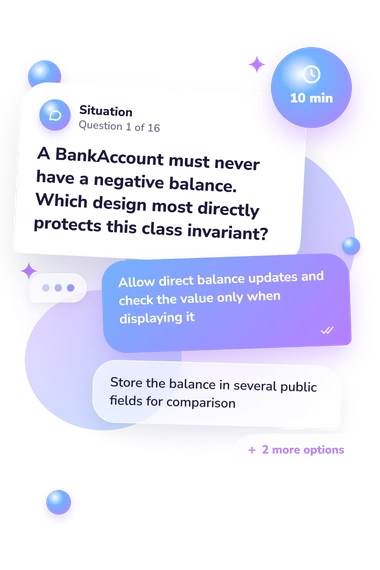
- Make OrderService depend on an injected repository abstraction
- Move all OrderService methods into SqlOrderRepository
- Create the repository in a static global variable
- Let SqlOrderRepository inherit from OrderService
Object Oriented Programming Quiz - Description and methodology of the test
People learning software design can use the object oriented programming quiz to check whether their understanding transfers from definitions to practical choices. It suits beginners, students, and developers reviewing fundamentals who want a focused picture of their recognition of OOP principles and selection of suitable design choices in scenarios. The oop quiz scenarios connect OOP terminology with design trade-offs, showing how familiar principles guide choices under constraints.
What This Assessment Explores
As an object oriented quiz, it tests whether a learner can recognize sound design choices in short programming scenarios. Items cover classes and state, constructors, identity versus value equality, encapsulation, abstraction, inheritance, polymorphism, composition, dependency direction, interface segregation, substitutability, immutability, extensibility, and patterns. Practical problems-protecting invariants, replacing infrastructure, or adding formats-make the result reflect applied judgment as well as terminology.
The single reported scale is Object-Oriented Programming Knowledge (0-16), interpreted through these bands:
- Foundations to Build (0-6) indicates that core definitions and object relationships need review.
- Developing Knowledge (7-12) shows understanding of many principles, with some design scenarios needing practice.
- Strong Knowledge (13-16) reflects a reliable grasp of concepts and practical design choices.
The result describes performance on these concepts, not general programming ability or all of software engineering.
Methodology and Scientific Basis
Each item presents a short scenario or principle with four answer choices. The task is to select the best design decision, such as injecting an abstraction, favoring composition, protecting an invariant, or using dynamic dispatch. Across the oops quiz questions and answers, respondents choose the principle or design decision that best fits each scenario.
The method is a scenario-based, single-best-answer multiple-choice questionnaire, not a personality or clinical measure. The questionnaire reports the displayed total and its defined result bands, and no additional weighting or point rule is established.
Conceptually, the content is consistent with Gamma et al. (1994), especially its treatment of reusable design solutions, and with Martin’s SOLID principles. Booch et al. (2007) supports the focus on objects, responsibilities, relationships, and design models; Gamma et al. (1993) adds a complementary account of abstraction and reuse. This questionnaire is consistent with those works, not an adaptation or validation of them.
Prior exposure, terminology, guessing, and chosen examples can affect performance. The score reflects performance on the tested OOP concepts, with interpretation shaped by those factors.
- Gamma, Erich, Richard Helm, Ralph Johnson, and John Vlissides. Design Patterns: Elements of Reusable Object-Oriented Software. Addison-Wesley Professional, 1994. ISBN 978-0-201-63361-0.
- Martin, Robert C. Agile Software Development: Principles, Patterns, and Practices. Prentice Hall, 2002. ISBN 978-0-13-597444-5.
- Booch, Grady, Robert A. Maksimchuk, Michael W. Engle, Bobbi J. Young, Jim Conallen, and Kelli A. Houston. Object-Oriented Analysis and Design with Applications. 3rd ed. Addison-Wesley Professional, 2007. ISBN 978-0-201-89551-3.
- Gamma, Erich, Richard Helm, Ralph E. Johnson, and John Vlissides. Design Patterns: Abstraction and Reuse of Object-Oriented Design. In ECOOP '93 - Object-Oriented Programming, Lecture Notes in Computer Science, vol. 707, pp. 406-431. Springer, 1993. 10.1007/3-540-47910-4_21.
Updated: