
Should I Shave My Head Quiz
How the Scales are Structured
Who Usually Takes This Test?
See How You Compare
Below is a preview of how scores are typically distributed across each scale.
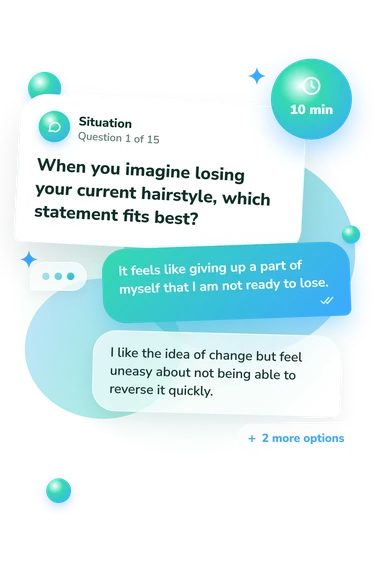
Example Questions From the Test
- It feels like giving up a part of myself that I am not ready to lose.
- I like the idea of change but feel uneasy about not being able to reverse it quickly.
- I have some attachment to my hair, yet I can picture myself without it.
- My sense of self feels flexible enough to include a shaved look.
- I have not considered the method, tools, length, or person doing it.
- I would probably use whatever option was easiest at the moment.
- I have a likely method but still need to confirm a few details.
- I know whether I would use a barber or suitable tools, what length I want, and when I would do it.
- I would decline because the idea does not feel real enough yet.
- I might agree for the spontaneity or the story.
- I would pause to picture the result and decide whether my interest holds up.
- I would feel ready because I have already made the choice for my own reasons.
Should I Shave My Head Quiz - Description and methodology of the test
For anyone weighing a dramatic appearance change, the Should I Shave My Head Quiz offers a structured way to examine the reasons behind that impulse before acting. It suits people who want to separate personal preference from outside pressure and think through the emotional and practical consequences of a shaved look. As a shaved head decision quiz, it shows where readiness is stronger and where more reflection may help.
What This Assessment Explores
The questions cover attachment to a familiar appearance, social reactions, waiting, regrowth, scalp exposure, timing, and unexpected results. They suit people considering a major change in presentation, including those exploring head shaving readiness.
The result has three dimensions:
- Change Comfort, 0-15, measures tolerance for a visibly different look and adjustment. Strong Attachment 0-5, Mixed but Open 6-10, Change-Ready 11-15.
- Motivation Clarity, 0-15, shows whether the wish is temporary, exploratory, or settled. Passing Interest 0-5, Active Curiosity 6-10, Clear Personal Choice 11-15.
- Practical Preparedness, 0-15, reflects plans for technique, upkeep, scalp care, timing, and surprises. Details Unsettled 0-5, Partly Prepared 6-10, Plan in Place 11-15.
Read together, the dimensions show whether interest, adaptability, and preparation align.
Methodology and Evidence Base
Each item describes a situation and offers four ordered responses, moving from uncertainty or outside influence toward clearer choice and preparation. Choosing the closest statement makes this a self-report format combining emotional reactions and practical scenarios.
Scores form three dimensions rather than one recommendation. The displayed ranges describe tendencies, but the contribution of each response to a scale is not specified; do not infer scoring from response order. Motivation can be strong while preparation remains incomplete.
Kose et al. (2016) provide the closest subject-specific context through research on hair shaving and body image; this questionnaire is conceptually consistent with that work, not an adaptation of its protocol. Anastasiades et al. (2026) address self-defined appearance and satisfaction, while Newton-Fenner et al. (2025) connect hair and scalp experiences with psychological wellbeing. Together, these studies offer related context for hair, appearance, and wellbeing; they do not validate or standardize this questionnaire or establish how it is scored.
Interpret the profile as a snapshot shaped by mood, social pressure, self-awareness, and regrowth expectations. It cannot predict satisfaction or decide for you; pause if your scalp is injured or irritated. Consider all scores as part of your head shaving decision.
- Kose, Gulsah, Sevinc Tastan, Murat Kutlay, and Orhan Bedir. "The effects of different types of hair shaving on the body image and surgical site infection in elective cranial surgery." Journal of Clinical Nursing 25, no. 13-14 (2016): 1876-1885. 10.1111/jocn.13149
- Anastasiades, Elly, Jennifer Todd, Elizabeth Kirk, and Viren Swami. "I don't care what you like, when I look in the mirror, I need to be happy": A qualitative study of hair-related positive body image. Body Image 58 (2026): 102136. 10.1016/j.bodyim.2026.102136
- Newton-Fenner, Alice, William M. Hirst, Therese Jones, Margaret Scott, Carl Roberts, Monique A. M. Smeets, Jeremy Shen, Anna Thomas, and Timo Giesbrecht. "Development of the Hair & Scalp CARE questionnaire: Measuring the impact of hair and scalp issues on psychological wellbeing in healthy populations." International Journal of Cosmetic Science 47, no. 5 (2025): 807-819. 10.1111/ics.13070
Updated: