
Would I Date You Quiz
How the Scales are Structured
Who Usually Takes This Test?
See How You Compare
Below is a preview of how scores are typically distributed across each scale.
Example Questions From the Test
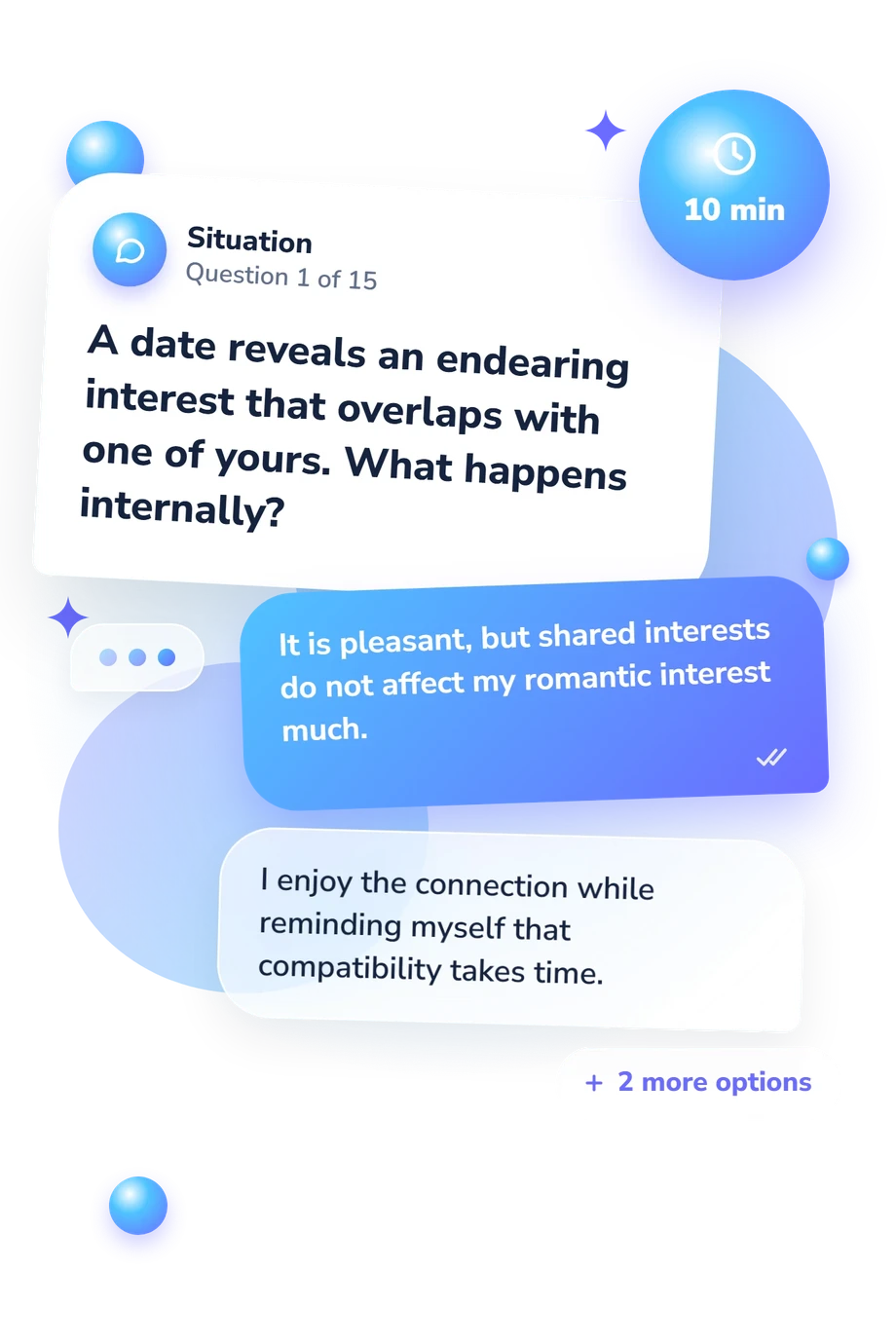
- It is pleasant, but shared interests do not affect my romantic interest much.
- I enjoy the connection while reminding myself that compatibility takes time.
- I feel an immediate lift and become more excited about dating them.
- It mainly makes me imagine enjoying that interest together as friends.
- Make plans for a second date while the energy is still fresh.
- See each other again, preferably in a relaxed group setting.
- Exchange warm messages first and decide within a day or two.
- Keep the connection friendly rather than plan another date.
- Try two or three more dates and notice whether attraction grows.
- Meet once more for something brief before deciding.
- Only see them again if it happens naturally in a group.
- Decline another date because I usually trust my first reaction.
Would I Date You Quiz - Description and methodology of the test
People deciding whether to pursue another date, slow the pace, or preserve a connection as friendship can use the Would I Date You Quiz as a structured prompt. It helps anyone examine a next step when attraction is unclear, momentum is uneven, or boundaries matter. As a romantic self-reflection tool, it turns everyday choices about follow-up, boundaries, and momentum into a profile for reflection.
What This Assessment Explores
The assessment examines how you interpret attraction and choose what to do next, rather than rating desirability. Scenarios cover first dates, texting, conflicting goals, follow-up, changing chemistry, and when warmth feels platonic. Anyone reflecting on dating decisions can use the result to notice responses to potential romantic connections, not to judge desirability.
The profile includes:
- Better as Friends (0-15) reflects platonic affinity: Romance-Oriented Fit (0-5) favors romance, Context-Dependent Fit (6-10) weighs circumstances, and Strong Platonic Fit (11-15) favors friendship.
- Curious Maybe (0-15) reflects gradual attraction: Quick Resolution (0-5) seeks certainty, Selective Curiosity (6-10) allows development, and Strong Slow-Burn Affinity (11-15) needs context.
- Enthusiastic Yes (0-15) reflects romantic momentum: Little Immediate Pull (0-5) signals low urgency, Interest Building (6-10) grows through interaction, and Clear Romantic Momentum (11-15) welcomes forward movement.
The highest score is strongest; results within one point blend.
Methodology and Evidence Base
The items form brief self-report vignettes around follow-up, changing chemistry, friendship, and romantic momentum, with four response options. Each option presents a way to handle the situation: act quickly, gather context, allow friendship, or pursue romantic momentum. As a romantic chemistry quiz, it emphasizes how attraction is recognized and acted on, not a fixed trait. Scoring compares three totals; response weights are unspecified, so choices should not be reverse-engineered into points.
The questionnaire is conceptually consistent with Campbell et al. (2018), which treats interpersonal chemistry as relevant to both friendship and romance. Reeder (2000) distinguishes liking from romantic attraction, while Lowey (2022) adds context for relationships beginning through friendship. It is not an adaptation of any one of these sources.
Interpret the profile as a snapshot of preferences and decision habits. Mood, expectations, dating context, and self-awareness can influence self-report. It is an online self-reflection questionnaire, and its scoring is not standardized, so the displayed bands are descriptive categories, not population norms or diagnostic cutoffs.
- Kelly Campbell, Jessie Nelson, Michele L. Parker, and Silvana Johnston (2018). Interpersonal chemistry in friendships and romantic relationships. Interpersona: An International Journal on Personal Relationships, 12(1), 34-50. 10.5964/ijpr.v12i1.289
- Heidi Reeder (2000). 'I like you... as a friend': The role of attraction in cross-sex friendship. Journal of Social and Personal Relationships, 17(3), 329-348. 10.1177/0265407500173002
- Erin Lowey (2022). Friends-first romantic relationship initiation. Master's thesis, University of Victoria.
Updated: