
Skater Quiz
How the Scales are Structured
Who Usually Takes This Test?
See How You Compare
Below is a preview of how scores are typically distributed across each scale.
Example Questions From the Test
- Use it only for lower-speed skating
- Keep using it as long as the straps remain attached
- Add padding inside it to restore impact protection
- Replace it because impact damage may not be visible
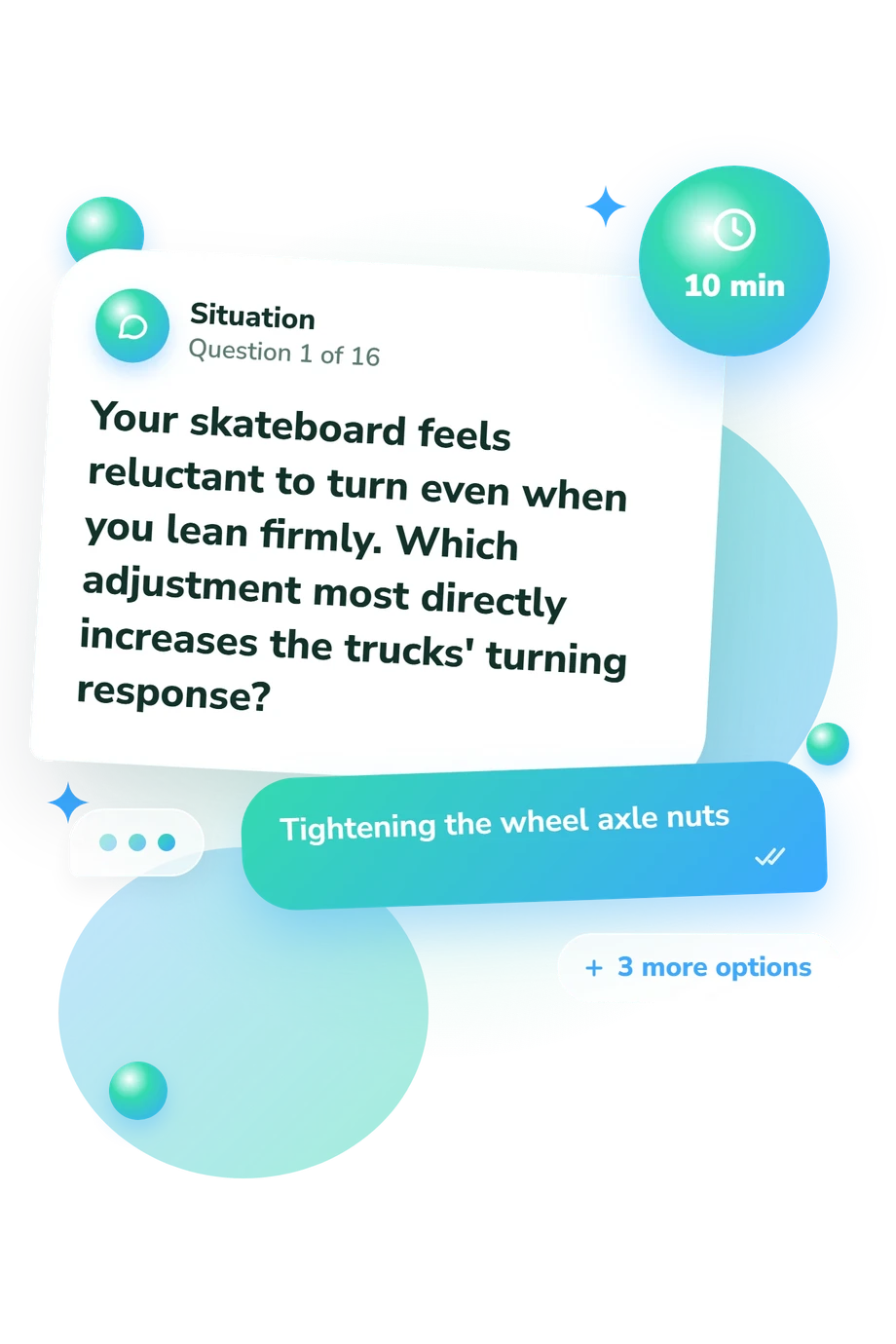
- A larger wheel diameter
- A heavier wheel core
- A wider contact patch
- A harder wheel compound
- They keep dirt from entering the wheel bearings
- They compress during leaning and influence how the trucks turn
- They attach the grip tape to the deck
- They prevent wheels from moving along the axles
Skater Quiz - Description and methodology of the test
Curious beginners and recreational riders may find this skater quiz useful before a first session, after a break, or when preparing for more deliberate practice. It gives readers a structured way to decide where preparation needs attention without requiring them to demonstrate skills on a board. For this skateboard quiz, the result can guide preparation by showing whether to revisit fundamentals before attempting more demanding situations.
What This Assessment Explores
The questions examine practical recognition rather than physical performance. They cover board components, truck adjustments, wheel properties, stance, movement, obstacles, park features, trick mechanics, and choices that reduce avoidable risk. This skateboard knowledge test checks whether terminology and basic cause-and-effect relationships are familiar before a reader practices them on a board.
Scores are reported on the Skateboarding Knowledge scale (0-16), with three result bands:
- Foundation to Build (0-6) indicates that some basics are recognized, while board parts, riding terms, and safety principles need review.
- Developing Knowledge (7-12) shows that many core concepts are understood, with gaps remaining in technique, setup, or terminology.
- Strong Knowledge (13-16) reflects broad command of practical skateboarding concepts, but it does not measure riding skill or guarantee safe execution.
Methodology and Evidence Base
Each item offers four answer choices and asks the respondent to identify the most appropriate explanation, adjustment, technique, or safety response. The skateboarding test therefore uses a knowledge-oriented format rather than observed riding performance. The result reports a total on the displayed scale; it should not be read as a measure of riding fluency.
Conceptually, the content is consistent with the instructional treatment of equipment, technique, and terminology in Welinder and Pete Whitley (2012); it is not presented as an adaptation of that work.
Safety items align with CPSC guidance, while ASTM F1492-25 supplies a relevant helmet-safety standard. CPSC guidance supports replacing a helmet after a hard impact and avoiding wet surfaces; ASTM F1492-25 addresses helmet performance.
The questionnaire is an online educational knowledge check. Its displayed result is best used to choose topics for further review rather than to infer actual riding skill. Prior exposure, reading interpretation, memory, and current attention can affect performance, while successful riding also depends on balance, timing, and control.
- Welinder, Per, and Peter Whitley. Mastering Skateboarding. Human Kinetics, 2012. 272 pp. ISBN 978-0-7360-9599-0.
- U.S. Consumer Product Safety Commission. Skateboarding Safety. Publication 93, 2012.
- ASTM International. Standard Specification for Helmets Used in Skateboarding and Trick Roller Skating, ASTM F1492-25. ASTM International, 2025. 10.1520/F1492-25
Updated: