
Guess the Picture Quiz
How the Scales are Structured
Who Usually Takes This Test?
See How You Compare
Below is a preview of how scores are typically distributed across each scale.
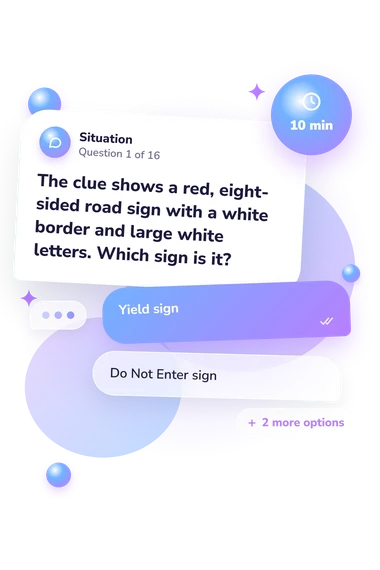
Example Questions From the Test
- Yield sign
- Do Not Enter sign
- Railroad crossing sign
- Stop sign
- Bangladesh
- Japan
- Indonesia
- Palau
- Okapi
- Zebra
- Striped hyena
- African wild donkey
Guess the Picture Quiz - Description and methodology of the test
People curious about everyday visual knowledge can use this guess the picture quiz as a focused self-check of how they recognize familiar subjects from distinctive details. It is suited to anyone who enjoys identifying what an image represents without requiring specialist knowledge. Presented as a trivia quiz in which you guess the picture, it keeps the purpose practical and easy to follow.
What This Assessment Explores
The clues sample features that make signs, foods, objects, animals, landmarks, and natural events identifiable. Respondents move from color, shape, texture, or a partial view to a named answer, so the result reflects visual knowledge rather than artistic skill. Each item becomes a get the picture quiz: respondents infer a subject from incomplete information and narrow four choices.
The main groups are:
- Signs and flags show recognition of familiar symbols.
- Foods, plants, and animals show how visual features guide identification.
- Landmarks and objects show whether structure supports recognition.
- Weather and natural phenomena show how patterns identify events.
Guess the Picture Knowledge ranges from 0-16: Emerging Recognizer (0-6) reflects missed distinctive details; Developing Recognizer (7-12) reflects many recognized clues; Sharp Recognizer (13-16) reflects consistent feature matching. The result describes performance on this set, not a fixed ability.
Methodology and Scientific Basis
Each item presents a visual clue with four choices. Selecting the best match tests recognition, naming, and forced-choice judgment. The result is presented through one overall knowledge scale, with three interpretation bands shown to the respondent.
The questionnaire is conceptually consistent with the Birmingham Object Recognition Battery, a published instrument for object-recognition performance, but it is distinct from that battery. Its broader mix of signs, food, wildlife, architecture, tools, and natural events makes it a visual knowledge exercise.
Richler and colleagues' work on individual differences in object recognition shows why this ability can be studied, while Snodgrass and Vanderwart's picture-recognition research demonstrates the importance of familiarity, naming agreement, and visual complexity. These studies provide context for object recognition and picture familiarity rather than establishing this questionnaire's validity or norms.
Rather than memorizing trivia quiz answers, respondents guess the picture from each clue. Attention, familiarity, cultural exposure, image clarity, and current context can affect performance, so one result cannot establish a diagnosis or stable trait.
- Riddoch, Jane M., and Glyn W. Humphreys. BORB: Birmingham Object Recognition Battery. Hove, UK: Lawrence Erlbaum Associates, 1993. ISBN 086377315X.
- Richler, Jennifer J., Andrew J. Tomarken, Mackenzie A. Sunday, Timothy J. Vickery, Kaitlin F. Ryan, R. Jackie Floyd, David Sheinberg, Alan C.-N. Wong, and Isabel Gauthier. Individual Differences in Object Recognition. Psychological Review, 126(2), 226-251, 2019. 10.1037/rev0000129.
- Snodgrass, Joan Gay, and Mary Vanderwart. A standardized set of 260 pictures: Norms for name agreement, image agreement, familiarity, and visual complexity. Journal of Experimental Psychology: Human Learning and Memory, 6(2), 174-215, 1980. 10.1037/0278-7393.6.2.174.