
Confined Space Quiz
How the Scales are Structured
Who Usually Takes This Test?
See How You Compare
Below is a preview of how scores are typically distributed across each scale.
Example Questions From the Test
- Stop or relocate the exhaust source and position the blower intake where it draws verified clean air.
- Reduce the blower speed to limit the amount of exhaust entering the space.
- Keep the arrangement but rely on the entrant’s sense of smell and gas monitor.
- Move the blower farther into the space so it pushes contaminated air toward the opening.
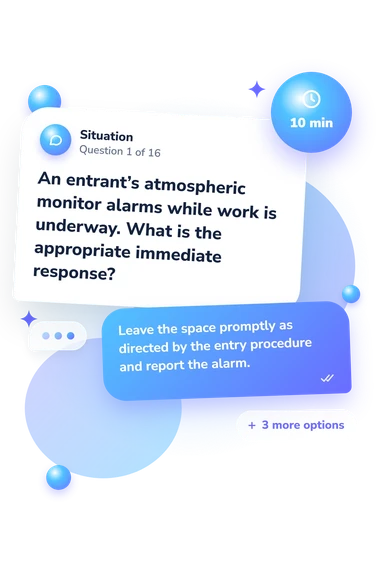
- Leave the space promptly as directed by the entry procedure and report the alarm.
- Silence the alarm and continue long enough to confirm whether symptoms appear.
- Move to another part of the space and wait for the reading to stabilize.
- Finish the current task if the ventilation system still appears to be operating.
- Toxic contaminants, oxygen, and then combustible gases or vapors
- Combustible gases or vapors, toxic contaminants, and then oxygen
- Oxygen, combustible gases or vapors, and then toxic contaminants
- The order does not matter as long as each test is completed once
Confined Space Quiz - Description and methodology of the test
Workers, supervisors, students, and others preparing for permit-required entry can use this confined space quiz to examine how they reason about hazards. The questionnaire functions as a confined space awareness quiz through practical decisions rather than personal traits: recognizing unsafe conditions, selecting controls, following roles, and responding when conditions or communication change. Its overall score indicates understanding of core entry principles, while question themes point to subjects for review within the workplace program.
What This Assessment Explores
The questionnaire presents scenarios involving ventilation, atmospheric testing, engulfment, isolation, permits, assigned roles, communication, coordination, and rescue. It suits people learning or reviewing entry principles; the items assess safe-decision recognition, not authorization or hands-on competence.
The question groups show the areas being tested:
- Hazard recognition identifies unsafe atmospheres, engulfment, and changing conditions.
- Entry controls connect permits, isolation, ventilation, and testing.
- Assigned roles clarify entrant, attendant, communication, and coordination duties.
- Emergency decisions show responses to alarms, exits, and designated rescue arrangements.
Confined Space Knowledge runs from 0-16. Foundation to build covers 0-6; Developing knowledge covers 7-12; Strong foundation covers 13-16. These bands describe answer knowledge, not certification or permission to enter.
For people reviewing procedures, this confined space safety quiz identifies topics for targeted study; employer procedures, site conditions, and jurisdictional requirements govern actual work.
Methodology and Scientific Basis
Each item offers four answer choices built around a workplace decision. Options cover stopping an exhaust source, testing oxygen before other hazards, maintaining an attendant, reassessing controls when welding begins, or arranging non-entry rescue. It is scenario-based multiple-choice, without observation or a practical skills demonstration.
The result presents one overall knowledge score with the displayed bands; question themes indicate subjects for review rather than separate topic results. As a confined space training quiz, this questionnaire can highlight knowledge to revisit, but performance reflects knowledge shown in responses, not competence.
The content is conceptually consistent with the OSHA 1910.146 Standard, which sets permit-space responsibilities and controls. It also aligns with NIOSH Publication 86-110 and Manwaring and Conroy (1990) on hazard recognition, prevention, and rescue planning. This questionnaire is not a published adaptation or independently validated version of those works.
This online version has no stated standardization or normative reference. Attention, prior instruction, self-awareness, and current context can affect answers. Use the result to guide review of the entry program, site-specific hazards, and emergency arrangements; if conditions become unacceptable or communication fails, follow the established exit procedure.
- Occupational Safety and Health Administration. Permit-required confined spaces, 29 C.F.R. § 1910.146. U.S. Department of Labor, 1993.
- National Institute for Occupational Safety and Health. Request for Assistance in Preventing Occupational Fatalities in Confined Spaces (NIOSH Publication No. 86-110). U.S. Department of Health and Human Services, 1986. 10.26616/NIOSHPUB86110
- Manwaring, Jan C., and Carol Conroy. Occupational confined space-related fatalities: Surveillance and prevention. Journal of Safety Research, 21(4), 157-164, 1990. 10.1016/0022-4375(90)90023-5
Updated: