
What Period Product Should I Use Quiz
How the Scales are Structured
Who Usually Takes This Test?
See How You Compare
Below is a preview of how scores are typically distributed across each scale.
Example Questions From the Test
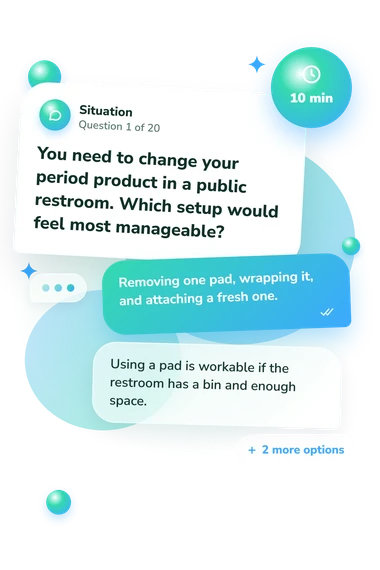
- Removing one pad, wrapping it, and attaching a fresh one.
- Using a pad is workable if the restroom has a bin and enough space.
- I could manage a pad, but carrying and disposing of several would be inconvenient.
- I would rather manage a compact internal product or change nothing attached to my underwear.
- Very important, and I am willing to wash and store a reusable cup.
- Important enough to accept some extra cleaning and maintenance.
- Somewhat important, but convenience usually takes priority.
- Not a major factor in my period-product decision.
- A compact internal absorbent product that can be replaced afterward.
- A tampon would be practical, although I might use it mainly for swimming.
- I could try a tampon, but insertion or removal would remain a concern.
- I would choose another swim-compatible option or adjust my plans rather than use a tampon.
What Period Product Should I Use Quiz - Description and methodology of the test
For anyone weighing comfort, privacy, activity, cleaning, and changing routines, this period product quiz helps compare practical trade-offs across five product profiles. It is useful when you are unsure where to start or want to see how each profile relates to your habits. The What Period Product Should I Use Quiz turns those comparisons into a structured result.
What This Assessment Explores
Questions cover trade-offs-public-restroom changes, swimming, sleep, flow, insertion, cleaning, laundry, and activity. This menstrual product comparison helps people weigh formats by comfort and routine, including those comparing tampons with pads alongside cups, discs, and period underwear.
The five result scales and their displayed bands are:
- Menstrual Cups (0-12) shows how reuse, cleaning, insertion, removal, and technique align; bands: Lower affinity 0-4; Possible fit 5-8; Strong fit 9-12.
- Menstrual Discs (0-12) shows how high placement, removal, and low-profile collection align; bands: Lower affinity 0-4; Possible fit 5-8; Strong fit 9-12.
- Pads (0-12) shows how external coverage, comfort, and easy changes align; bands: Lower affinity 0-4; Possible fit 5-8; Strong fit 9-12.
- Period Underwear (0-12) shows how washable protection, absorbency, changes, and laundry align; bands: Lower affinity 0-4; Possible fit 5-8; Strong fit 9-12.
- Tampons (0-12) shows how insertion, timing, activity, and sensation align; bands: Lower affinity 0-4; Possible fit 5-8; Strong fit 9-12.
Methodology and Evidence Base
The questionnaire presents 20 situations with four answer choices. Each response reflects comfort, access, maintenance, or activity preferences, not a point on one compatibility continuum. Items address reusable care, internal placement, external comfort, replacement timing, absorbency, privacy, travel, and laundry.
Results summarize product-specific preferences. Ranges and bands describe relative fit within this questionnaire; they do not establish a universal scoring rule or clinical cutoff. The tampons-versus-pads decision is considered alongside cups, discs, and period underwear, letting readers compare period product options through routine, access, comfort, and activity.
The questionnaire is conceptually consistent with product-use studies: Medina-Perucha et al. (2022) offers the closest comparison of reusable and non-reusable perceptions. Masvawure and Durodola address disc acceptability; van Eijk et al. (2019) review cup use; VanLeeuwen and Torondel examine reusable underwear. These studies do not validate its scores or serve as its source instrument.
The tool is an unvalidated self-report summary. Answers may shift with current flow, experience, privacy, self-awareness, or social desirability. Compare the five product-specific bands as separate signals: a stronger result for one category does not cancel a possible fit in another.
- Medina-Perucha L, López-Jiménez T, Holst AS, Jacques-Aviñó C, Munrós-Feliu J, Martínez-Bueno C, Valls-Llobet C, Pinzón Sanabria D, Vicente-Hernández MM, Berenguera A. Use and perceptions on reusable and non-reusable menstrual products in Spain: A mixed-methods study. PLOS ONE. 2022;17(3):e0265646. 10.1371/journal.pone.0265646
- Masvawure TB, Durodola R. "The Disc Will Always Win!": Qualitative Pilot Study Findings on the Acceptability of Reusable Menstrual Products Among College Students on a U.S. Campus. American Journal of Health Promotion. 2026; online ahead of print: 8901171261469375. 10.1177/08901171261469375
- van Eijk AM, Zulaika G, Lenchner M, Mason L, Sivakami M, Nyothach E, Unger H, Laserson K, Phillips-Howard PA. Menstrual cup use, leakage, acceptability, safety, and availability: A systematic review and meta-analysis. The Lancet Public Health. 2019;4(8):e376-e393. 10.1016/S2468-2667(19)30111-2
- VanLeeuwen C, Torondel B. Exploring menstrual practices and potential acceptability of reusable menstrual underwear among a Middle Eastern population living in a refugee setting. International Journal of Women's Health. 2018;10:349-360. 10.2147/IJWH.S152483