
Chinese New Year Quiz
How the Scales are Structured
Who Usually Takes This Test?
See How You Compare
Below is a preview of how scores are typically distributed across each scale.
Example Questions From the Test
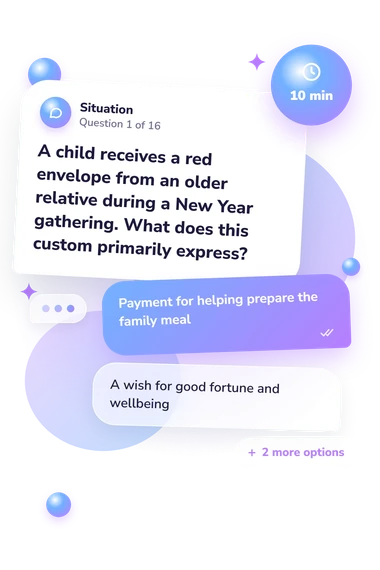
- Payment for helping prepare the family meal
- A wish for good fortune and wellbeing
- A formal invitation to lead next year’s celebration
- Repayment of a symbolic family debt
- Five years
- Ten years
- Twelve years
- Sixty years
- The day of the spring equinox
- The morning after the Lantern Festival
- New Year’s Eve, for the reunion dinner
- The seventh evening of the first lunar month
Chinese New Year Quiz - Description and methodology of the test
Curious learners, families, and celebrants can use this lunar new year quiz to connect familiar customs with the meanings behind them. The chinese new year quiz is intended for anyone who wants a focused way to review the festival’s calendar, foods, symbols, stories, and regional variation. Its result indicates which areas feel familiar and which invite further learning.
What This Assessment Explores
The assessment checks cultural knowledge rather than identity. It links the festival’s calendar with reunion meals, cleaning customs, red envelopes, decorations, zodiac cycles, foods, stories, and the Lantern Festival. Questions in this quiz about Chinese New Year ask the respondent to connect timing, language, ritual, and meaning.
Regional and family variation matters, so a different custom is not automatically an error. The result shows familiarity with widely observed traditions and meanings. The Chinese New Year Knowledge scale runs from 0-16 correct answers and uses these bands:
- Foundations to Build (0-6) shows recognition of some elements and topics to learn.
- Developing Knowledge (7-12) reflects major traditions, with finer distinctions and regional context to explore.
- Strong Knowledge (13-16) indicates a broad grasp of widely observed customs and meanings.
This educational score does not measure cultural identity.
Methodology and Evidence Base
Each item presents a situation or knowledge question with four answer choices. The respondent selects one option, and the total reflects the number of correct answers. This is a direct educational knowledge assessment, not a psychological trait model.
The four-choice structure can work for a quiz for kids about Chinese New Year, although younger readers may need help with vocabulary. Families can also discuss why an answer fits, rather than treating unfamiliarity as a personal shortcoming.
Its cultural framing is conceptually consistent with White and Leung (2015). Aijmer (2003) and Crump (2008) add historical and comparative context for chronology, rituals, symbols, and regional variation, while Laamann (2005) reviews Aijmer’s study. These works support the subject matter; they do not show that this online questionnaire is a standardized adaptation of a published instrument.
No standardization framework, population norms, reliability estimate, or clinical cutoff is stated. Familiarity may reflect teaching, family practice, media exposure, or regional background, and self-report answers can be affected by memory and current context. Read the result as a focused snapshot of cultural knowledge, with traditions understood as varied rather than fixed.
- White, Leanne, and Daniel Leung. Wishing You Good Health, Prosperity and Happiness: Exploring the Rituals and Traditions of Chinese New Year. In Rituals and Traditional Events in the Modern World, edited by Jennifer Laing and Warwick Frost, 78-89. Routledge, 2015. ISBN 9780415707367.
- Aijmer, Göran. New Year Celebrations in Central China in Late Imperial Times. The Chinese University of Hong Kong Press, 2003. ISBN 9789629960247.
- Crump, William D. Encyclopedia of New Year's Holidays Worldwide. McFarland & Company, 2008, China entry, pp. 56-59. ISBN 9780786433933.
- Laamann, Lars Peter. Review of New Year Celebrations in Central China in Late Imperial Times, by Göran Aijmer. Bulletin of the School of Oriental and African Studies 68, no. 3 (2005): 495-496. 10.1017/S0041977X05460279.