
Arithmetic Quiz
How the Scales are Structured
Who Usually Takes This Test?
See How You Compare
Below is a preview of how scores are typically distributed across each scale.
Example Questions From the Test
- 8 counters
- 7 counters
- 6 counters
- 9 counters
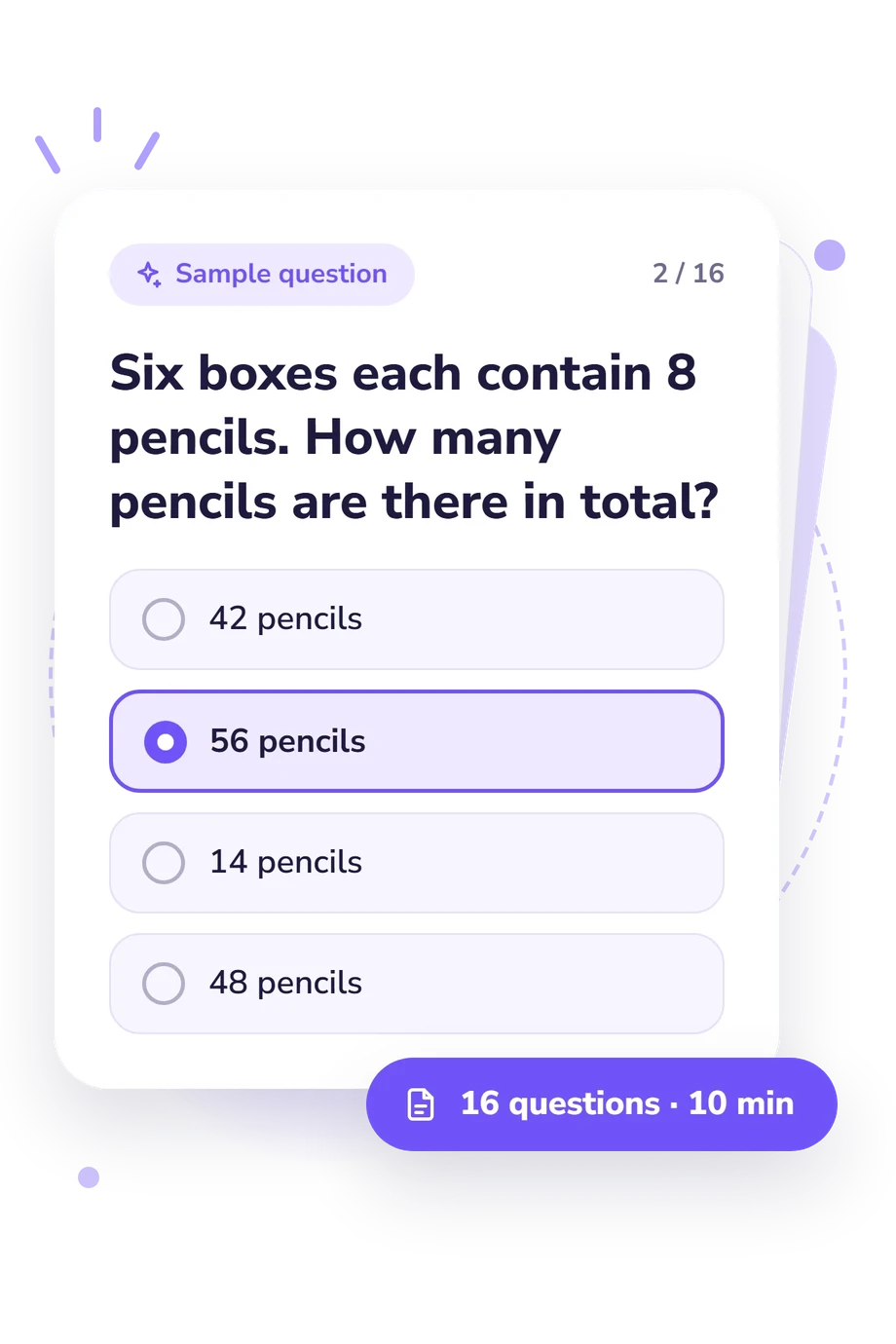
- 42 pencils
- 56 pencils
- 14 pencils
- 48 pencils
- 185 more items
- 225 more items
- 165 more items
- 175 more items
Arithmetic Quiz - Description and methodology of the test
For learners, parents, and adults revisiting core calculation skills, this arithmetic quiz offers a focused way to see overall performance across the tested concepts. It suits anyone who wants a practical snapshot before planning study, tutoring, or independent review. The quiz uses basic arithmetic skills in practical, school-style problems rather than abstract psychological traits.
What This Assessment Measures
The assessment samples practical arithmetic across whole-number operations, missing-number equations, estimation, mean, signed numbers, fractions, money, decimals, and order of operations. Its result reflects current performance on these concepts, not personality or general intelligence. As an arithmetic skills assessment, it can help a learner spot difficulty with number relationships, multi-step reasoning, or shifts between fractions and decimals.
The test reports one overall Arithmetic Knowledge scale (0-16), with these result bands:
- Foundations to build (0-6) indicates that calculation methods, number relationships, or operation rules need deliberate review.
- Developing knowledge (7-12) indicates that many core tasks are manageable, while multi-step, fractional, decimal, or signed-number problems may be less consistent.
- Strong knowledge (13-16) indicates a reliable command of the arithmetic concepts sampled in the test.
Methodology and Evidence Base
Each item presents a short problem with four answer choices, making the method a content-focused multiple-choice performance assessment. The sample ranges from equal sharing and totals to estimation, temperature, fractions, money, decimals, and order of operations, requiring direct calculation and recognition of number relationships. The result is one aggregate knowledge score interpreted through the three displayed bands; no separate item weighting is specified.
The structure offers useful comparison points with the ACCUPLACER Arithmetic Test (College Board, 2019) for arithmetic content and performance-focused assessment, while Boora, Pasiphol, and Tangdhanakanond (2015) provide a contrasting cognitive-diagnostic research context and Pittalis (2025) addresses rational-number sense. These publications offer relevant context for arithmetic content and rational-number skills, but neither establishes this test's validity, norms, or standardization.
Without broader norms, the result is a performance snapshot rather than a population percentile. Performance can also shift with attention, confidence, prior instruction, and current context. For someone using the result to plan practice, this arithmetic practice test can point toward review of the underlying operations and worked examples; one score cannot reveal every misconception.
- College Board. (2019). ACCUPLACER Suite of Assessments Technical Manual. College Board.
- Boora, S., Pasiphol, S., & Tangdhanakanond, K. (2015). Development of Cognitive Diagnostic Testing on Basic Arithmetic Operation. Procedia - Social and Behavioral Sciences, 191, 769-772. 10.1016/j.sbspro.2015.04.533
- Pittalis, M. (2025). An empirically validated rational number sense framework. Mathematics Education Research Journal, 37(1), 125-160. 10.1007/s13394-024-00484-2
Updated: