
Lash Quiz
How the Scales are Structured
Who Usually Takes This Test?
See How You Compare
Below is a preview of how scores are typically distributed across each scale.
Example Questions From the Test
- I would rather leave placement entirely to a technician
- I could learn it, though I might prefer smaller sections
- I like the idea of mastering one band that creates the whole look
- I would prefer a brush-on product with no separate lash piece
- A complete, noticeable lash shape I can apply for the event
- Extra definition created only with a buildable cosmetic formula
- A subtle enhancement assembled from several small sections
- The consistent look of lashes maintained across several weeks
- A quick coat I can adjust and wash off that evening
- A polished look that takes a little more preparation
- Careful placement of several small lash sections
- A maintained look that usually needs no morning lash makeup
Lash Quiz - Description and methodology of the test
For readers choosing among temporary makeup, at-home application, and salon maintenance, the Lash Quiz creates a preference profile rather than a beauty verdict. It connects daily habits, desired control, removal tolerance, and willingness to book appointments with a practical routine. It helps readers answer the practical what eyelash extensions should i get quiz question: which option better matches their preferences.
What This Assessment Measures
Questions map removal, placement control, maintenance, flexibility, intensity, budget, and time. The profile suits people choosing among quick cosmetics, home application, and professional care, while this lash style quiz focuses on the method and routine they prefer rather than their natural features.
Natural lash length, density, and curl are outside its scope. The four result types are:
- DIY Lash Clusters (0-12) measures affinity for tailored small-section placement across Limited fit (0-4), Possible fit (5-8), and Strong fit (9-12).
- Everyday Mascara (0-12) measures preference for flexible, removable definition across Limited fit (0-4), Possible fit (5-8), and Strong fit (9-12).
- Salon Lash Extensions (0-12) measures preference for technician-created upkeep across Limited fit (0-4), Possible fit (5-8), and Strong fit (9-12).
- Strip Lashes (0-12) measures preference for changeable full bands across Limited fit (0-4), Possible fit (5-8), and Strong fit (9-12).
Methodology and Evidence Base
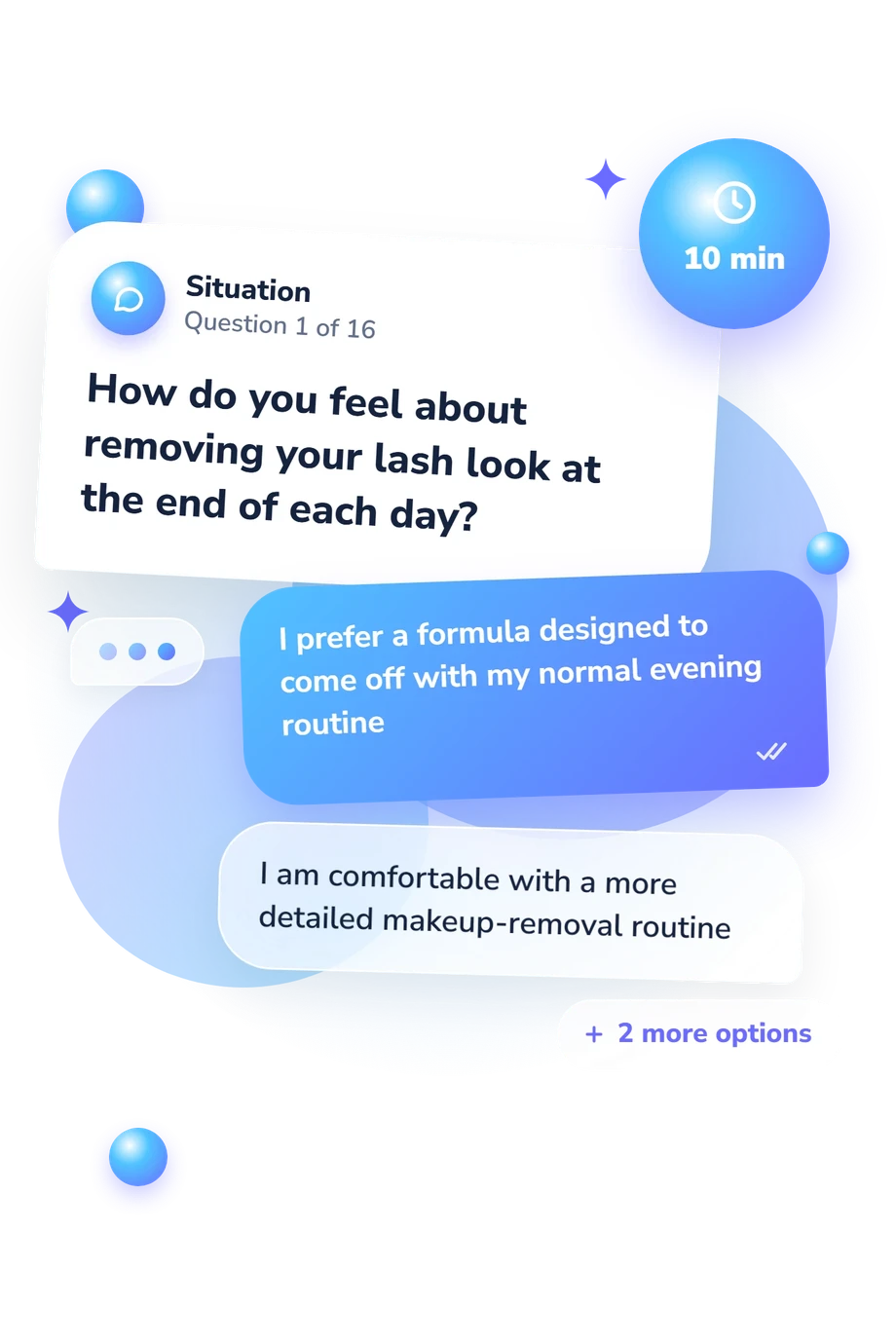
Each item presents a situation with four response options covering removal, placement, time pressure, appointments, budget, intensity, reuse, and care. There are no right answers; respondents choose the routine that best matches their priorities.
Selections produce four preference totals. The highest indicates strongest affinity, while totals within one point indicate a blended result. The descriptive bands are not norm-standardized, so they indicate relative preference within this questionnaire rather than comparison with a reference population.
Lee and Han (2017) provide the closest conceptual match because their study examined use, preference, and satisfaction involving extended and false eyelashes. This questionnaire is conceptually consistent with that work, not an adaptation. Dang and colleagues (2016) developed and validated the Eyelash Satisfaction Questionnaire, while Amano and colleagues (2012) documented ocular disorders associated with extensions.
Self-report results can shift with current circumstances, previous experience, self-awareness, and willingness to maintain a look. The profile works as a lash preference quiz, helping you choose a routine without establishing product safety. Follow product directions, and stop for pain, swelling, injury, vision changes, or persistent irritation.
- Kyeong-Hwa Lee, Chae-Jeong Han. Usage of, Preference for, and Satisfaction with Extended Eyelashes and False Eyelashes in Adult Women. Asian Journal of Beauty & Cosmetology. 2017;15(3):299-309. 10.20402/ajbc.2016.0125
- Jeff Dang, Jason C. Cole, Somali M. Burgess, Min Yang, Selena R. Daniels, John G. Walt. Development and Validation of the Eyelash Satisfaction Questionnaire. Aesthetic Surgery Journal. 2016;36(2):221-228. 10.1093/asj/sjv154
- Yuki Amano, Yuka Sugimoto, Minoru Sugita. Ocular disorders due to eyelash extensions. Cornea. 2012;31(2):121-125. 10.1097/ICO.0b013e31821eea10
Updated: