
What Is My Vibrational Frequency Quiz
How the Scales are Structured
Who Usually Takes This Test?
See How You Compare
Below is a preview of how scores are typically distributed across each scale.
Example Questions From the Test
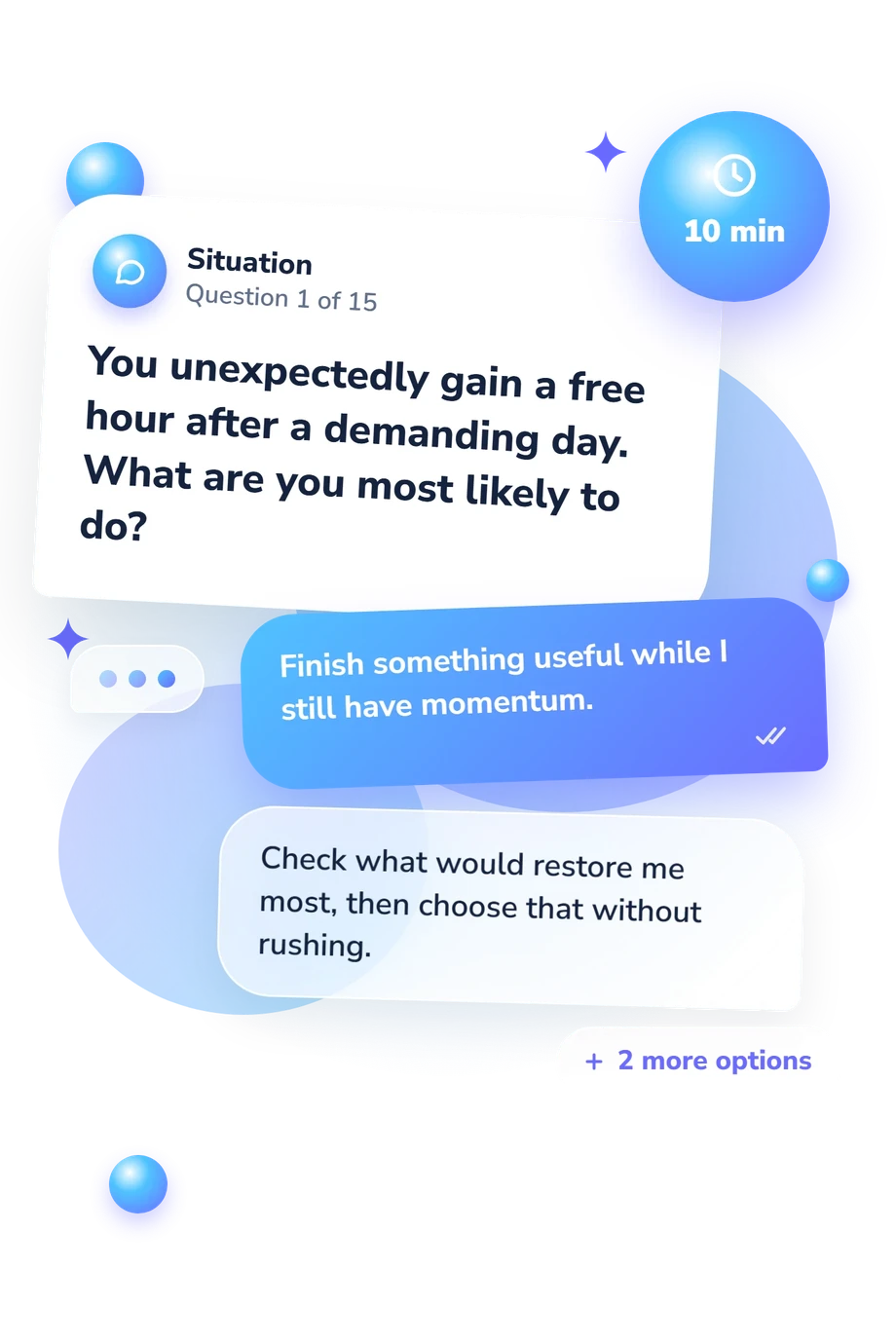
- Finish something useful while I still have momentum.
- Check what would restore me most, then choose that without rushing.
- Look for something highly stimulating so I can switch out of the mood.
- Settle into a familiar restful activity and let the day fade.
- I pause, notice the shift, and redirect my energy toward what now feels meaningful.
- I keep moving through the day, though some disappointment lingers.
- I lose momentum and reach for distraction until the feeling passes.
- I take a little time to reset before deciding what to do instead.
- Rarely; my energy is usually at one extreme or the other.
- On some days, especially when my schedule cooperates.
- Often, even when the week includes some pressure.
- Occasionally, but it tends to be brief.
What Is My Vibrational Frequency Quiz - Description and methodology of the test
People who want to understand how feelings, energy, and personal priorities interact can use the What Is My Vibrational Frequency Quiz to organize familiar experiences into a current profile. Readers wondering about their frequency profile can use the result to notice patterns in everyday choices, relationships, and responses to change, then consider which areas feel steady and which may need attention.
What This Assessment Explores
This questionnaire uses reflective language rather than measuring a literal vibration. Its situations explore emotional responses, energy shifts, values-based choices, disappointment, appreciation, tension, and competing demands. Rather than naming a fixed vibration level, it translates the metaphor into a changing pattern that can help readers notice how they meet feelings, restore energy, and act on priorities.
The result separates three dimensions:
- Emotional Openness (0-15) reflects making room for feelings: Protected Heart (0-5), Selective Openness (6-10), or Receptive Flow (11-15).
- Grounded Vitality (0-15) reflects noticing and responding to energy needs: Energy Turned Inward (0-5), Variable Current (6-10), or Grounded Current (11-15).
- Intentional Alignment (0-15) reflects matching choices to values: Open-Ended Direction (0-5), Emerging Alignment (6-10), or Purposeful Alignment (11-15).
Together, the bands describe current tendencies across these areas and show where your responses may be more or less consistent.
Methodology and Scientific Basis
Each item presents an everyday situation with four response options. The choices cover emotion, energy changes, values conflicts, and social experiences; choosing the response most like you makes this a self-report exercise rather than a knowledge test.
Responses are organized into three displayed scores. The questionnaire does not specify item-level weights, so exact point contributions cannot be inferred from score ranges alone. The displayed bands are descriptive ranges that organize results from lower to higher expression of each tendency.
Conceptual reference points include the Subjective Vitality Scale (Ryan & Frederick, 1997), which treats vitality as felt aliveness and available energy; Gross and John (2003) provide a parallel for emotional processing, while the Valuing Questionnaire (Smout et al., 2014) parallels values-based choice. These instruments are conceptual parallels, not evidence that this questionnaire uses their items, scoring, or norms.
The soul-frequency language here organizes lived patterns around emotion, energy, and values. Because self-report reflects honesty, self-awareness, and current circumstances, the result describes a present tendency and is best read alongside the situations that shaped your answers.
- Ryan, R. M., & Frederick, C. (1997). On energy, personality, and health: Subjective vitality as a dynamic reflection of well-being. Journal of Personality, 65(3), 529-565. 10.1111/j.1467-6494.1997.tb00326.x
- Smout, M., Davies, M., Burns, N., & Christie, A. (2014). Development of the Valuing Questionnaire (VQ). Journal of Contextual Behavioral Science, 3(3), 164-172. 10.1016/j.jcbs.2014.06.001
- Gross, J. J., & John, O. P. (2003). Individual differences in two emotion regulation processes: Implications for affect, relationships, and well-being. Journal of Personality and Social Psychology, 85(2), 348-362. 10.1037/0022-3514.85.2.348
Updated: