
Defense Mechanisms Quiz
How the Scales are Structured
Who Usually Takes This Test?
See How You Compare
Below is a preview of how scores are typically distributed across each scale.
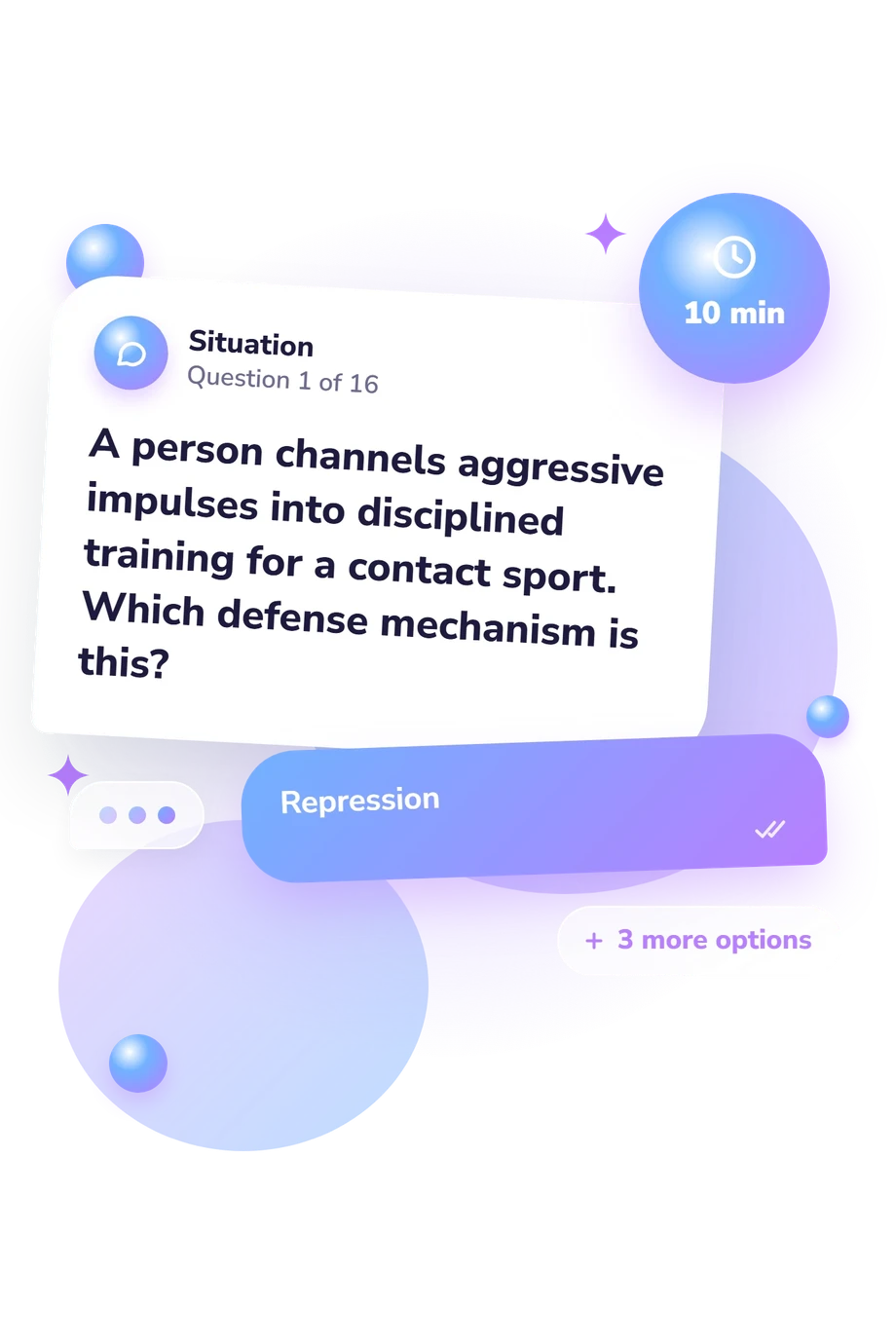
Example Questions From the Test
- Repression
- Regression
- Sublimation
- Undoing
- Intellectualization
- Displacement
- Undoing
- Reaction formation
- Projection
- Displacement
- Rationalization
- Identification
Defense Mechanisms Quiz - Description and methodology of the test
Readers who want to understand the language of psychological coping can use this assessment to connect short situations with established defense concepts. As a defence mechanisms quiz, it is intended for learners and curious adults who want a structured introduction rather than a personal label. The defense mechanisms quiz returns an educational result about conceptual recognition, helping the respondent see which distinctions deserve further attention.
What This Assessment Explores
Defense mechanisms are mental processes used to manage anxiety, conflict, or feelings that are difficult to tolerate. The scenarios place them in situations involving criticism, jealousy, disappointment, relationship strain, insecurity, and frightening news. Each item asks which concept best explains the response, so the task is conceptual recognition rather than a judgment about personality.
The question groups show:
- Naming mechanisms tests whether you can match a response with concepts such as denial, projection, or sublimation.
- Distinguishing neighbors tests whether you can separate repression from suppression and projection from displacement.
- Reading context tests whether situational details guide your choice instead of a mechanism’s label alone.
A result from your defense mechanism quiz is reported as Defense Mechanisms Knowledge: 0-16 correct: Foundations to build (0-6), Developing knowledge (7-12), or Strong knowledge (13-16). It measures item accuracy only, not your own defenses or a diagnosis.
Methodology and Scientific Basis
Each item presents four answer choices, and the respondent selects the mechanism or statement that best fits. The set combines brief vignettes with direct distinctions, including repression versus suppression and examples of projection, displacement, sublimation, denial, and related defenses. The score is the total number of correct selections on the knowledge scale.
The conceptual framework is consistent with Anna Freud’s account of ego defenses and Phebe Cramer’s developmental treatment of their study. The closest empirical reference is Defense Mechanism Rating Scales (Perry & Cooper, 1989), a clinician-rated approach for evaluating defenses in interviews and life vignettes. This questionnaire is conceptually consistent with that work, not a reproduction or validated adaptation of it.
For educational review, the questionnaire works as a short defense mechanism test, helping identify which concepts the respondent understands and which distinctions remain uncertain. The quiz is not documented as a standardized, norm-referenced administration, so its bands are descriptive rather than population-based. Results may also reflect prior learning and reading comprehension, making the score a snapshot of educational knowledge rather than a complete account of personal experience.
- Perry, J. Christopher, and Steven H. Cooper. "An Empirical Study of Defense Mechanisms: I. Clinical Interview and Life Vignette Ratings." Archives of General Psychiatry 46, no. 5 (1989): 444-452. 10.1001/archpsyc.1989.01810050058010
- Freud, Anna. The Ego and the Mechanisms of Defence. London: Leonard and Virginia Woolf at the Hogarth Press and the Institute of Psycho-Analysis, 1937.
- Cramer, Phebe. The Development of Defense Mechanisms: Theory, Research, and Assessment. New York: Springer, 1991. 10.1007/978-1-4613-9025-1
Updated: