
Pub Quiz
How the Scales are Structured
Who Usually Takes This Test?
See How You Compare
Below is a preview of how scores are typically distributed across each scale.
Example Questions From the Test
- Clarinet
- Flute
- Oboe
- Saxophone
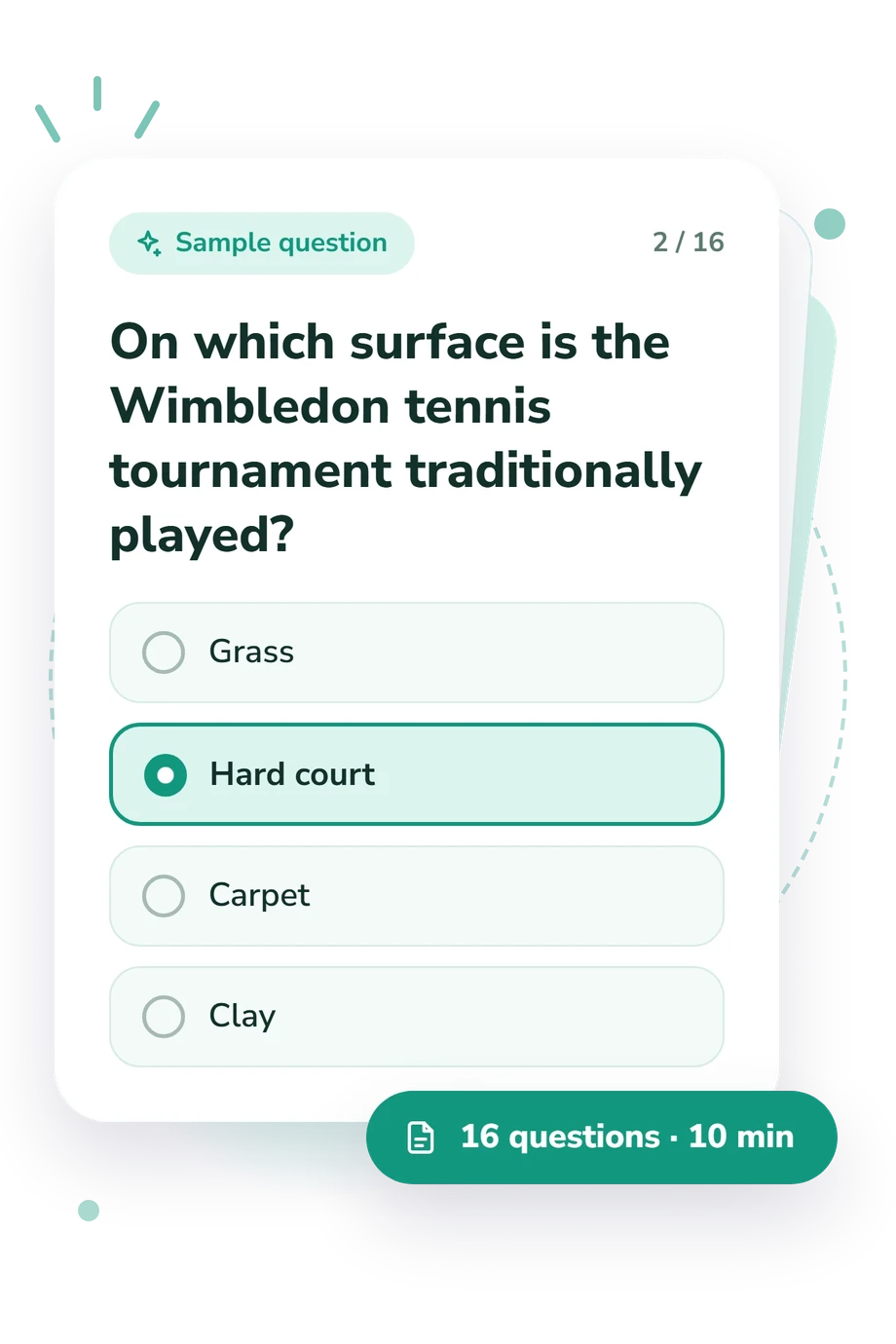
- Grass
- Hard court
- Carpet
- Clay
- A modern documentary about wartime society
- A recent textbook chapter about the war
- A diary written by a nurse in 1916
- A historical novel published decades later
Pub Quiz - Description and methodology of the test
For readers who enjoy broad-recall challenges, this pub quiz offers a compact way to see how comfortably they move among factual knowledge and simple reasoning. It is suited to curious adults, friends preparing for a bar quiz, or anyone who wants a snapshot of overall performance across familiar school, cultural, and everyday topics. The result offers a basis for further curiosity, practice, and conversation.
What This Assessment Explores
Questions span music, sport, history, geography, science, language, literature, art, and culture. Some test recall, while others require calculation, chronology, source recognition, or everyday explanation. Together they form a broad snapshot rather than a single-subject exam.
That breadth matters in pub-quiz trivia, where an unfamiliar topic can matter as much as a difficult fact. The single result reflects overall performance across the covered subjects, rather than reporting separate subject scores.
The questions represent these broad themes, while the score is reported as one overall measure:
- The knowledge measure runs from 0-16: Starter Knowledge (0-6) reflects core facts still developing; Developing Knowledge (7-12) reflects a solid general base; Standout Knowledge (13-16) reflects broad, dependable knowledge.
- Cultural and humanities topics appear through questions about works, people, events, language, and historical context.
- Science, geography, and reasoning topics ask readers to connect places, systems, institutions, and everyday principles.
Methodology and Scientific Basis
Each item presents one question with four answer choices, combining recognition, recall, and brief reasoning rather than open-ended writing. In an online pub-quiz format, this structure keeps responses comparable while moving across factual knowledge and simple application.
Scoring is reported through the questionnaire’s single knowledge measure: stronger results indicate broader and more dependable performance across the covered material. The total should be read as performance on these items rather than a population norm.
Conceptually, the questionnaire is consistent with the General Knowledge Test, which treats general knowledge as broad semantic memory with distinguishable components. It is not presented as a direct adaptation of that instrument. Related work by Lynn and colleagues examines general-knowledge performance, while Ackerman connects knowledge with accumulated learning, intellectual processes, interests, and experience.
Reviewing missed answers can guide further learning and topic review, helping readers decide which subjects to revisit, while results may shift with language, education, cultural exposure, attention, and guessing. A single sitting cannot separate limited knowledge from momentary distraction.
- Irwing, P., Cammock, T., & Lynn, R. (2001). Some evidence for the existence of a general factor of semantic memory and its components. Personality and Individual Differences, 30(5), 857-871. 10.1016/S0191-8869(00)00078-7
- Lynn, R., Irwing, P., & Cammock, T. (2001). Sex differences in general knowledge. Intelligence, 30(1), 27-39. 10.1016/S0160-2896(01)00064-2
- Ackerman, P. L. (1996). A theory of adult intellectual development: Process, personality, interests, and knowledge. Intelligence, 22(2), 227-257. 10.1016/S0160-2896(96)90016-1
Updated: