
Nostalgia Quiz
How the Scales are Structured
Who Usually Takes This Test?
See How You Compare
Below is a preview of how scores are typically distributed across each scale.
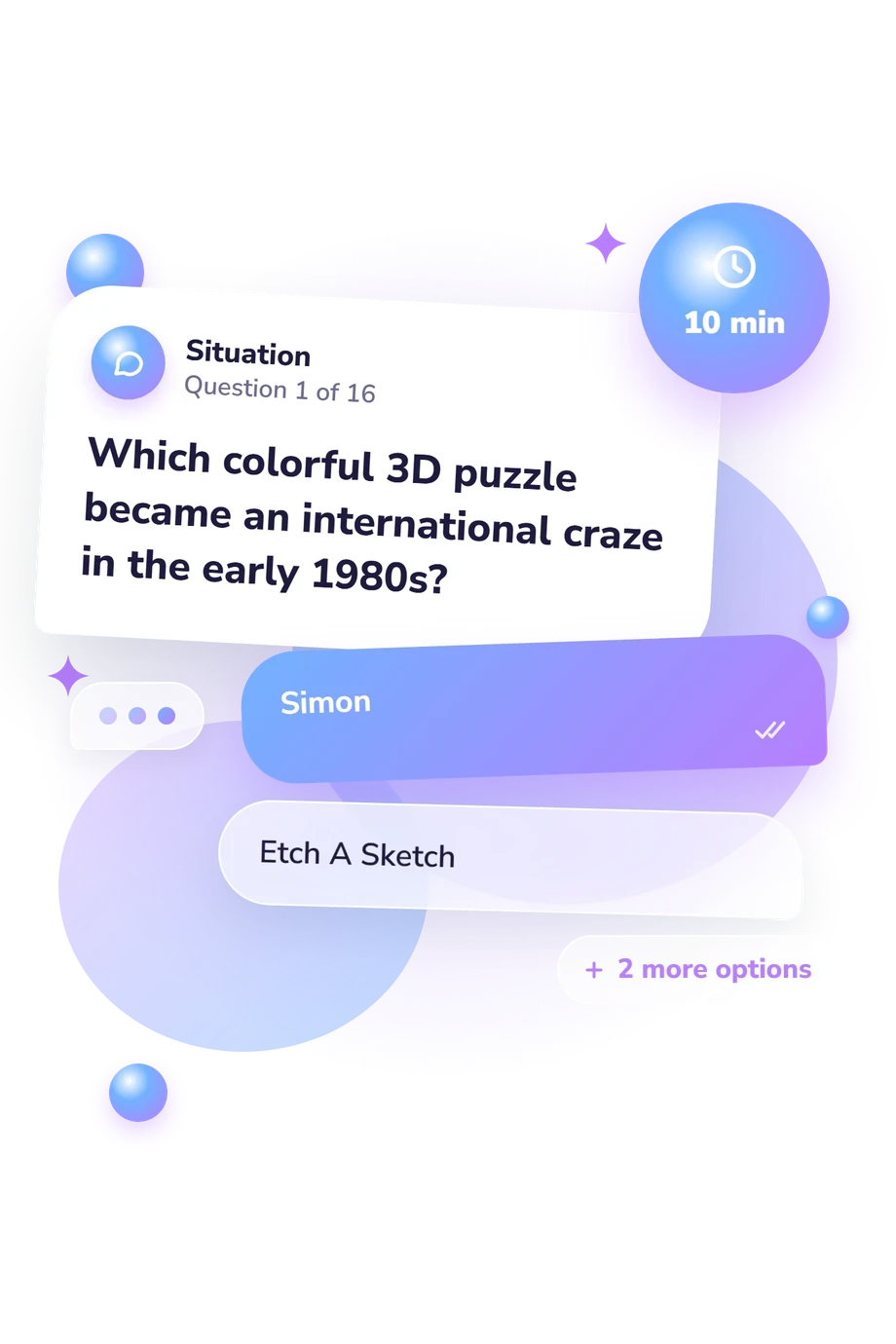
Example Questions From the Test
- Simon
- Etch A Sketch
- Rubik’s Cube
- Speak & Spell
- A LaserDisc
- A VHS tape
- A DVD
- A Video CD
- Jaws
- Close Encounters of the Third Kind
- Alien
- Star Wars
Nostalgia Quiz - Description and methodology of the test
People who enjoy cultural memory, old media, and the everyday objects that shaped recent decades can use this nostalgia quiz to see how accurately they recognize familiar references. It also works as a nostalgic quiz for anyone curious about the link between remembered cultural moments and factual knowledge. The result offers a focused profile of recall across entertainment, technology, music, and social history.
What This Assessment Explores
These questions measure cultural recognition rather than personal reminiscence. You identify objects, events, formats, performers, inventions, and media habits associated with the 1950s-1990s. The result shows how readily you connect familiar touchstones with the period that produced them.
The displayed scale, Nostalgia Knowledge (0-16), is shown in three bands: Memory Starter (0-6) recognizes some major references; Decades Explorer (7-12) shows solid command across several eras; Nostalgia Expert (13-16) connects detailed clues with their cultural context. As a nostalgia test, it highlights your strongest areas of recall.
The recurring content groups are:
- Entertainment and music measure recognition of films, bands, television, and styles.
- Technology and formats measure familiarity with devices, recordings, broadcasts, and digital life.
- Everyday objects measure knowledge of items once common in homes, cars, and leisure.
- Historical moments measure whether public events are placed in the right period.
Methodology and Evidence Base
The questionnaire uses four-option multiple-choice items. Each scenario asks you to identify the best-fitting object, format, performer, film, game, technology, or historical event, so recognition depends on context as well as isolated recall.
The displayed total summarizes the answer pattern, but no public weighting formula is stated for individual responses. Treat the result as a descriptive score rather than reverse-engineering how points are assigned. As a nostalgia trivia quiz, it is most useful for showing which cultural references you recognize confidently.
The subject matter is conceptually consistent with Bartlett and Snelus (1980), who studied memory for popular songs across the lifespan; Barrett et al. (2010), who connected music-evoked nostalgia with affect and memory; and Batcho (1995), who examined nostalgia as a recollective emotional experience. This online questionnaire is not presented as an adaptation or standardized reproduction of those works. It has no stated published norms, reliability estimates, or validated clinical cutoffs, and scores may reflect cultural exposure, media access, age, education, and familiarity with particular references as much as general memory ability.
- Bartlett, J. C., & Snelus, P. (1980). Lifespan memory for popular songs. The American Journal of Psychology, 93(3), 551-560. 10.2307/1422730
- Barrett, F. S., Grimm, K. J., Robins, R. W., Wildschut, T., Sedikides, C., & Janata, P. (2010). Music-evoked nostalgia: affect, memory, and personality. Emotion, 10(3), 390-403. 10.1037/a0019006
- Batcho, K. I. (1995). Nostalgia: a psychological perspective. Perceptual and Motor Skills, 80(1), 131-143. 10.2466/pms.1995.80.1.131
Updated: