
Mountain Bike Quiz
How the Scales are Structured
Who Usually Takes This Test?
See How You Compare
Below is a preview of how scores are typically distributed across each scale.
Example Questions From the Test
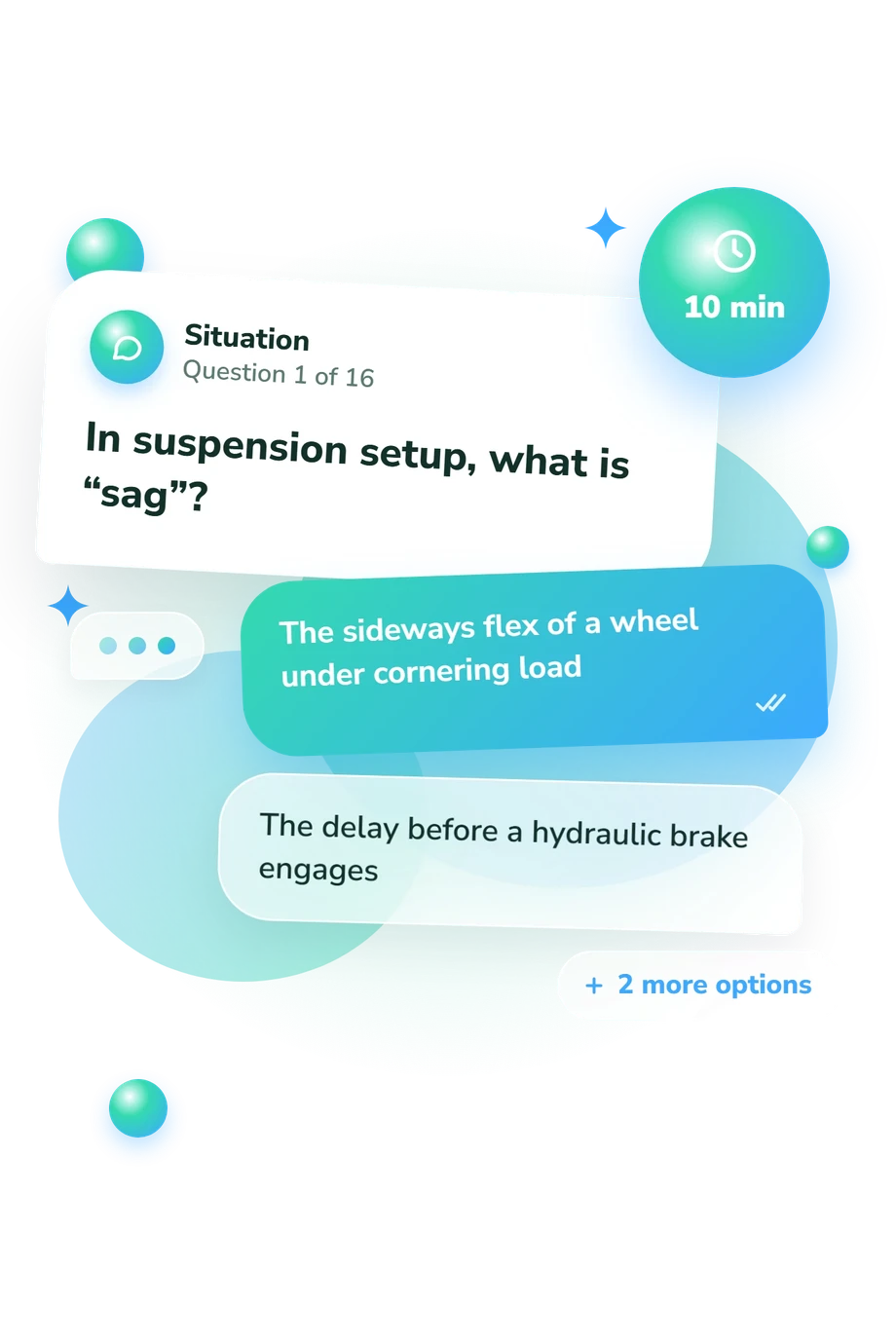
- The sideways flex of a wheel under cornering load
- The delay before a hydraulic brake engages
- The total travel left after the fork bottoms out
- The amount suspension compresses under the rider's normal weight
- The tire pressure is too low for the load and terrain
- The rebound damping is too slow
- The brake rotor is slightly warped
- The handlebar roll is too far forward
- Keep using it because only visible cracks affect protection
- Test it by pressing firmly on the impact area
- Add a second layer of padding inside the shell
- Replace it according to the manufacturer's crash guidance
Mountain Bike Quiz - Description and methodology of the test
Riders who want a snapshot of their trail knowledge can use the mtb quiz to examine decisions that affect control, equipment, safety, and shared trails. Beginners building a foundation and regular riders checking familiar habits can both use the mountain bike quiz to assess recognition of sound decisions in setup, handling, maintenance, safety, and etiquette scenarios. Its result summarizes mountain-bike knowledge rather than identifying strengths or practice areas.
What This Assessment Measures
The questions examine practical knowledge rather than speed or competitive performance. Scenarios cover suspension and tire setup, braking, cornering, body position, obstacles, drivetrain diagnosis, component use, helmet safety, trail etiquette, and choices that reduce damage to wet natural-surface trails.
As a mountain biking skills test, the result is reported on Mountain Bike Knowledge (0-16), reflecting the number of correct answers: Foundation Builder (0-6) shows some recognized essentials; Capable Rider (7-12) reflects useful working knowledge; Trail-Savvy (13-16) reflects strong, well-rounded understanding. These labels describe tested knowledge, not riding style.
The main areas represented are:
- Setup and equipment knowledge shows how well you understand suspension, tires, controls, and component function.
- Handling and maintenance knowledge reflects braking, cornering, descending, obstacles, shifting, valves, and drivetrain problems.
- Safety and trail practice knowledge captures helmet replacement, yielding, and choices that protect natural-surface trails.
Methodology and Evidence Base
Each item presents a practical situation with answer choices, and the respondent selects the best answer. The score reflects the number of correct responses, so a higher total means more tested knowledge was recognized; the result bands describe performance on these items rather than a rider's complete ability.
The content is conceptually consistent with Lopes and McCormack's mountain-bike skills work, especially body position, suspension, braking, cornering, and obstacle technique. Repair and setup scenarios align with Jones's work, while trail-yielding and wet-trail decisions reflect IMBA's guidance. The braking scenario has a narrower connection to the study by Miller and colleagues, whose research examined braking and performance through an isolated off-road turn.
This online MTB knowledge test scores correct responses and displays bands describing performance on the questionnaire. Interpret the displayed band as a summary across tested topics, not a profile of individual skills. Since all answers form one total, the result cannot identify which topic needs attention; terminology, memory, and personal experience can influence answers, while written choices cannot establish behavior across changing terrain, weather, traffic, or mechanical conditions.
- Lopes, Brian, and Lee McCormack. Mastering Mountain Bike Skills. 3rd ed., Human Kinetics, 2017. ISBN 9781492544494.
- Jones, C. Calvin. Big Blue Book of Bicycle Repair. 4th ed., Park Tool, 2019. ISBN 9780976553069.
- International Mountain Bicycling Association. Rules of the Trail. IMBA, n.d.
- Miller, Matthew C., Philip W. Fink, Paul W. Macdermid, Daniel Allen, and Stephen R. Stannard. “Braking and Performance Characteristics of Experienced and Inexperienced Mountain Bikers Navigating an Isolated Off-Road Turn Using a Brake Power Meter.” International Journal of Performance Analysis in Sport, vol. 18, no. 4, 2018, pp. 495-506. DOI 10.1080/24748668.2018.1496383.
Updated: