
Measurement Quiz
How the Scales are Structured
Who Usually Takes This Test?
See How You Compare
Below is a preview of how scores are typically distributed across each scale.
Example Questions From the Test
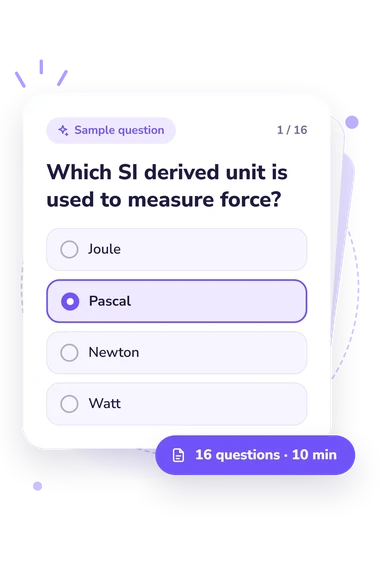
- Joule
- Pascal
- Newton
- Watt
- Repeat the measurement and calculate the mean
- Round the first result to a whole second
- Replace seconds with minutes
- Use only the shortest recorded time
- Stopwatch
- Thermometer
- Electronic balance
- Metre rule
Measurement Quiz - Description and methodology of the test
Students, teachers, and curious learners who want to check their grasp of laboratory basics can use this measurement quiz to review how scientific quantities are defined, measured, recorded, and compared. Learners can use a measurement knowledge test to check readiness for an introductory practical class or revise core laboratory decisions and calculations. Its scenarios offer focused practice in choosing instruments, reading values, and applying rules to calculations.
What This Assessment Measures
Rather than testing terminology alone, the assessment uses laboratory situations and calculations. It checks whether a learner can apply measurement rules to readings, choose an appropriate procedure, and interpret numerical results. The measurement questions in this quiz cover SI units, conversions, instrument choice, accuracy, precision, significant figures, density, meniscus reading, and instrument offsets.
One scale summarizes performance: Scientific Measurement Knowledge (0-16). Its bands are Foundations to Build (0-6), Developing Knowledge (7-12), and Strong Knowledge (13-16). They describe command of measurement concepts and practical application.
These result areas show what the score reflects:
- SI units and conversions show whether quantities are recognized and related correctly.
- Instrument choice indicates whether a tool suits the quantity, procedure, and needed resolution.
- Accuracy and precision show how repeated results relate to one another and an accepted value.
- Recording and calculation practices reveal whether readings, significant figures, and derived quantities are handled correctly.
Methodology and Evidence Base
Each item uses a selected-response format with four alternatives. Prompts ask respondents to identify units or instruments, perform conversions and density calculations, read a meniscus, apply significant-figure rules, and reason about accuracy, precision, or an instrument offset.
The questionnaire reports one displayed result and provides no separate topic scores. Interpret that result across the covered skills.
As a scientific measurement test, the questionnaire is conceptually consistent with the Physics Measurement Questionnaire (Allie et al., 1998), which addresses understanding of experimental measurement. It is not presented as an adaptation of that instrument. Volkwyn et al. (2008) link introductory laboratory work with measurement understanding, Vignal et al. (2023) addresses uncertainty reasoning, and Newell and Tiesinga (2019) supply the SI framework for the units used here.
The bands are performance descriptions for this questionnaire, indicating performance across measurement concepts. Scores may also reflect guessing, prior instruction, language, concentration, and familiarity with laboratory contexts; use them to choose review topics, knowing that written answers cannot fully represent hands-on practice.
- Allie, Saalih, Andy Buffler, Bob Campbell, and Fred Lubben. (1998). First-year physics students’ perceptions of the quality of experimental measurements. International Journal of Science Education, 20(4), 447-459. 10.1080/0950069980200405
- Vignal, Michael, Gayle Geschwind, Benjamin Pollard, Rachel Henderson, Marcos D. Caballero, and H. J. Lewandowski. (2023). Survey of physics reasoning on uncertainty concepts in experiments: An assessment of measurement uncertainty for introductory physics labs. Physical Review Physics Education Research, 19, 020139. 10.1103/PhysRevPhysEducRes.19.020139
- Volkwyn, Trevor S., Saalih Allie, Andy Buffler, and Fred Lubben. (2008). Impact of a conventional introductory laboratory course on the understanding of measurement. Physical Review Special Topics - Physics Education Research, 4(1), 010108. 10.1103/PhysRevSTPER.4.010108
- Newell, David B., and Eite Tiesinga. (2019). The International System of Units (SI), 2019 Edition. National Institute of Standards and Technology Special Publication 330. 10.6028/NIST.SP.330-2019