
Lord of the Flies Chapter 7 Quiz
How the Scales are Structured
Who Usually Takes This Test?
See How You Compare
Below is a preview of how scores are typically distributed across each scale.
Example Questions From the Test
- The body of a dead parachutist
- A living pilot who is trapped in the rocks
- A boar caught beneath a torn parachute
- A burned tree stump covered by vines
- He has discovered that the supposed beast is only a dead boar
- He has found fresh human footprints beside the signal fire
- He has seen something large that appears to move or rise
- He has spotted a ship’s light beyond the island
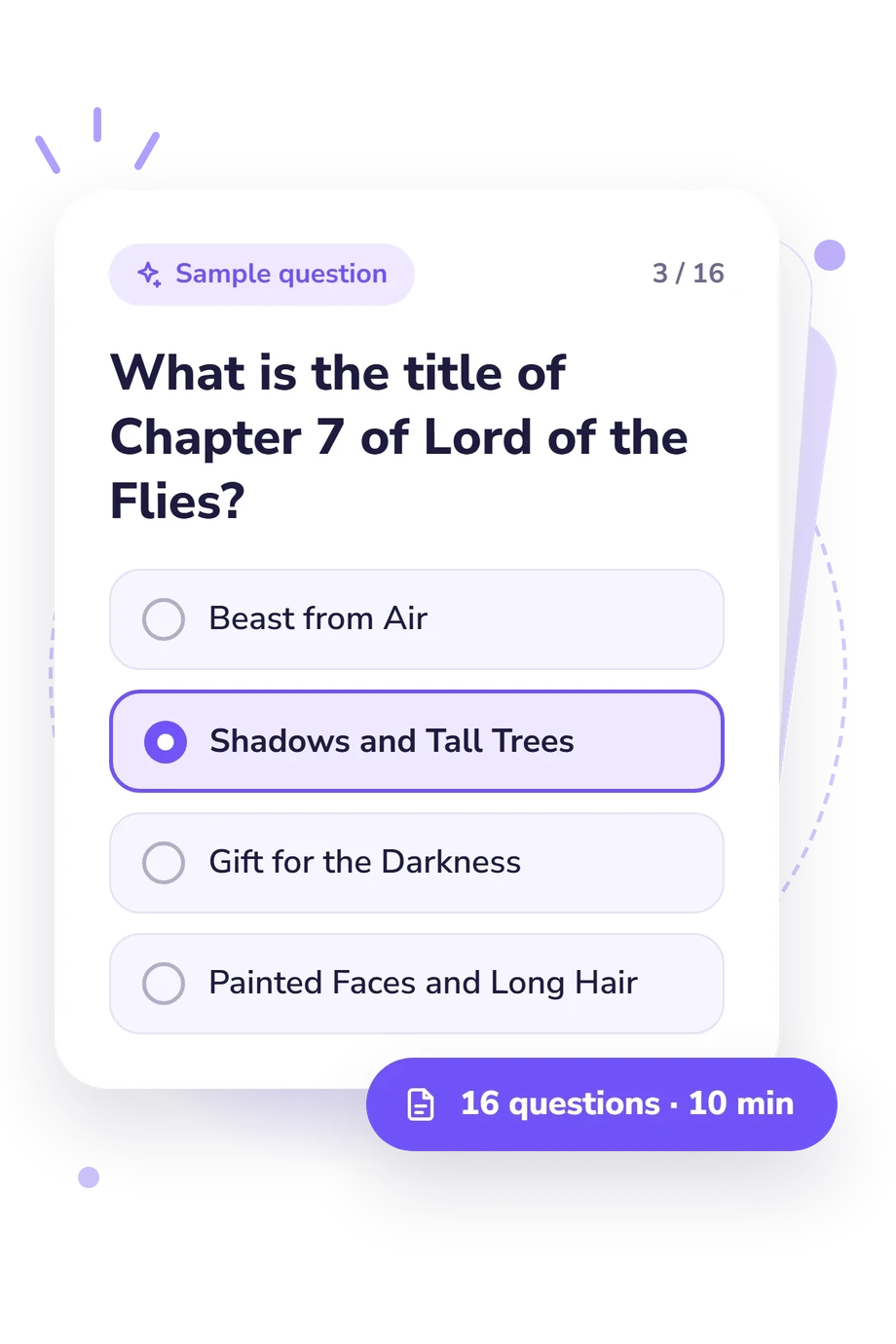
- Beast from Air
- Shadows and Tall Trees
- Gift for the Darkness
- Painted Faces and Long Hair
Lord of the Flies Chapter 7 Quiz - Description and methodology of the test
Readers who want to check close reading of Ralph, Jack, Simon, and the mountain episode can use this assessment to test recall alongside interpretation. The Lord of the Flies Chapter 7 Quiz is intended for students and independent readers who want to see whether the chapter’s motives, symbols, sequence, and conflict are clear. For revision, readers can use it as a Lord of the Flies Chapter 7 summary quiz that checks both plot and interpretation.
What This Assessment Explores
Chapter 7 brings together the hunt, Ralph’s pleasure in violence, fear of the beast, and the climb toward the summit. Questions ask readers to track sequence, identify motives, and connect setting with conflict. As a Lord of the Flies Chapter 7 reading quiz, it supports focused revision.
The result is reported on the Lord of the Flies Chapter 7 Knowledge scale, which runs from 0-16. The displayed bands describe what the score indicates:
- Foundation (0-6) shows that central events, especially the hunt and mountain expedition, need review.
- Developing (7-12) shows that the main plot is understood, but motives, sequence, or symbols need closer attention.
- Strong (13-16) shows detailed command of Chapter 7 and its links to conflict and themes.
The result is most useful when it points to passages or ideas worth revisiting, rather than serving as a verdict on overall literary ability.
Methodology and Scientific Basis
Each item uses four answer choices and asks about a scene, detail, character decision, sequence, or symbolic meaning. The format focuses on chapter-specific comprehension, including events, character decisions, sequence, and symbolic meaning. Correct answers contribute one point to the total, which is then reported in the displayed bands.
As a Chapter 7 comprehension quiz, it covers both the chapter’s broad sequence and its specific details.
Lord of the Flies (Golding, 1954) supplies the primary literary source for the events and images examined. Gregor and Kinkead-Weekes (2004) add editorial context, while Singh (1997) supports attention to boys’ government, group pressure, and tension between social order and violence. The quiz is conceptually consistent with these works, but it is not an adaptation of their scholarship; the score reflects performance on these Chapter 7 content questions.
Interpret the result as a focused study guide: a lower band points to passages to revisit, while a higher band suggests stronger command of Chapter 7. Memory, reading conditions, and emphasis on plot versus symbolism can affect answers, so the score describes current chapter understanding rather than overall reading ability.
- Golding, William. Lord of the Flies. London: Faber and Faber, 1954.
- Golding, William. Lord of the Flies (Schools Edition). Introduction and notes by Ian Gregor and Mark Kinkead-Weekes. London: Faber and Faber, 2004. ISBN 9780571056866.
- Singh, Minnie. "The Government of Boys: Golding's Lord of the Flies and Ballantyne's Coral Island." Children's Literature 25 (1997): 205-213. 10.1353/chl.0.0478
Updated: