
Is My Period Pain Normal Quiz
How the Scales are Structured
Who Usually Takes This Test?
See How You Compare
Below is a preview of how scores are typically distributed across each scale.
Example Questions From the Test
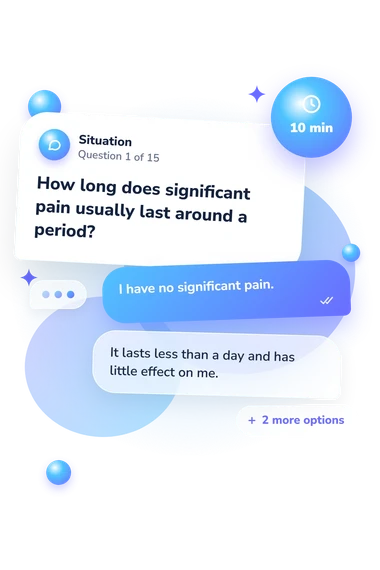
- I have no significant pain.
- It lasts less than a day and has little effect on me.
- It lasts one to two days and noticeably affects what I can do.
- It lasts more than two days, continues after bleeding, or also occurs between periods.
- Pregnancy is not possible for me, and I have no unusual pain or bleeding.
- Pregnancy could be possible, but any pain is mild and there is no unusual bleeding.
- Pregnancy could be possible and I have persistent pain or unexpected bleeding.
- Pregnancy is known or possible and I have severe or one-sided pain, heavy bleeding, dizziness, faintness, or shoulder pain.
- It does not wake me or prevent me from sleeping.
- It occasionally delays sleep or wakes me briefly.
- It disrupts several hours of sleep during some periods.
- It repeatedly keeps me awake or makes sleep nearly impossible.
Is My Period Pain Normal Quiz - Description and methodology of the test
People deciding whether menstrual pain or bleeding deserves attention can use the Is My Period Pain Normal Quiz to organize symptoms. It is intended for self-reflection when discomfort, cycle changes, or associated symptoms are difficult to judge. The result addresses whether period cramps are normal, giving the are my period cramps normal quiz question a practical focus through patterns that merit monitoring or discussion with a healthcare professional.
What This Assessment Explores
The questions cover pain duration and change, sleep, activities, relief, bleeding length and flow, clots, leaks, spotting, and associated symptoms including fever, vomiting, dizziness, one-sided pain, or possible pregnancy.
These topics organize reports by duration, change, disruption, bleeding, and associated symptoms; they do not establish what is normal.
Rather than producing severity scores, this period pain scale quiz organizes pain, bleeding, and associated symptoms by disruption, change, and context. The displayed dimensions are:
- Bleeding Pattern Concerns (0-15) reflects bleeding duration, flow, leaks, clots, and spotting; bands are Baseline 0, Some signal 1-2, and Prompt review 3-15.
- Pain and Daily Function (0-15) reflects pain duration, sleep disruption, activity limits, and relief; bands are Baseline 0, Some signal 1-2, and Prompt review 3-15.
- Whole-Body and Urgent Symptoms (0-15) reflects associated whole-body or urgent symptoms; bands are Baseline 0, Some signal 1-2, and Urgent review 3-15.
Methodology and Scientific Basis
Each item uses four ordered self-report responses, moving from no notable concern toward persistent, disruptive, or urgent experiences. Results are displayed across three thematic scales, and the bands are unvalidated reflective summaries rather than measures of blood loss, symptom severity, or diagnosis.
Pain content is conceptually consistent with the DSI (Chen et al., 2021), especially its focus on daily interference; this online questionnaire is not an adaptation of that instrument. Bleeding concerns overlap with the Menstrual Bleeding Questionnaire (Matteson et al., 2015), while ACOG guidance provides context for changing menstrual patterns and severe or progressive dysmenorrhea.
To interpret the how bad are my period cramps quiz, focus on function: whether pain interrupts sleep, limits activity, changes suddenly, or breaks through usual relief. Read the three dimensions separately because one concerning response can matter even when a scale score is low. Recall and current circumstances can affect self-report. Seek urgent help for fainting, breathing difficulty, uncontrolled bleeding, sudden severe or one-sided pain, fever with severe pelvic pain, or severe pain or bleeding when pregnancy is possible.
- Chen CX, Murphy T, Ofner S, Yahng L, Krombach P, LaPradd M, Bakoyannis G, Carpenter JS. Development and Testing of the Dysmenorrhea Symptom Interference (DSI) Scale. Western Journal of Nursing Research. 2021;43(4):364-373. 10.1177/0193945920942252
- Matteson KA, Scott DM, Raker CA, Clark MA. The menstrual bleeding questionnaire: development and validation of a comprehensive patient-reported outcome instrument for heavy menstrual bleeding. BJOG: An International Journal of Obstetrics & Gynaecology. 2015;122(5):681-689. 10.1111/1471-0528.13273
- American College of Obstetricians and Gynecologists' Committee on Adolescent Health Care. Dysmenorrhea and Endometriosis in the Adolescent. Obstetrics & Gynecology. 2018;132(6):e249-e258. 10.1097/AOG.0000000000002978
- American College of Obstetricians and Gynecologists. Menstruation in Girls and Adolescents: Using the Menstrual Cycle as a Vital Sign. Obstetrics & Gynecology. 2015;126(6):e143-e146. 10.1097/AOG.0000000000001215