
Household Water Use Quiz
How the Scales are Structured
Who Usually Takes This Test?
See How You Compare
Below is a preview of how scores are typically distributed across each scale.
Example Questions From the Test
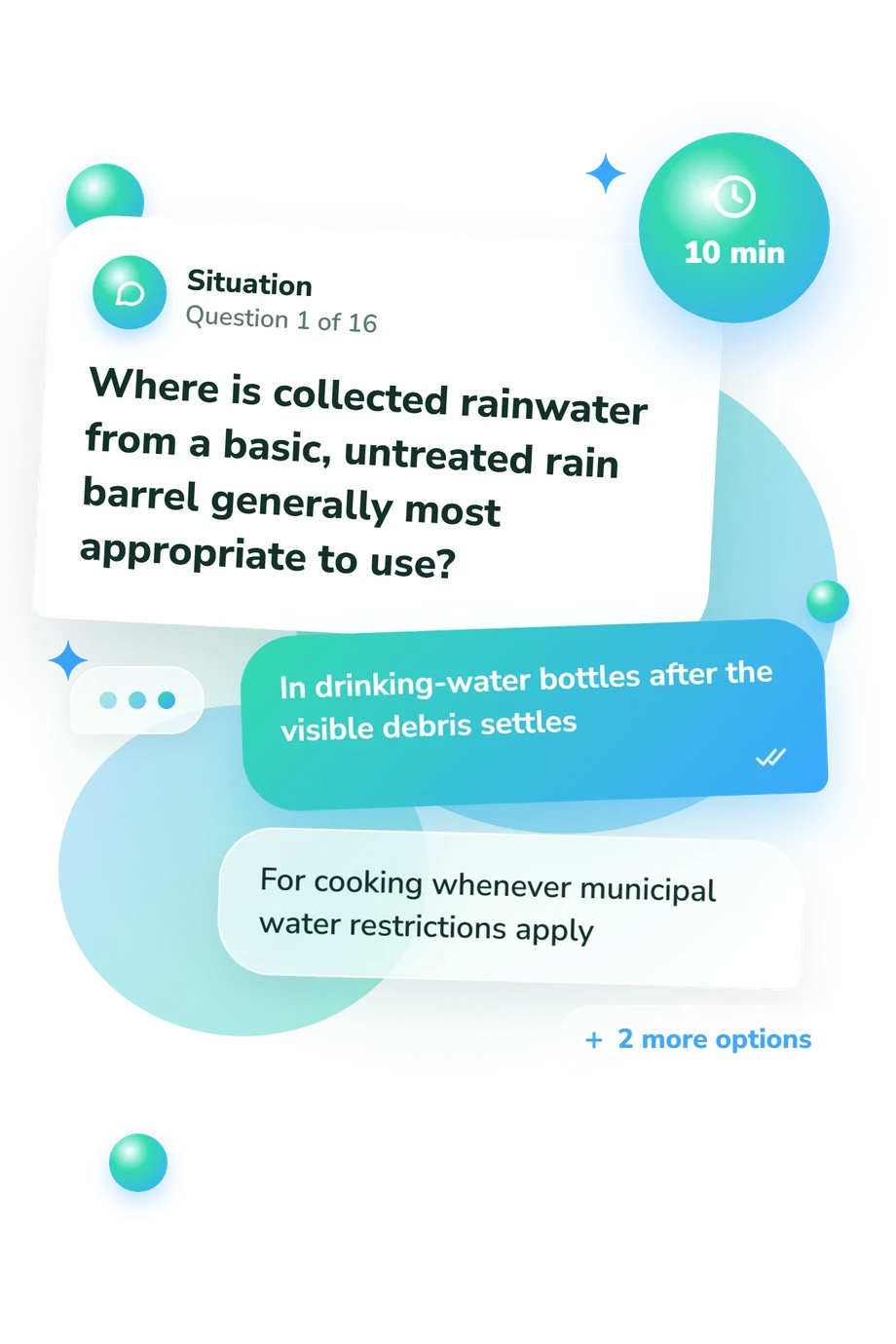
- In drinking-water bottles after the visible debris settles
- For cooking whenever municipal water restrictions apply
- On ornamental plants, subject to local rules and site conditions
- In any indoor tap because rainwater is naturally purified
- A toilet produces replacement water internally after each flush
- Toilet leaks occur only underground and cannot affect the bowl
- The meter stops recording water once it enters a toilet tank
- Water may flow quietly from the tank to the bowl between flushes
- It can reduce unnecessary flow and stress on pipes and fixtures
- It makes every fixture release more water in a shorter time
- It eliminates the need to repair dripping valves and seals
- It allows irrigation to run at midday without evaporation
Household Water Use Quiz - Description and methodology of the test
People who want to make sense of everyday water choices can use the household water use quiz to check practical knowledge rather than estimate a utility bill. It suits residents, learners, and anyone reviewing how home routines affect water demand. By taking the water use quiz, readers can translate familiar household situations into concrete decisions about leak detection, fixture choices, and irrigation principles.
What This Assessment Measures
It examines household water-use knowledge: spotting leaks, choosing efficient fixtures and appliances, understanding greywater and water footprints, estimating flow savings, and matching irrigation to weather and plant needs. It suits general readers who want to understand daily decisions rather than estimate one home's consumption.
The themes make household water conservation concrete. The result is organized as Household Water Use Knowledge, scored 0-16 and interpreted through these bands:
- Building Foundations (0-6) indicates recognition of core concepts, with room to strengthen knowledge of leaks, fixtures, appliances, and outdoor habits.
- Developing Knowledge (7-12) indicates practical understanding alongside decisions or calculations that may need refinement.
- Strong Knowledge (13-16) indicates a well-rounded grasp of efficient household water use, while actual consumption depends on household and local conditions.
The score is educational, not a water audit: household size, climate, fixtures, and local rules can change actual use.
Methodology and Evidence Base
Each item presents a practical scenario with four answer choices. The set combines recognition, cause-and-effect judgments, and simple calculations across indoor use, irrigation, plumbing, reuse, and indirect water demand. The questionnaire reports a result on the displayed scale; its educational result describes knowledge levels rather than clinical thresholds.
The closest conceptual reference is the Community Knowledge about Water study, which examines links between water knowledge, behavior, and policy support. Fielding and colleagues place household conservation in the context of infrastructure, routines, and psychosocial influences. The WELLS study offers a related environmental-literacy measurement perspective. Together, these studies provide conceptual context for the topics covered here rather than establishing this questionnaire's development or validity.
Viewed as a household water knowledge test, the questionnaire provides an educational profile for learning rather than a basis for population comparison. Results may vary with prior experience, local rules, interpretation, and response accuracy. Use the profile to choose learning priorities; actual consumption requires separate bills, meter readings, and site-specific inspection.
- Dean, Angela J., Kelly S. Fielding, and Fiona J. Newton. “Community Knowledge about Water: Who Has Better Knowledge and Is This Associated with Water-Related Behaviors and Support for Water-Related Policies?” PLOS ONE 11, no. 7 (2016): e0159063. 10.1371/journal.pone.0159063
- Fielding, Kelly S., Sally Russell, Anneliese Spinks, and Aditi Mankad. “Determinants of Household Water Conservation: The Role of Demographic, Infrastructure, Behavior, and Psychosocial Variables.” Water Resources Research 48 (2012): W10510. 10.1029/2012WR012398
- Irvin, Veronica L., Diana Rohlman, Amelia Vaughan, Rebecca Amantia, Claire Berlin, and Molly L. Kile. “Development and Validation of an Environmental Health Literacy Assessment Screening Tool for Domestic Well Owners: The Water Environmental Literacy Level Scale (WELLS).” International Journal of Environmental Research and Public Health 16, no. 5 (2019): 881. 10.3390/ijerph16050881
Updated: