
Heart Anatomy Quiz
How the Scales are Structured
Who Usually Takes This Test?
See How You Compare
Below is a preview of how scores are typically distributed across each scale.
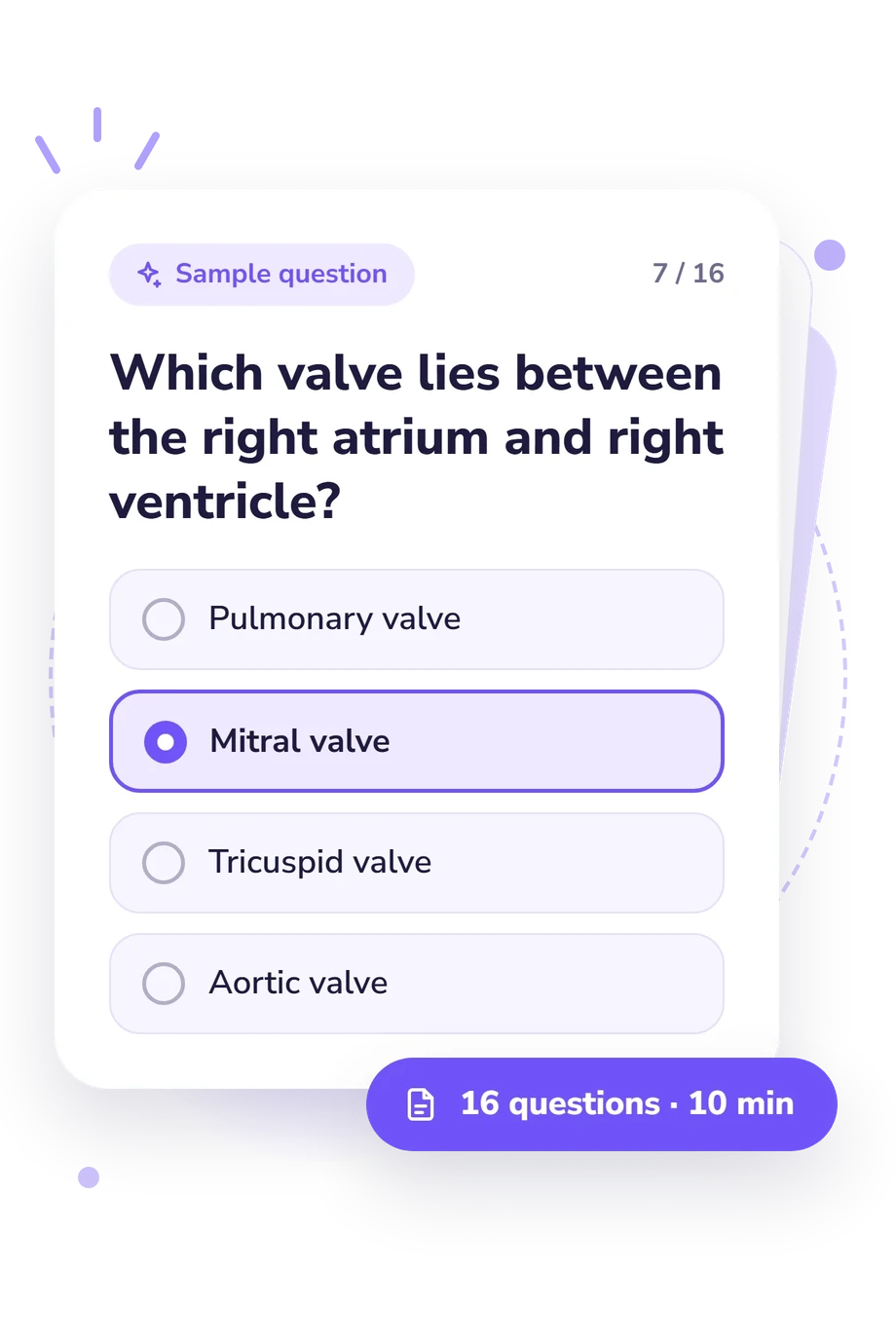
Example Questions From the Test
- Right marginal artery
- Circumflex artery
- Anterior interventricular artery
- Posterior interventricular artery
- Pulmonary trunk below the pulmonary valve
- Aortic arch near its major branches
- Ascending aorta just above the aortic valve
- Descending thoracic aorta
- Tricuspid valve
- Mitral valve
- Aortic valve
- Pulmonary valve
Heart Anatomy Quiz - Description and methodology of the test
Students, health-profession learners, and curious readers who want to check their grasp of cardiac structure can use this heart anatomy quiz as a focused knowledge check. It is useful before revision or after studying, because the result shows which core relationships are secure and which deserve another look. A heart quiz of this kind tests recognition and application rather than personal opinion or clinical judgment.
What This Assessment Explores
For learners revising cardiac structure, the assessment treats the heart as an organized system, linking names to location and function. This heart anatomy assessment includes items that work like a heart labeling quiz, while others ask you to follow blood flow or identify structures from anatomical positions.
The main question groups are:
- Chambers, walls, and landmarks show whether you can locate atria, ventricles, septa, the apex, and surface features.
- Valves and circulation test whether you can distinguish pulmonary from systemic routes and place valves correctly.
- Great vessels, coronary anatomy, and internal features measure recognition of vessels, chordae tendineae, pericardial layers, fossa ovalis, and the sinoatrial node.
Together, these topics make the assessment a parts of the heart quiz that checks relationships. Heart Anatomy Knowledge (0-16) awards one point per correct answer. Foundations to review (0-6), Developing knowledge (7-12), and Strong knowledge (13-16) are the result bands.
Methodology and Evidence Base
Each item presents a short anatomical prompt followed by four answer choices. The format tests recognition, localization, and sequence reasoning: selecting the correct option may require naming a structure, tracing blood flow, or applying a normal anatomical relationship. By linking locations and pathways, the heart diagram quiz checks spatial connections among structures.
Scoring is direct: every correct response contributes one point to the educational scale, and the total is interpreted through the catalogue bands rather than a clinical cutoff. The questionnaire is not norm-referenced or standardized, so the result describes performance on this set of anatomy items.
Content is conceptually consistent with the structures and pathways in Drake et al. (2019) and Moore et al. (2018); it is not an adaptation of either textbook. Melovitz Vasan et al. (2018) provides anatomy-education evidence relevant to multiple-choice testing, while D'Antoni et al. (2019) supports structured, evidence-based learning approaches. Prior study, terminology familiarity, attention, and recall accuracy can influence performance, so this anatomy knowledge check is best used to target revision rather than represent complete competence.
- Drake RL, Vogl AW, Mitchell AWM. Gray's Anatomy for Students. 4th ed. Philadelphia, PA: Elsevier; 2019.
- Moore KL, Dalley AF II, Agur AMR. Clinically Oriented Anatomy. 8th ed. Philadelphia, PA: Wolters Kluwer; 2018.
- Melovitz Vasan CA, DeFouw DO, Holland BK, Vasan NS. Analysis of testing with multiple choice versus open-ended questions: Outcome-based observations in an anatomy course. Anatomical Sciences Education. 2018;11(3):254-261. 10.1002/ase.1739
- D'Antoni AV, Mtui EP, Loukas M, Tubbs RS, Zipp GP, Dunlosky J. An evidence-based approach to learning clinical anatomy: A guide for medical students, educators, and administrators. Clinical Anatomy. 2019;32(1):156-163. 10.1002/ca.23298
Updated: