
Golf Rules Quiz
How the Scales are Structured
Who Usually Takes This Test?
See How You Compare
Below is a preview of how scores are typically distributed across each scale.
Example Questions From the Test
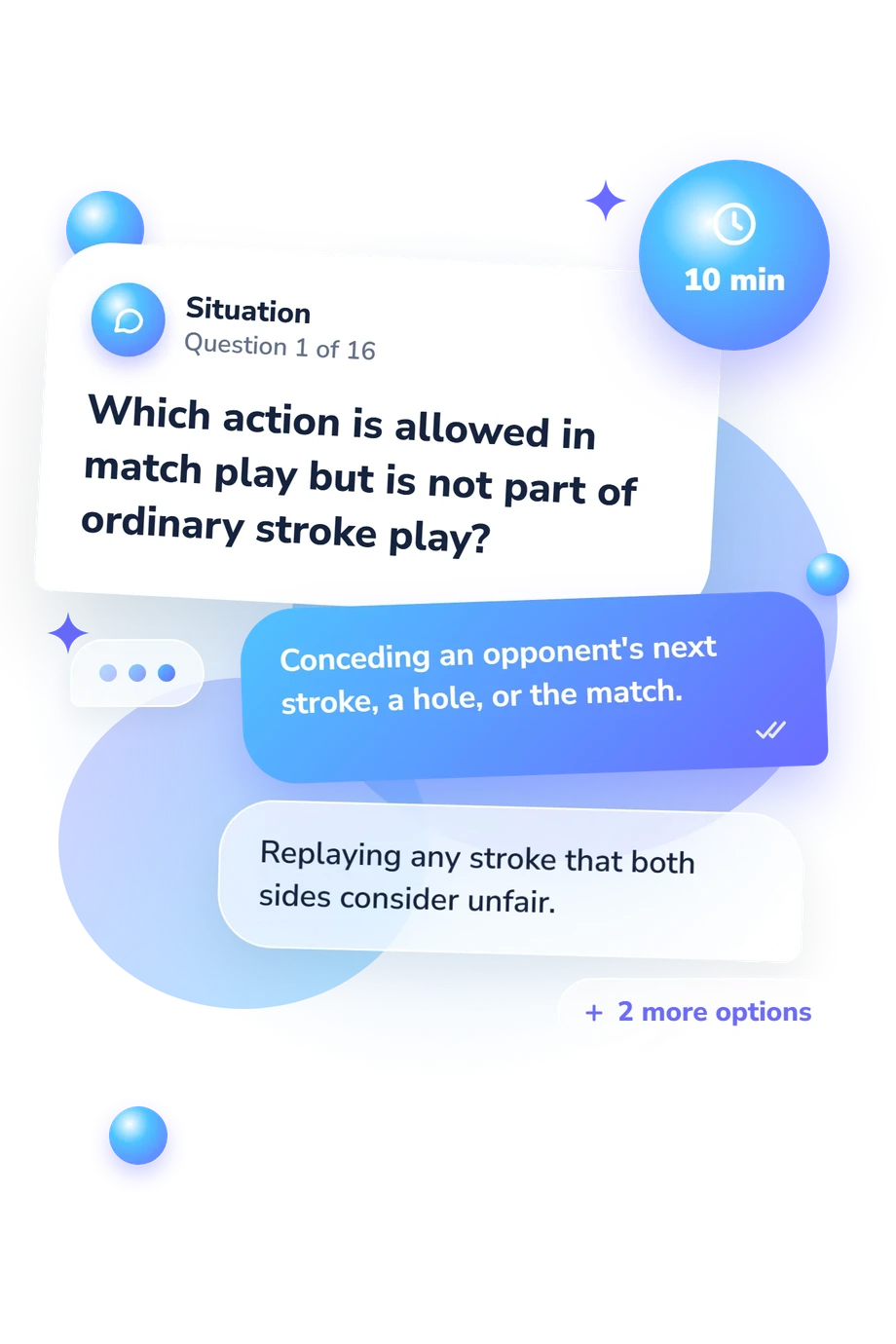
- Conceding an opponent's next stroke, a hole, or the match.
- Replaying any stroke that both sides consider unfair.
- Ignoring a penalty when both players agree it made no difference.
- Combining both players' scores into one score for the hole.
- There is no maximum if every club is declared before play.
- 12 clubs.
- 15 clubs.
- 14 clubs.
- Move the ball away from the leaf and replace it without penalty.
- Remove the leaf only after playing the ball out of the bunker.
- Remove the leaf, taking care not to cause the ball to move.
- Remove the leaf only by taking unplayable-ball relief.
Golf Rules Quiz - Description and methodology of the test
Players who want to check whether they can apply everyday golf procedures will find this assessment useful, especially before casual rounds, club play, or rules study. A golf rules quiz can reveal whether your understanding is secure when a ball is lost, moved, embedded, or affected by course conditions. As a basic quiz on golf rules, it points toward topics worth reviewing rather than judging playing ability.
What This Assessment Explores
The questions examine decisions that affect a stroke, a ball’s location, or a penalty. They cover concessions, relief, provisional balls, wrong greens, embedded balls, bunkers, flagsticks, club limits, advice, identification, and accidental movement. A rules of golf quiz therefore tests application, not terminology.
The result is an educational snapshot. Golf Rules Knowledge runs from 0-16: Foundations to build (0-6), Developing knowledge (7-12), and Strong knowledge (13-16). These bands describe familiarity with the covered situations, not an official ruling or referee credential.
Themes include:
- Play formats show whether you distinguish match-play concessions from stroke-play procedures.
- Relief and penalties show how you handle lost, out-of-bounds, unplayable, embedded, and penalty-area situations.
- Ball and course conditions show whether you respond correctly to movement, wrong greens, flagsticks, and identification.
- Equipment and conduct show whether you understand club limits, marking, loose impediments, and advice.
Methodology and Evidence Base
Each item presents a situation with four answer choices. Selecting the option that best matches the governing procedure tests recognition and application rather than free-form explanation. Questions about golf rules distinguish a penalty from free relief and a correct replacement from an incorrect drop.
The questionnaire reports one overall result rather than separate subscales, interpreted through descriptive bands rather than a universal pass mark. It indicates performance on the covered situations, not referee status or mastery of every rule.
Some conduct items make this a golf etiquette quiz when behavior affects rules, such as advice, marking, or loose impediments; it is not a broad measure of sportsmanship.
The evidence base is conceptually aligned with Knowledge Test for Golf Rules (Chung et al., 2015), which used item response theory to study golf-rules knowledge. This questionnaire is not a direct adaptation or standardized equivalent. Its reference point is The R&A and USGA’s 2023 rules framework.
Interpretation should remain modest: the output provides descriptive bands, not population norms or certification. Self-report, memory, attention, and scenario wording can affect responses, while local rules or competition conditions may change what applies.
- Il-Mi Chung, Junwoo Lee, and Ji-Hun Hwang. Development of the Knowledge Test for Golf Rules using the IRT Analysis. The Korean Journal of Measurement and Evaluation in Physical Education and Sports Science, 2015, 17(2), 87-98. 10.21797/ksme.2015.17.2.007
- The R&A and United States Golf Association. The Rules of Golf, effective January 2023. The R&A and USGA, 2023.
Updated: