
Gerunds Participles and Infinitives Quiz
How the Scales are Structured
Who Usually Takes This Test?
See How You Compare
Below is a preview of how scores are typically distributed across each scale.
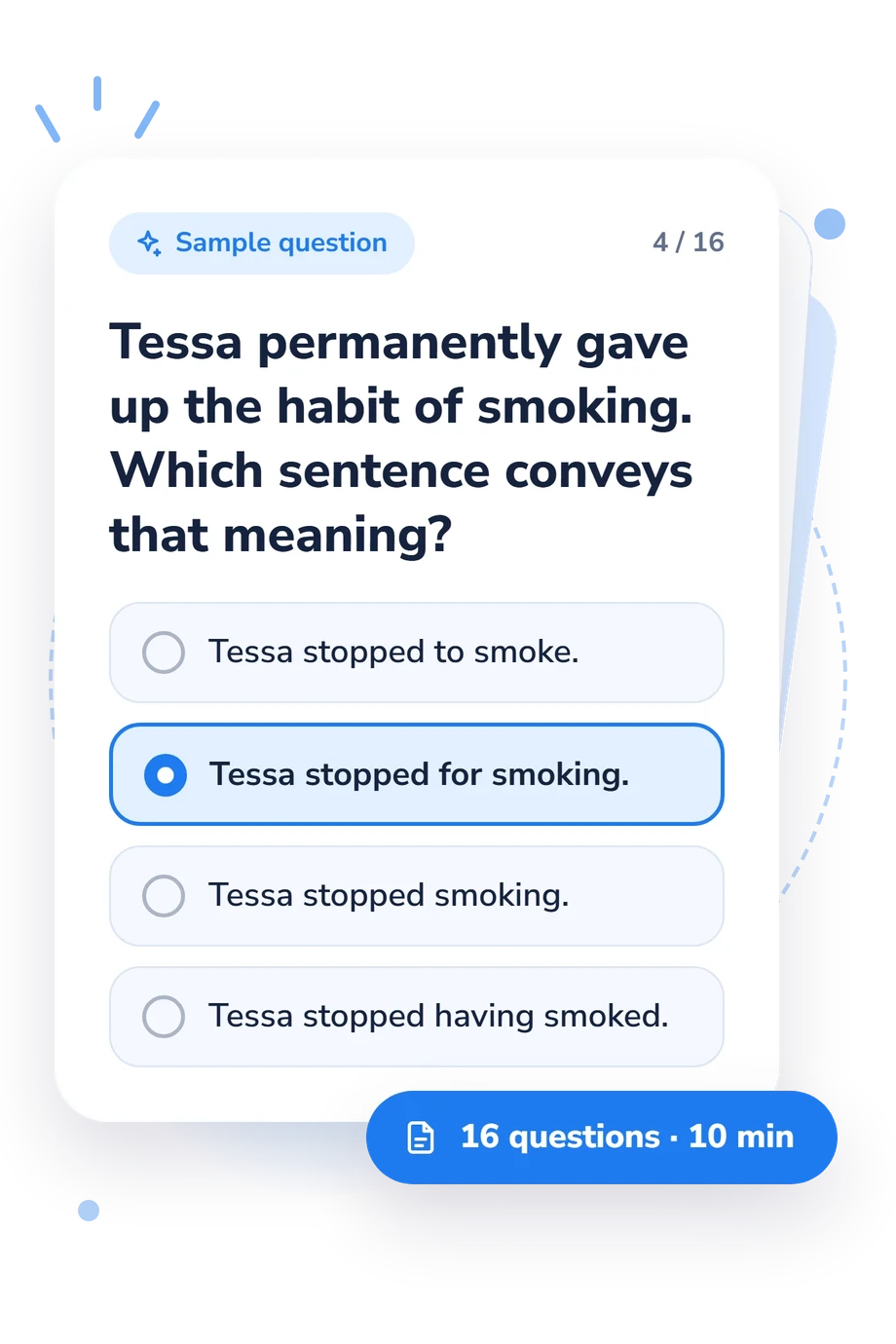
Example Questions From the Test
- As a gerund naming an activity
- As a present participle modifying “dog”
- As the main verb in the simple present
- As an infinitive complement
- You must to submit the form by Friday.
- You must submitted the form by Friday.
- You must submitting the form by Friday.
- You must submit the form by Friday.
- A past participle modifying “vase”
- The simple-past main verb of the sentence
- A gerund serving as the subject
- A full infinitive used as a complement
Gerunds Participles and Infinitives Quiz - Description and methodology of the test
Readers who want a focused review of English grammar can use the Gerunds Participles and Infinitives Quiz to distinguish these forms in context. It suits learners, teachers planning revision, and independent users who want an English verbals quiz with practical feedback. The result points to practice priorities without treating a short online score as a complete measure of language ability.
What This Assessment Explores
Questions focus on how gerunds, participles, and infinitives function in sentences when one form can serve different roles. They ask you to identify participles, recognize gerunds as subjects or objects, choose verb patterns, interpret purpose or earlier action, and repair dangling or nonparallel constructions.
As a quiz about verbals, gerunds, infinitives and participles, it connects form with meaning. A correct choice depends on how a word or phrase operates in its sentence, not only on an ending such as -ing or to-.
The displayed scale is Gerunds, Participles, and Infinitives Knowledge (0-16), with these result bands:
- Foundations to Review (0-6) indicates that some forms need further review.
- Developing Knowledge (7-12) shows understanding of common patterns with possible confusion in complex choices.
- Strong Knowledge (13-16) reflects reliable performance across identification and application tasks.
The result highlights which grammar decisions merit further practice.
Methodology and Evidence Base
Each item presents a sentence or short context with four answer choices. Tasks combine recognition and application: you classify a form, select a construction that conveys a meaning, or identify a phrase’s grammatical role. This gerund, infinitive and participle quiz tests contextual decisions rather than memorized labels alone.
The questionnaire reports a 0-16 result from item performance, with the displayed bands supplying its interpretation. It is not a standardized language assessment; no separate subscales or norm-referenced proficiency levels are reported, so the score is a focused snapshot of the grammar represented here.
Its framework is conceptually consistent with Huddleston, Pullum and Reynolds (2022), whose analysis distinguishes gerunds, participles, and infinitives through syntactic function and distribution. It also aligns with Huddleston and Pullum and Michael Swan’s usage guidance. These sources support the grammatical distinctions; they do not establish that this online questionnaire is an adaptation of a published instrument.
Performance can vary with attention, recent study, and interpretation of context. Uncertainty about a sentence can affect the result, so use it to target review and check progress through writing practice.
- Huddleston, Rodney, Geoffrey K. Pullum, and Brett Reynolds. A Student's Introduction to English Grammar. 2nd ed. Cambridge University Press, 2022. 10.1017/9781009085748
- Huddleston, Rodney, and Geoffrey K. Pullum. The Cambridge Grammar of the English Language. Cambridge University Press, 2002. 10.1017/9781316423530
- Swan, Michael. Practical English Usage. 4th ed. Oxford University Press, 2016. ISBN 9780194202411
Updated: