
Emo Music Quiz
How the Scales are Structured
Who Usually Takes This Test?
See How You Compare
Below is a preview of how scores are typically distributed across each scale.
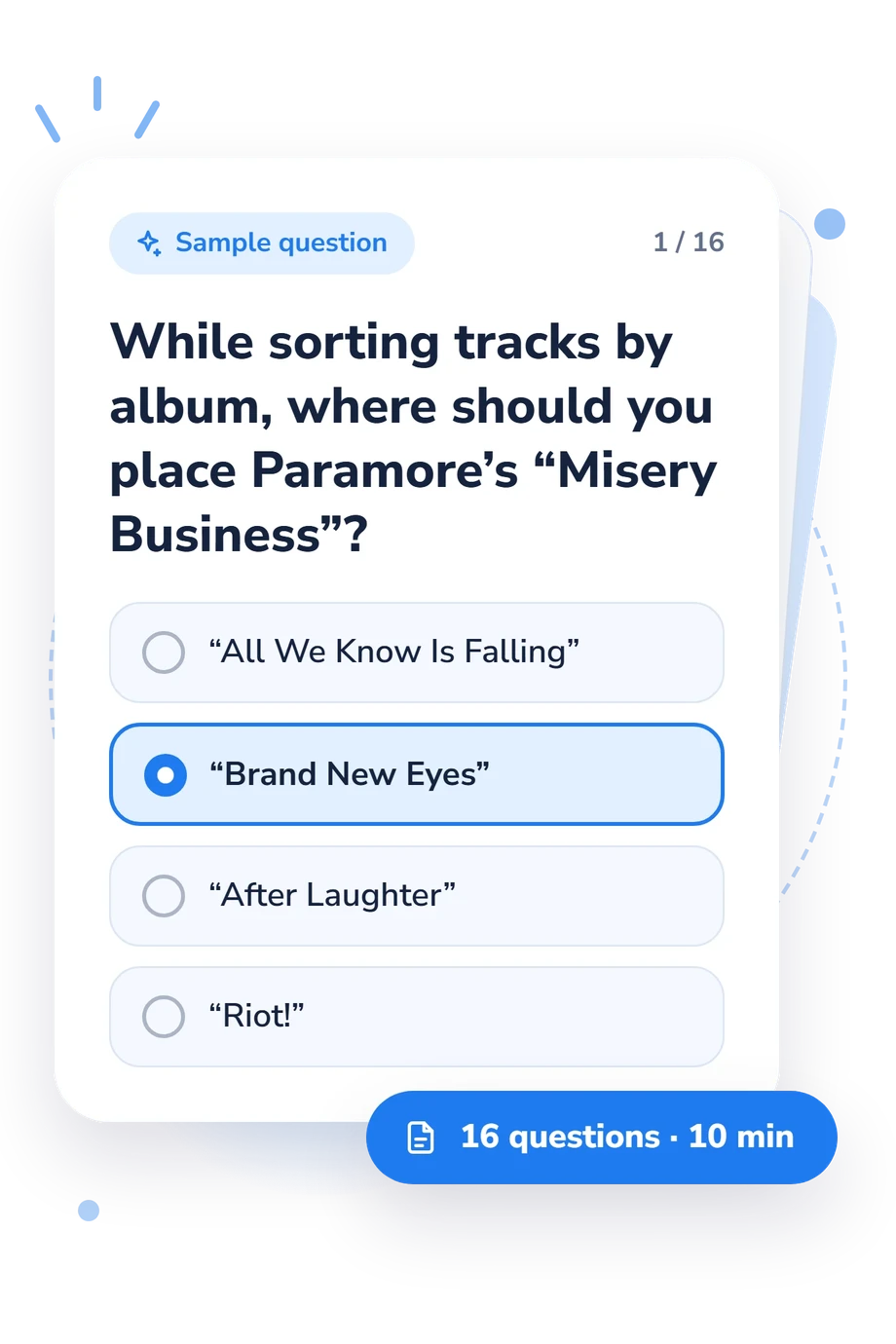
Example Questions From the Test
- “All We Know Is Falling”
- “Brand New Eyes”
- “After Laughter”
- “Riot!”
- “Pain”
- “Sweetness”
- “The Middle”
- “A Praise Chorus”
- “Vindicated”
- “Screaming Infidelities”
- “Hands Down”
- “Stolen”
Emo Music Quiz - Description and methodology of the test
Readers who want to place familiar bands, songs, and albums within emo’s wider story can use this self-check to turn listening memories into a clearer profile. The emo music quiz suits fans exploring the genre’s vocabulary, history, and recurring scene connections. As an emo song quiz, it offers a focused way to see how much of the tested knowledge you demonstrate; the total can prompt further listening.
What This Assessment Explores
These questions test recognition and context rather than mood or musical preference. They ask readers to identify lyric clues, connect songs with artists, place albums historically, distinguish related styles, and recognize emo’s scene roots. The focus suits listeners who want to check or expand their knowledge.
The result uses one scale, Emo Music Knowledge (0-16), with bands that describe increasing command rather than taste:
- Scene Starter (0-6) shows recognition of some touchstones and suggests room to explore artists, albums, and subgenres.
- Developing Discography (7-12) indicates solid knowledge of major songs and scenes, with deeper cuts left to discover.
- Deep-Cut Knowledge (13-16) reflects strong command of history, styles, albums, and lyric clues.
This emo music trivia format measures demonstrated knowledge, not authenticity or emotional connection.
Methodology and Evidence Base
Each item has four answer choices. Prompts cover lyric identification, artist-album matching, chronology, genre terms, and scene history, sampling factual recall rather than one continuous opinion. One point is awarded for each correct answer, creating a simple total that is descriptive, not a percentile or clinical classification.
The quiz’s historical framing is conceptually consistent with work by Andy Greenwald, Taylor Markarian, and Judith May Fathallah on emo’s development, communities, texts, and cultural meaning; work by Jenessa N. Williams and Francesca Sobande adds context on gender, race, and nostalgia in scene memory. These books and the article provide historical or cultural context, not a validated scoring instrument for this quiz. The questionnaire is an online knowledge assessment without documented standardization.
An emo music knowledge test like this depends on recall, listening exposure, and familiarity with emo songs within a genre whose boundaries can be debated. A missed answer may reflect limited contact with a band, a release-date mix-up, or uncertainty about classification rather than limited musical understanding. Read the total as a snapshot of demonstrated knowledge and use it to choose topics for further exploration.
- Greenwald, Andy. Nothing Feels Good: Punk Rock, Teenagers, and Emo. New York: St. Martin's Griffin, 2003. ISBN 9780312308636.
- Markarian, Taylor. From the Basement: A History of Emo Music and How It Changed Society. Miami, FL: Mango Publishing, 2019. ISBN 9781642501148.
- Fathallah, Judith May. Emo: How Fans Defined a Subculture. Iowa City, IA: University of Iowa Press, 2020. DOI 10.2307/j.ctv179h22p.
- Williams, Jenessa N., and Francesca Sobande. Note to scene: Gender, race and rose-tinted nostalgia in emo. European Journal of Cultural Studies, published online November 23, 2025. DOI 10.1177/13675494251380627.
Updated: