
Do I Have a Kidney Infection Quiz
How the Scales are Structured
Who Usually Takes This Test?
See How You Compare
Below is a preview of how scores are typically distributed across each scale.
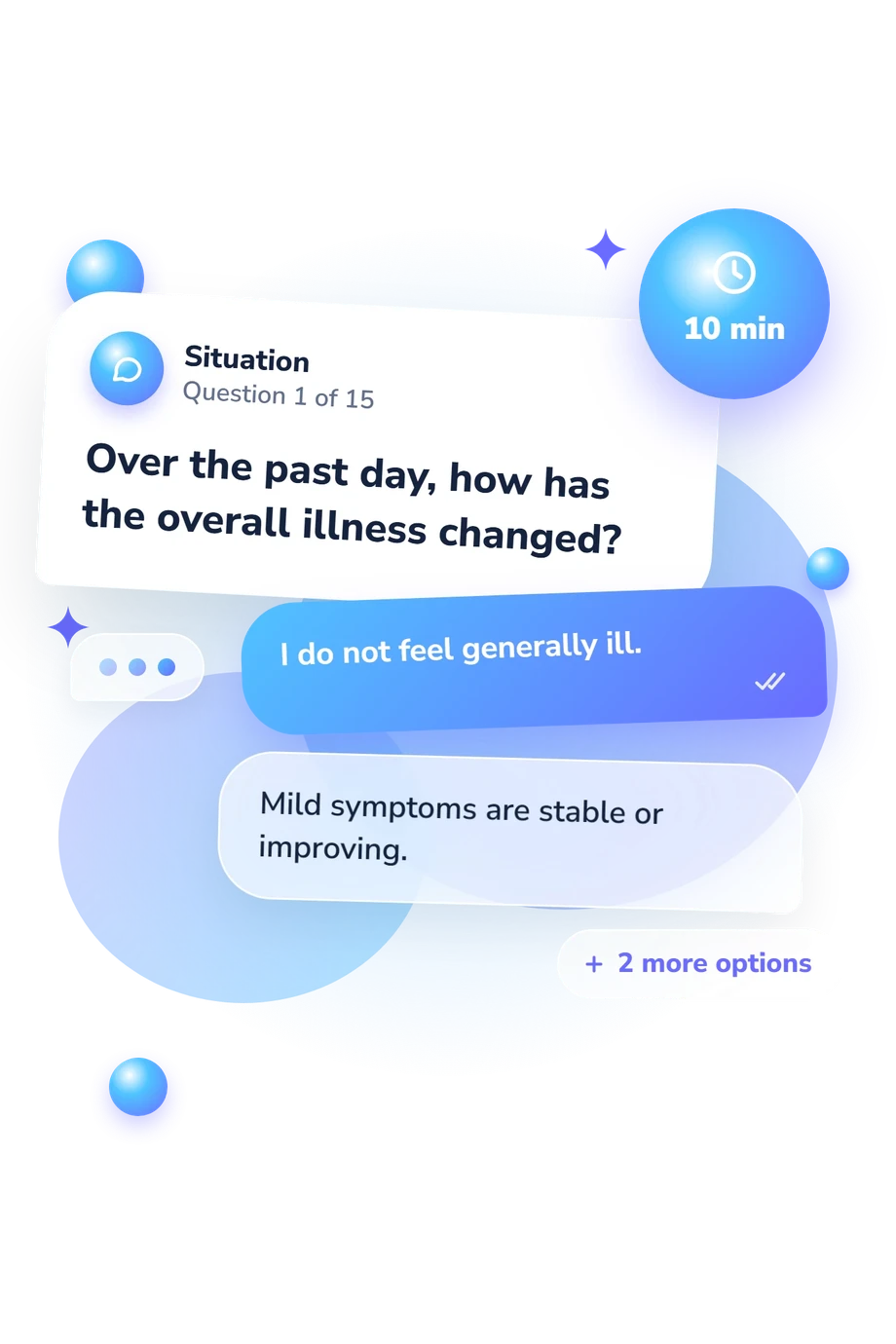
Example Questions From the Test
- I do not feel generally ill.
- Mild symptoms are stable or improving.
- Several symptoms are gradually worsening or new symptoms are appearing.
- I have become much sicker within hours, especially with fever, shaking, or severe weakness.
- No chills or unusual shivering.
- Occasional mild shivering that passes quickly.
- Repeated chills that make it difficult to get comfortable.
- Intense, uncontrollable shaking chills or chills with rapid deterioration.
- I do not have pain or tenderness there.
- I notice mild, occasional discomfort that is easy to ignore.
- The pain or tenderness is persistent or interferes with normal movement.
- The pain is severe, rapidly worsening, or difficult to tolerate.
Do I Have a Kidney Infection Quiz - Description and methodology of the test
People deciding whether recent urinary discomfort, feverishness, flank pain, or worsening illness deserves prompt attention may use the Do I Have a Kidney Infection Quiz as a structured self-report check. As a kidney infection quiz, it helps organize symptoms before a clinical conversation. The result separates current symptoms from urgency signals and helps the reader identify what to discuss promptly.
What This Assessment Explores
It examines urinary changes, side or back pain, feverishness, chills, nausea, vomiting, weakness, urine output, alertness, circulation, and vulnerability contexts such as pregnancy, transplantation, immune suppression, or complicating health conditions.
In this UTI or kidney infection quiz, the three dimensions separate local symptoms from systemic illness:
- Urgent Complication and Vulnerability Indicators (0-15) flags features or contexts that may increase urgency: No indicators selected (0), Added concern (1-2), Urgent action (3-15).
- Urinary and Flank Symptoms (0-15) summarizes urinary changes and side or back pain: No symptoms selected (0), Symptom to review (1-2), Prompt medical review (3-15).
- Whole-Body Illness Signs (0-15) summarizes feverishness, chills, nausea, weakness, and progression: No whole-body signs selected (0), Change to review (1-2), Prompt medical action (3-15).
A zero does not rule out infection, and any red flag overrides the total.
Methodology and Scientific Basis
Each item offers four ordered choices, moving from no current problem or normal functioning to marked, worsening, or potentially dangerous experiences. The format is structured self-report, focused on recent change and present state. The format helps someone wondering whether they have got a kidney infection use a have i got a kidney infection quiz to organize symptom timing for a clinical conversation. The choices capture symptom change, intensity, and ability to function.
Results appear as three separate summaries rather than one combined score. Their displayed bands are reflective, unvalidated categories for each dimension; they should not be read as severity thresholds. Confusion, fainting, breathing difficulty, collapse, inability to keep fluids down, very low urine output, blood in urine, or rapidly worsening severe pain matters independently of the total.
Clinical framing is conceptually consistent with Efstathiou et al. (2003), which examined mortality and treatment failure in acute pyelonephritis, and with Johnson and Russo (2018), which reviews adult assessment and management. The 2024 WikiGuidelines consensus adds broader urinary-tract infection context. This questionnaire is not an adaptation of those publications; current context, response bias, and limited self-awareness can affect results.
- Efstathiou SP, Pefanis AV, Tsioulos DI, et al. Acute Pyelonephritis in Adults: Prediction of Mortality and Failure of Treatment. Archives of Internal Medicine. 2003;163(10):1206-1212. 10.1001/archinte.163.10.1206
- Johnson JR, Russo TA. Acute Pyelonephritis in Adults. New England Journal of Medicine. 2018;378(1):48-59. 10.1056/NEJMcp1702758
- Nelson Z, Aslan AT, Beahm NP, et al. Guidelines for the Prevention, Diagnosis, and Management of Urinary Tract Infections in Pediatrics and Adults: A WikiGuidelines Group Consensus Statement. JAMA Network Open. 2024;7(11):e2444495. 10.1001/jamanetworkopen.2024.44495
Updated: