
Confirmation Quiz
How the Scales are Structured
Who Usually Takes This Test?
See How You Compare
Below is a preview of how scores are typically distributed across each scale.
Example Questions From the Test
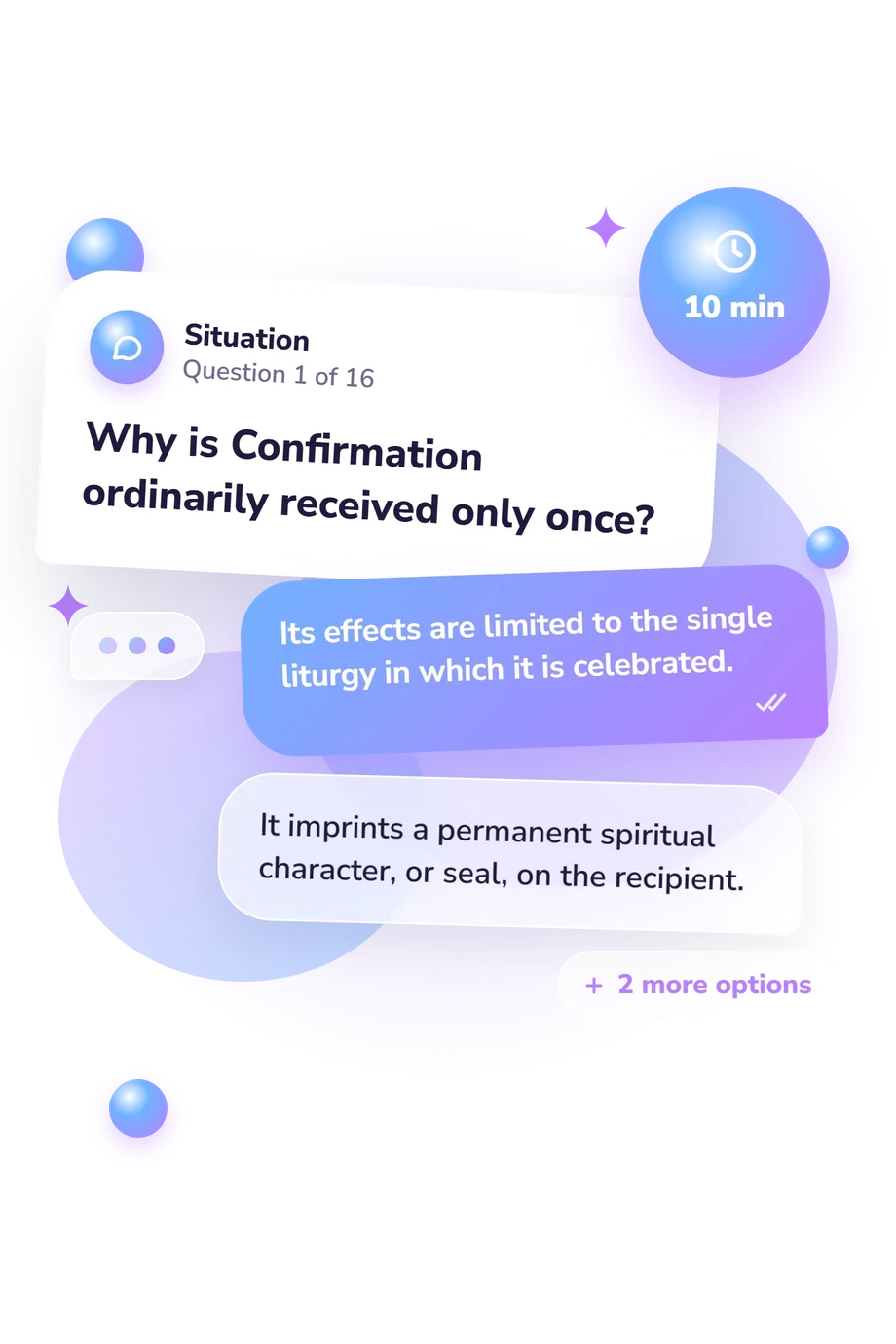
- Its effects are limited to the single liturgy in which it is celebrated.
- It imprints a permanent spiritual character, or seal, on the recipient.
- Church law permits only one ceremony involving sacred oil in a person's lifetime.
- Receiving the Eucharist later takes the place of any further need for the Holy Spirit.
- The candidate's sponsor
- A bishop
- Any baptized adult chosen by the parish
- The candidate's parent or guardian
- Receiving a white garment from the sponsor
- Being anointed on the forehead with sacred chrism by the minister
- Lighting a candle from the paschal candle
- Signing a written statement of church membership
Confirmation Quiz - Description and methodology of the test
For people preparing for Confirmation, teaching Catholic formation, or revisiting the sacrament’s meaning, this confirmation quiz offers a focused way to check doctrinal understanding. A Catholic quiz about Confirmation can clarify how well the respondent connects Confirmation with Baptism, the Holy Spirit, sacramental signs, and Christian witness. The result places overall Confirmation knowledge within a broad band and indicates themes that may merit review.
What This Assessment Explores
At its core, the questionnaire checks whether respondents can recognize teachings about Confirmation and apply them to sacramental situations. It suits learners, candidates, sponsors, catechists, and adults; it does not measure devotion or emotional intensity.
The main dimensions are these:
- Confirmation and Baptism are connected through questions about strengthening, completion, and permanent sacramental character.
- The Holy Spirit is explored through the seal, seven gifts, Pentecost, and Confirmation’s grace.
- Sacramental practice covers the minister, chrism, anointing, sponsors, preparation, and customary age.
- Christian witness is framed through courage, charity, service, and respect.
As a confirmation knowledge test, it gives one result: Confirmation Knowledge, 0-16. Emerging Foundation (0-6) signals review of Confirmation’s purpose, signs, and Baptismal link; Developing Knowledge (7-12) shows many essentials with some clarification; Strong Knowledge (13-16) indicates a well-rounded grasp of central Catholic teaching. Local practices may vary.
Methodology and Evidence Base
Each item presents one question with four answer choices. Some ask for direct doctrinal recognition, while others use short scenarios about sponsors, preparation, witness, emotional expectations, or sacramental practice. The respondent selects the answer that best matches Catholic teaching rather than writing an explanation.
The questionnaire reports a result on the displayed 0-16 Confirmation Knowledge scale. Used for confirmation self-review or guided discussion, it offers a snapshot of selected answers and current knowledge across the questionnaire’s themes, including doctrine, sacramental signs, preparation, and Christian witness.
The content is conceptually consistent with Sacramental Preparation Protocol III (USCCB, 2013), especially its treatment of Confirmation’s purpose, signs, preparation, and witness. The Catechism and Code of Canon Law provide the doctrinal and canonical framework, while Pecknold and Laborde add theological context. The questionnaire is not presented as an adaptation of any one publication.
Interpretation should account for memory, wording, prior instruction, and local practice. The result can identify useful topics for further study, but it cannot establish complete sacramental readiness or replace broader teaching and reflection.
- United States Conference of Catholic Bishops, Subcommittee on the Catechism. Sacramental Preparation Protocol III, Confirmation: A Working Instrument of the Subcommittee on the Catechism. Approved June 9, 2013. Washington, DC: United States Conference of Catholic Bishops, 2013.
- Catholic Church. Catechism of the Catholic Church: Revised in Accordance with the Official Latin Text Promulgated by Pope John Paul II. 2nd ed. Vatican City: Libreria Editrice Vaticana; Washington, DC: United States Catholic Conference, 1997.
- Catholic Church. Code of Canon Law: Latin-English Edition, New English Translation. Washington, DC: Canon Law Society of America, 1999.
- Pecknold, Chad C., and Lucas Laborde. “Confirmation.” In The Oxford Handbook of Sacramental Theology, edited by Hans Boersma and Matthew Levering, 487-499. Oxford University Press, 2015. 10.1093/oxfordhb/9780199659067.013.10
Updated: