
Comma Splice Quiz
How the Scales are Structured
Who Usually Takes This Test?
See How You Compare
Below is a preview of how scores are typically distributed across each scale.
Example Questions From the Test
- A comma separating three or more items in a series
- A comma following a dependent introductory clause
- A comma used by itself to join two independent clauses
- A comma separating coordinate adjectives before a noun
- A sentence fragment caused by a missing main clause
- A comma splice joining two independent clauses
- A fused sentence with no punctuation between its clauses
- A correct compound sentence containing a coordinating conjunction
- Because the sidewalk was wet, rain must have fallen overnight.
- The sidewalk was wet; because rain fell overnight.
- The sidewalk was wet because it had rained overnight.
- Rain fell overnight, because the sidewalk was wet.
Comma Splice Quiz - Description and methodology of the test
Readers who want to sharpen sentence-level editing can use this comma splice quiz to test whether they distinguish complete clauses from dependent ones and recognize the punctuation choices that connect them. As a comma splice test, it suits students, writers, teachers, and anyone reviewing grammar foundations. The result points to the areas where clause recognition and repair deserve more attention.
What This Assessment Explores
The assessment targets a practical editing decision: whether a comma has incorrectly joined two independent clauses. It checks recognition of dependent openings, coordinating conjunctions, conjunctive adverbs, semicolons, and other repairs that preserve the relationship between ideas. This comma-splices-and-fused-sentences quiz gives learners and editors focused feedback on sentence-level accuracy.
One displayed scale, Comma Splice Knowledge (0-16), organizes the result into three bands:
- Foundations to Review (0-6) shows that clause structure and the comma rule need review.
- Developing Editor (7-12) means many repairs are recognized, but some patterns remain uncertain.
- Strong Command (13-16) indicates consistent recognition and sound repairs in varied contexts.
Together, these outcomes describe applied punctuation knowledge, not overall writing quality. They can show whether review should begin with clause structure or move toward choosing among valid repairs.
Methodology and Evidence Base
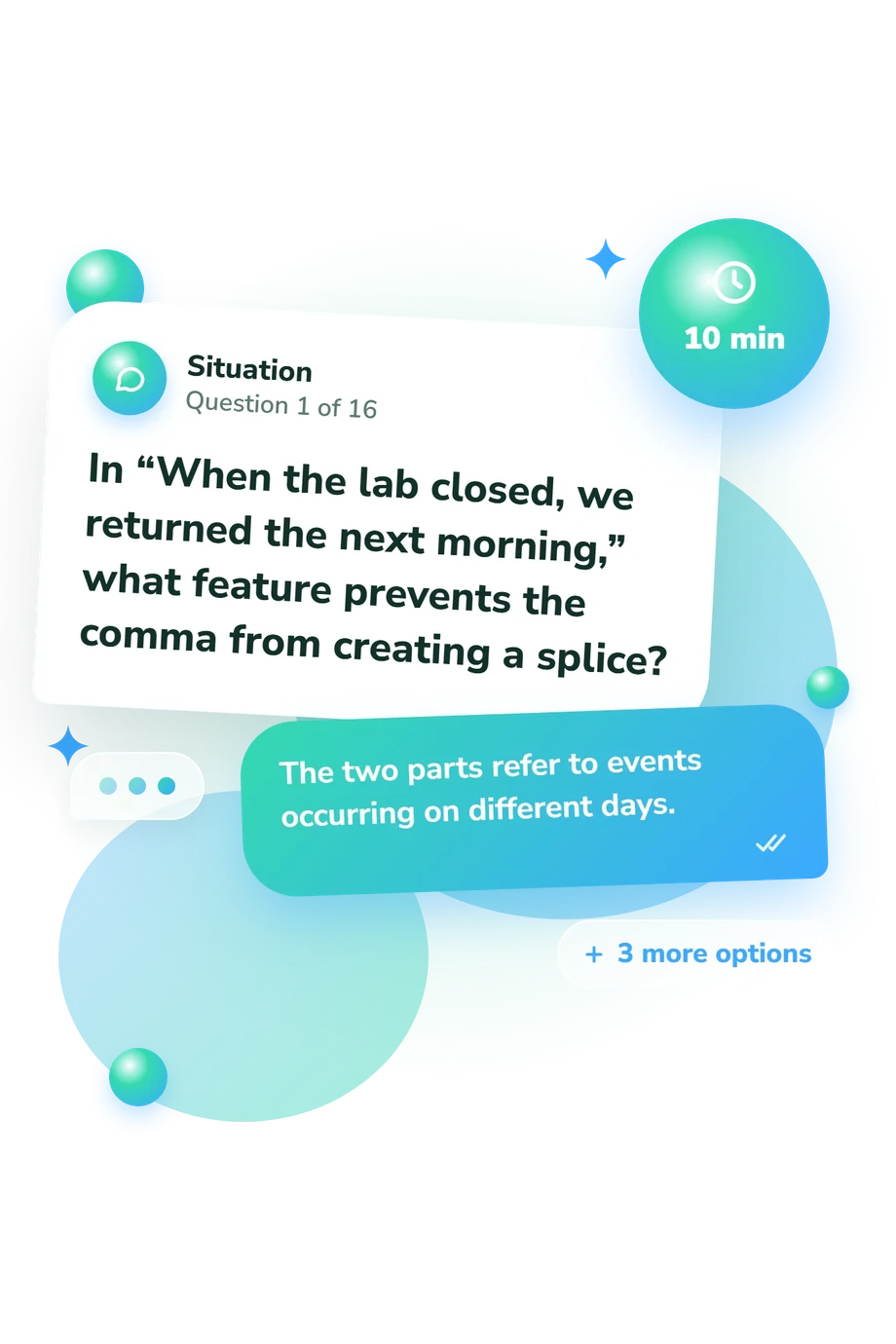
Each item presents a sentence or short passage with answer choices. You identify a comma splice, distinguish it from a fused sentence or a correct construction, and select a repair using a semicolon, coordinating conjunction, subordinating conjunction, or separate sentences. This run-on-and-comma-splice quiz tests editing decisions as well as terminology.
The display reports one knowledge result within defined performance bands. Because point values are not documented, do not infer an item-by-item formula or treat the total as a norm-referenced percentile.
Spector (2022) is the closest subject match, distinguishing faulty joins between independent clauses from repairs that preserve their relationship. Hacker and Sommers provide the broader clause-and-punctuation framework. Purdue Online Writing Lab separates run-ons, comma splices, and fused sentences, while University of Wisconsin-Madison supports semicolons between closely related independent clauses. The questionnaire is conceptually consistent with these sources, but it is not a standardized administration or validated adaptation of them.
Results can vary with attention, prior instruction, and familiarity with grammar terminology. Success on selected examples does not establish general writing ability; use the outcome to target practice in your own sentences.
- Stephen Spector. “The Dreaded Comma Splice.” In The Quotable Guide to Punctuation, pp. 93-98. Oxford University Press, 2022. 10.1093/oso/9780190675530.003.0012.
- Diana Hacker and Nancy Sommers. The Bedford Handbook. 12th ed. Bedford/St. Martin’s, 2023.
- Purdue Online Writing Lab. “Run-ons - Comma Splices - Fused Sentences.” Purdue University, n.d.
- Writing Center, University of Wisconsin-Madison. “Using Semicolons.” University of Wisconsin-Madison, n.d.
Updated: