
Are You a Gigachad Quiz
How the Scales are Structured
Who Usually Takes This Test?
See How You Compare
Below is a preview of how scores are typically distributed across each scale.
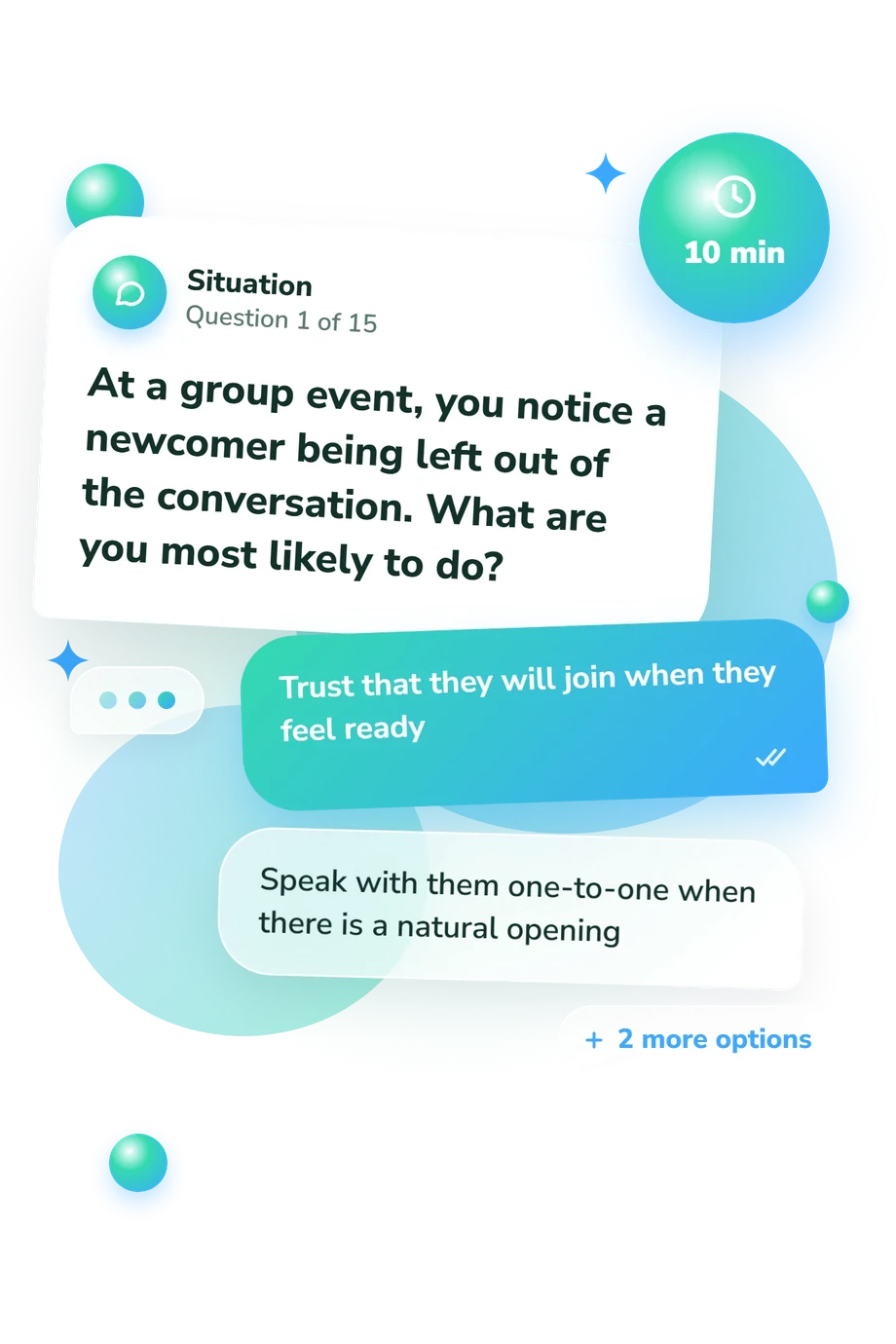
Example Questions From the Test
- Trust that they will join when they feel ready
- Speak with them one-to-one when there is a natural opening
- Bring them into the current conversation with context and a genuine question
- Introduce them to someone who seems to share their interests
- Review what caused the miss, set a revised deadline, and schedule the next action
- Give myself space before deciding whether the goal still matters
- Move the deadline and make a renewed effort to catch up
- Continue informally without setting another date right away
- Stay outside it because they understand the conflict better than I do
- Support the person whose position seems strongest to me
- Slow the exchange down and help each person state what they actually need
- Suggest pausing the discussion before tempers make it harder to resolve
Are You a Gigachad Quiz - Description and methodology of the test
People who want a playful but structured look at how they handle goals, self-doubt, and social situations may use the Are You a Gigachad Quiz as a self-reflection profile. It is intended for readers curious about a balanced form of confidence rather than dominance. Its gigachad quiz framing connects everyday choices with practical strengths that can be noticed, questioned, and developed.
What This Assessment Explores
The questions examine how someone turns intentions into action, stays steady under comparison or criticism, and uses confidence without crowding out other people. Scenarios cover missed deadlines, disrupted routines, setbacks, difficult choices, group tension, social inclusion, and boundary-setting.
The questionnaire uses a playful giga chad quiz premise to present capability as a balance of persistence, self-trust, and constructive influence rather than status or force. The result describes patterns to reflect on, not a permanent verdict about character.
The result is organized around three displayed dimensions:
- Disciplined Follow-Through (0-15) shows sustained action: Flexible starter (0-5), Building momentum (6-10), Steady follow-through (11-15).
- Grounded Confidence (0-15) shows steady self-trust: Quiet footing (0-5), Emerging assurance (6-10), Grounded confidence (11-15).
- Respectful Presence (0-15) shows strength with consideration: Reserved presence (0-5), Considerate presence (6-10), Respectful strength (11-15).
Methodology and Evidence Base
Each item presents a familiar situation with four response options. Scenarios ask about motivation, criticism, conflict, disappointment, social uncertainty, and competing demands, allowing the result to reflect choices made under pressure rather than abstract self-descriptions. Responses are converted into three displayed profiles, but the point value assigned to each option is not stated; the ranges should not be reverse-engineered into an answer key.
The displayed dimensions are conceptually consistent with positive masculinity literature associated with Kiselica and Englar-Carlson, which emphasizes strengths without equating healthy masculinity with dominance. McDermott and colleagues examine positive masculine role norms; this questionnaire is conceptually consistent with that work, not a direct administration or adaptation of it.
The displayed score bands belong to this online profile and offer descriptive guides for reading its dimensions. Readers may use the result as a self-reflection test, but answers may vary with current stress, social context, and self-awareness; the result should not be treated as a diagnosis.
- Kiselica, Mark S., & Englar-Carlson, Matt. (2010). Identifying, affirming, and building upon male strengths: The positive psychology/positive masculinity model of psychotherapy with boys and men. Psychotherapy, 47(3), 276-287. 10.1037/a0021159
- McDermott, Ryon C., Pietrantonio, Kipp R., Browning, Brandon R., McKelvey, Daniel K., Jones, Zachary K., Booth, Nathan R., & Sevig, Todd D. (2019). In search of positive masculine role norms: Testing the positive psychology positive masculinity paradigm. Psychology of Men & Masculinities, 20(1), 12-22. 10.1037/men0000160
- Mahalik, James R., Locke, Benjamin D., Ludlow, L. H., Diemer, Matthew A., Scott, Ryan P. J., Gottfried, Michael, & Freitas, Gabriela. (2003). Development of the Conformity to Masculine Norms Inventory. Psychology of Men & Masculinity, 4(1), 3-25. 10.1037/1524-9220.4.1.3
Updated: